
Threaded Rods & Studs
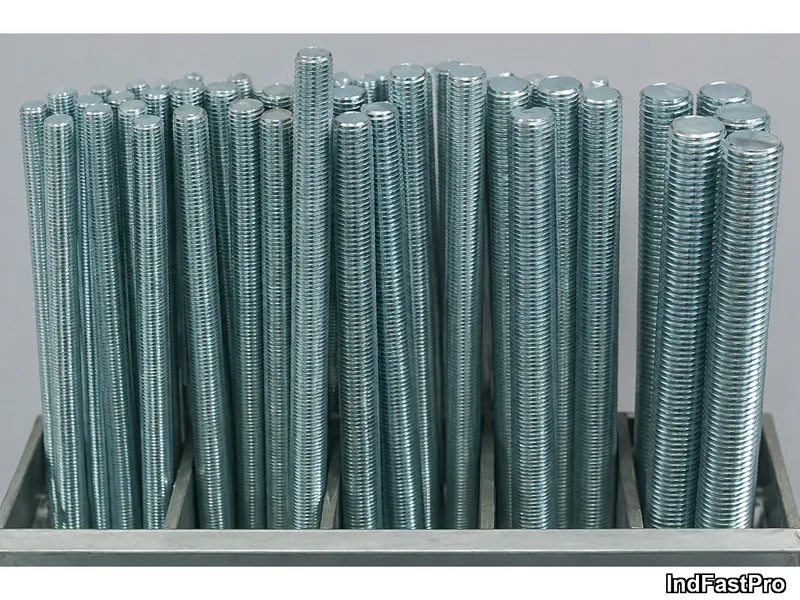
Headless fully threaded rods and studs used with nuts on both ends — DIN 975 / DIN 976-1 metric rods (M2–M64) and ASME B18.31.2 continuous-thread, double-end and flange-bolting studs, in carbon steel, A2/A4 stainless and ASTM A193/A194 flange pairings.
Last updated: 2026-11
Specifications
Industry-standard reference ranges — availability confirmed per quotation; not a stocked-range claim.
| Thread range | M2–M64, coarse and fine (DIN 975) | 1/4–1-1/2 in, UNC / UNF / 8UN (ASME B18.31.2) |
|---|---|
| lengths | Typically 1 m, 2 m and 3 m, custom lengths available (metric) | 1/4-in increments through 10 in, whole and half inches above (ASME B18.31.2) |
| strength grade | Stainless Class 70 (≥700 MPa) up to M24, Class 50 (≥500 MPa) M27 and above | Carbon steel 4.6, 4.8, 8.8, 10.9, 12.9 | Stud bolts paired to ASTM A193 (B7, B8/B8M), A320 L7, A453 Gr 660 with A194 nuts |
| thread tolerance | 6g per ISO 724 / ISO 965-1 (DIN 975) | UN/UNR per ASME B1.1 (ASME B18.31.2) |
| Types | continuous thread stud | double-end stud (clamping type / tap-end type) | flange bolting stud (stud bolt) |
Materials
- A2 stainless steel (304)
- A4 stainless steel (316)
- carbon steel
Engineering guidance
Threaded rod looks like the simplest product in the catalog and fails in the least obvious ways: the standard designation on the drawing decides the fit, the grade decides the load, and the coating decision is where stainless and carbon-steel routes diverge. The sections below carry the family-level rules; the per-size figures live in the standards tables under Specifications.
Which standard designation goes on the order
DIN 975 is the most widely recognized metric threaded-rod designation, but it has been formally withdrawn and integrated into DIN 976-1 — products are still made to DIN 975 specifications while some jurisdictions and quality systems require the current standard. GB/T 15389-1994 non-equivalently adopted DIN 975:1986, and the 2025 revision (effective February 2026) extends coverage beyond it: coarse threads to M68 and fine threads to M72×6 where DIN 975 stops at M64, plus a wider stainless performance-grade set including A4-80 (≥800 MPa). In corresponding sizes and grades many manufacturers produce rod compliant with both standards simultaneously; sizes above M64, A4-80 and documented passivation are the cases that force the GB designation.
For inch-series flange work the standard is ASME B18.31.2, which covers three configurations: the continuous thread stud, the double-end stud (clamping type with identical ends, or tap-end type with unequal thread lengths), and the flange bolting stud used with a nut on each end per ASME B16.5 joints. Flange bolting follows the UNC-up-to-1-inch, 8UN-above convention, and stud lengths are driven by the B16.5 joint stack-up — flange thickness, gasket and nut heights — so length selection starts from the flange rating table.
Grade and material: what the rod can hold
Stainless rod splits by diameter in the DIN system: Class 70 (tensile strength ≥700 MPa) applies up to M24 and Class 50 (≥500 MPa) from M27 up — so a longer rod is often a lower-grade rod, which the joint calculation must see. GB/T 15389-2025 adds the finer grade ladder (A2-50 to A4-80, plus D4/D6) and carbon-steel performance grades 8.8, 10.9 and 12.9. Material follows the environment: A2 (304, 18% Cr / 8% Ni) for general construction and machinery, A4 (316, with 2–3% molybdenum) wherever chlorides meet the rod — marine, coastal or wash-down service.
For stud bolts the material rule is structural: ASME B18.31.2 is a dimensional standard only, and the callout is complete only when paired with an ASTM bolting specification — A193 B7 with A194 2H nuts as the refinery default, B8/B8M for corrosive and high-temperature service, A320 L7 for low temperature, A453 Gr 660 for thermal cycling. Because the grade lives in the ASTM document, a rod quoted as "B18.31.2 only" has no strength basis at all.
What to demand with the order
Threaded rod is a documentation-driven product: the same M12 rod exists in several standards and grade ladders, so the verification step is paperwork, not measurement. Request documentation confirming compliance with the required standard and grade — and where the drawing names GB/T 15389-2025, that includes the revision's passivation requirement for stainless and the zinc-flake or hot-dip-galvanizing requirements for steel rod, which DIN 975 leaves to manufacturer discretion. Length series are verifiable against the standards directly: metric rod in 1/2/3 m lengths, ASME B18.31.2 continuous thread in quarter-inch increments through 10 in and whole/half inches above.
What this page cannot verify: which grade a specific mill's stock actually carries (the same rod size is routinely stocked in more than one grade), and the color-coding conventions some manufacturers use to mark A2 versus A4 rod ends — those are manufacturer conventions, not standard requirements.
Ordering & documentation
Documents
Shipments of Threaded Rods & Studs are backed by Mill Test Certificate (MTC), Dimensional Report, Salt Spray Test Report on request, with full batch traceability from raw material to finished product. Quality management for this threaded rods & studs line follows the owner-confirmed compliance list: ISO 9001:2015, RoHS, REACH. Exact document sets are confirmed on the order.
Quotation
- Rod/stud standard and designation, property class or material grade.
- Thread system, nominal diameter, pitch, overall length and any unthreaded/threaded-end lengths.
- Coating, heat treatment and matching nut/washer requirements.
- Joint or suspension duty, quantity per length and required certificates.
Sample & supply
Minimum order quantities and lead times for threaded rods & studs are confirmed at quotation — send rod or stud standard and designation, thread size and length, grade and coating on the RFQ and the quote will carry a firm schedule; sample availability is confirmed with the quotation.
Storage & shipping
Threaded Rods & Studs are packed for export and shipped factory-direct to buyers in Europe, Asia, the Americas and the Middle East. Store these threaded rods & studs dry and protected until installation, and keep coated parts in their packaging until use; specific packing and preservation requirements can be stated on the order and confirmed at quotation.
Frequently asked questions
Is DIN 975 still the right designation to put on an RFQ?
DIN 975 has been formally withdrawn and integrated into DIN 976-1, but it remains the most widely referenced threaded-rod designation and products are still manufactured to its specifications. Some jurisdictions and quality systems require the current standard — if your project follows DIN/ISO drawings, name DIN 975 or DIN 976-1 explicitly and we confirm compliance documentation at quotation.
A2 or A4 stainless threaded rod — which suits the environment?
A2 (304) carries 18% chromium and 8% nickel and is the standard choice for general construction, machinery and indoor/moderate outdoor exposure. A4 (316) adds 2–3% molybdenum for pitting and crevice corrosion resistance against chlorides — the standard recommendation for marine, coastal and chemical environments. Where a drawing requires the higher-strength A4-80 grade (≥800 MPa), that sits in the GB/T 15389-2025 grade set rather than the DIN 975 Class 50/70 split.
What does a complete stud-bolt line item need?
Standard + size + material + nuts + finish. ASME B18.31.2 is dimensional only — a stud bolt callout is complete when paired with an ASTM bolting specification (for example A193 B7 studs with A194 2H nuts for refinery service, or B8/B8M for corrosive and high-temperature service). State the flange rating so stud length can follow the B16.5 joint stack-up, and name the coating (e.g. PTFE) so the torque value matches.
Request a Quote
Get factory-direct pricing from the manufacturer.
What to include in your Threaded Rods & Studs inquiry
- ✓ Name the rod/stud standard and designation, property class or material grade.
- ✓ Give thread system, nominal diameter, pitch, overall length and any unthreaded/threaded-end lengths.
- ✓ State coating, heat treatment and matching nut/washer requirements.
- ✓ Describe the joint or suspension duty, quantity per length and required certificates.
- ✓ Factory-direct pricing for your Threaded Rods & Studs
- ✓ Standard and custom specifications
- ✓ Factory-direct export to buyers in Europe, Asia, the Americas and the Middle East
- ✓ Full fastener family support