
Dry Film Lubricant Coating
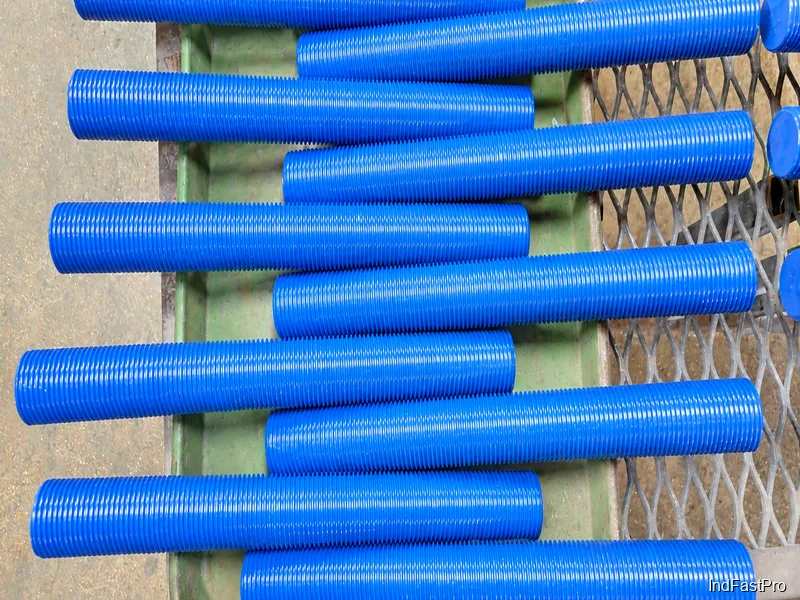
Dry film lubricant per MIL-PRF-46010 — a thin bonded, non-oily coating of solid lubricant in a resin binder, applied over plated or passivated fasteners for consistent, repeatable torque-tension results on critical joints.
Last updated: 2026-11
Specifications
Dry film lubricant is a thin bonded coating — usually a resin binder loaded with molybdenum disulfide or a similar solid lubricant (graphite and PTFE chemistries are also used) — applied to control friction during installation. It is not a corrosion finish by itself; it is layered on top of a plated or passivated part to get consistent, repeatable torque-tension results, especially on high-strength fasteners where friction variation between installations can throw off preload significantly. Because it is a thin, dry, non-oily film it does not attract dirt and grit the way a wet lubricant does, which matters for parts stored or handled in the field. You will see it called out on fasteners going into critical joints — structural bolts, fittings with tight preload windows, and hardware that gets removed and reinstalled during maintenance — and it is also the standard anti-galling topcoat for passivated stainless threads.
| Coating type | Thin bonded coating — resin binder loaded with a solid lubricant (molybdenum disulfide; graphite and PTFE chemistries also used) |
|---|---|
| Reference standard | MIL-PRF-46010 |
| Function | Controls friction during installation — applied over a base finish for consistent, repeatable torque-tension results, especially on high-strength fasteners where friction variation throws off preload |
| Corrosion protection | Not a primary corrosion finish by itself; many dry film lubricants contain rust inhibitors |
| Appearance | Matte gray/black solid film after curing |
| Surface character | Thin, dry, non-oily — does not attract dirt and grit the way a wet lubricant does; suits parts stored or handled in the field |
| Process control | Coating thickness and cure must be controlled for repeatable friction values; the coating requires proper curing after application |
| Typical callouts | Structural bolts, fittings with tight preload windows, hardware removed and reinstalled during maintenance; anti-galling topcoat on passivated stainless threads |
Materials
- High-strength steel fasteners on critical joints
- Passivated stainless fasteners (galling-prone threads)
- Fasteners over zinc, cadmium, or zinc-nickel base finishes
Ordering & documentation
Documents
Shipments are backed by Mill Test Certificate (MTC), Dimensional Report, Salt Spray Test Report on request, with full batch traceability from raw material to finished product. Quality management follows the owner-confirmed compliance list: ISO 9001:2015, RoHS, REACH. Exact document sets are confirmed on the order.
Quotation
- The fastener family (Dry Film Lubricant Coating) plus the standard designation from your drawing — DIN / ISO / JIS / ASTM / ANSI, or a drawing for custom parts.
- Size (diameter and length), thread type (metric or inch), property class or grade, and coating or finish.
- Quantity per size and your target delivery date.
- Destination country, and any required documents (for example a mill test certificate) so the quote includes them.
Sample & supply
Minimum order quantity is per batch, carried with the fastener order. Finishing run adds 5–10 days to the fastener lead time. Quantities or variants outside the standard range are confirmed at quotation.
Storage & shipping
Parts are packed for export and shipped factory-direct to buyers in Europe, Asia, the Americas and the Middle East. Store fasteners dry and protected until installation, and keep coated parts in their packaging until use; specific packing and preservation requirements can be stated on the order and confirmed at quotation.
Frequently asked questions
Does a dry film lubricant replace the corrosion finish?
No — it is a friction-control layer, not a sacrificial barrier. Dry film lube is specified under MIL-PRF-46010 as a topcoat over a plated or passivated base finish that carries the corrosion duty; on its own it is not a primary corrosion finish (although many formulations add rust inhibitors). The reason to specify it is preload accuracy and galling control: on high-strength and stainless hardware, the difference between an oiled thread and a controlled bonded film shows up directly in torque-tension scatter, joint after joint.
What is the MOQ and lead time for this finish?
Finishing runs per batch carried with the fastener order and adds 5–10 days to the fastener lead time. Coated parts follow the finish line that processes them, so confirm the exact schedule against quantity and finish class at quotation.
What should an RFQ for this finish state?
State the base fastener (grade, diameter, length), the coating standard and class (or the process plus thickness/color requirement where no standard callout exists), any salt-spray or friction requirement, and quantity per size — plus destination country and required documents such as a mill test certificate.
Related knowledge
- Reading a Fastener Coating Callout: ISO 10683 Designations, Salt-Spray Hours and What to Confirm With the Plater
- Zinc-Plated vs Hot-Dip Galvanized Fasteners: Which Coating for Which Environment
- Zinc-Flake Coating for Fasteners: When the Evidence Supports It, and What to Verify at the Coater
- Zinc-Flake vs Zinc-Nickel for High-Strength Fasteners: What the Evidence Settles on Hydrogen, Salt Spray, Friction and Specs
Request a Quote
Get factory-direct pricing from the manufacturer.
What to include in your inquiry
- ✓ Standard and property class (e.g. DIN 912, ISO 4762, class 8.8) — or a drawing for custom parts.
- ✓ Sizes, lengths and thread type (metric or inch).
- ✓ Quantity per size and your target delivery date.
- ✓ Destination country, plus any coating or finish requirement.
- ✓ Any documents you need with the shipment (e.g. mill test certificate) so the quote includes them.
- ✓ Your inquiry goes straight to the factory team by email and gets a reply within 24 hours.
- ✓ Factory-direct pricing
- ✓ Standard and custom specifications
- ✓ Factory-direct export to buyers in Europe, Asia, the Americas and the Middle East
- ✓ Full fastener family support