
PTFE (Fluoropolymer) Coating
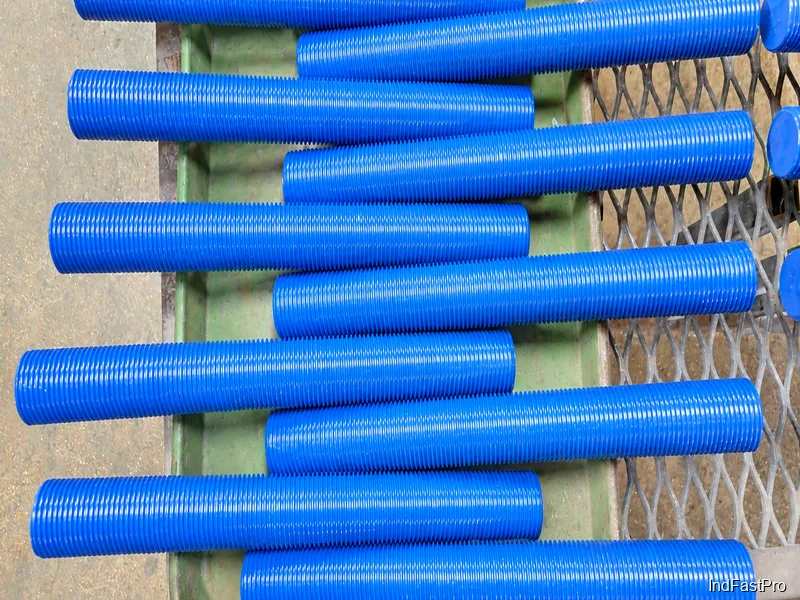
PTFE / fluoropolymer coating (Teflon®, Xylan® class) for studs and bolts — three-coat corrosion protection with low-friction break-out, tested to thousands of hours in salt spray, limited to ~200–260 °C service.
Last updated: 2026-11
Specifications
PTFE coating is the low-friction, corrosion-resistant finish for bolting in aggressively corrosive service — offshore and petrochemical stud bolting being the classic case. It is applied as a system, not a single layer: a corrosion-resistant base coat, an adhesion coat, then the PTFE non-stick topcoat. Coated studs break loose far more easily than corroded plain or galvanized hardware, but the coating changes joint behavior: friction coefficients are proprietary and vary by applicator, so k-factor must be tested for the specific coating batch, lubrication is still required, and nuts are over-tapped to clear the coating thickness. Service temperature is limited to roughly 200–260 °C.
| Coating type | Fluoropolymer (PTFE) topcoat system — Teflon®, Xylan® and equivalent chemistries |
|---|---|
| Application | Three-coat system: corrosion-resistant base coat, adhesion coat, PTFE topcoat |
| Corrosion resistance | Vendor salt-fog (ASTM B117) results up to 4,000 hours reported for fluoropolymer systems, vs ~96 hours for conventional zinc- or cadmium-plated fasteners |
| Max service temperature | ~200–260 °C (400–500 °F); not for high-temperature applications |
| Friction behavior | Low break-out torque; k-factor is applicator-specific and must be tested per coating lot — coating is not a substitute for lubrication |
| Thread fit | Nuts over-tapped to clear coating; expect 20–40% reduced thread engagement unless otherwise engineered |
| Typical substrates | ASTM A193 B7 stud bolts and matching heavy hex nuts |
Where this grade fits
PTFE and other low-friction coatings change the tightening physics, not just the corrosion rating: a bare-steel torque value applied to a PTFE-coated bolt over-tensions it and can yield the part, so the coating-specific nut factor (or a reduced torque) governs installation. State the coating on the RFQ so torque documentation is quoted to match.
Deep read: Calculating Bolt Preload and Clamp Force: Torque, Friction and Tightening Method · Zinc-Flake vs Zinc-Nickel for High-Strength Fasteners: What the Evidence Settles on Hydrogen, Salt Spray, Friction and Specs
Materials
- Carbon steel stud bolts (e.g. ASTM A193 B7)
- Alloy steel bolts and studs
- Heavy hex nuts (over-tapped for coating)
Ordering & documentation
Documents
Shipments are backed by Mill Test Certificate (MTC), Dimensional Report, Salt Spray Test Report on request, with full batch traceability from raw material to finished product. Quality management follows the owner-confirmed compliance list: ISO 9001:2015, RoHS, REACH. Exact document sets are confirmed on the order.
Quotation
- The fastener family (PTFE (Fluoropolymer) Coating) plus the standard designation from your drawing — DIN / ISO / JIS / ASTM / ANSI, or a drawing for custom parts.
- Size (diameter and length), thread type (metric or inch), property class or grade, and coating or finish.
- Quantity per size and your target delivery date.
- Destination country, and any required documents (for example a mill test certificate) so the quote includes them.
Sample & supply
Minimum order quantity is per batch, carried with the fastener order. Finishing run adds 5–10 days to the fastener lead time. Quantities or variants outside the standard range are confirmed at quotation.
Storage & shipping
Parts are packed for export and shipped factory-direct to buyers in Europe, Asia, the Americas and the Middle East. Store fasteners dry and protected until installation, and keep coated parts in their packaging until use; specific packing and preservation requirements can be stated on the order and confirmed at quotation.
Frequently asked questions
Does the PTFE coating remove the need for lubrication?
No. Around 30,000 psi bolt load the coating starts to strip and bind, so lubricated assembly still gives better accuracy and less bolt-load scatter. Treat the coating as corrosion protection plus lower break-out torque, not as a lubricant: test the k-factor for your lubricant and coating combination, and re-test whenever the coating manufacturer changes.
What is the MOQ and lead time for this finish?
Finishing runs per batch carried with the fastener order and adds 5–10 days to the fastener lead time. Coated parts follow the finish line that processes them, so confirm the exact schedule against quantity and finish class at quotation.
What should an RFQ for this finish state?
State the base fastener (grade, diameter, length), the coating standard and class (for example ASTM B841 Class 2 with black trivalent passivate, or ISO 10683 with a specified topcoat), any thickness or salt-spray requirement, lubrication or torque-tension needs, and quantity per size — plus destination country and required documents such as a mill test certificate.
Related knowledge
- Reading a Fastener Coating Callout: ISO 10683 Designations, Salt-Spray Hours and What to Confirm With the Plater
- Zinc-Plated vs Hot-Dip Galvanized Fasteners: Which Coating for Which Environment
- Zinc-Flake Coating for Fasteners: When the Evidence Supports It, and What to Verify at the Coater
- Zinc-Flake vs Zinc-Nickel for High-Strength Fasteners: What the Evidence Settles on Hydrogen, Salt Spray, Friction and Specs
- Zinc-Flake vs Zinc-Nickel for High-Strength Fasteners: What the Evidence Settles on Hydrogen, Salt Spray, Friction and Specs
Request a Quote
Get factory-direct pricing from the manufacturer.
What to include in your inquiry
- ✓ Standard and property class (e.g. DIN 912, ISO 4762, class 8.8) — or a drawing for custom parts.
- ✓ Sizes, lengths and thread type (metric or inch).
- ✓ Quantity per size and your target delivery date.
- ✓ Destination country, plus any coating or finish requirement.
- ✓ Any documents you need with the shipment (e.g. mill test certificate) so the quote includes them.
- ✓ Your inquiry goes straight to the factory team by email and gets a reply within 24 hours.
- ✓ Factory-direct pricing
- ✓ Standard and custom specifications
- ✓ Factory-direct export to buyers in Europe, Asia, the Americas and the Middle East
- ✓ Full fastener family support