
ASME B18.29.1 Helicoil (STI) Tapped Hole Chart (Inch Series)
ASME B18.29.1 helicoil (STI) tapped-hole chart, inch series — the oversized internal thread a helical coil insert installs into, with the collected per-thread table for UNC and UNF series: major, pitch (Class 2B) and minor diameter limits plus suggested tap drills.
Last updated: 2026-11
Specifications
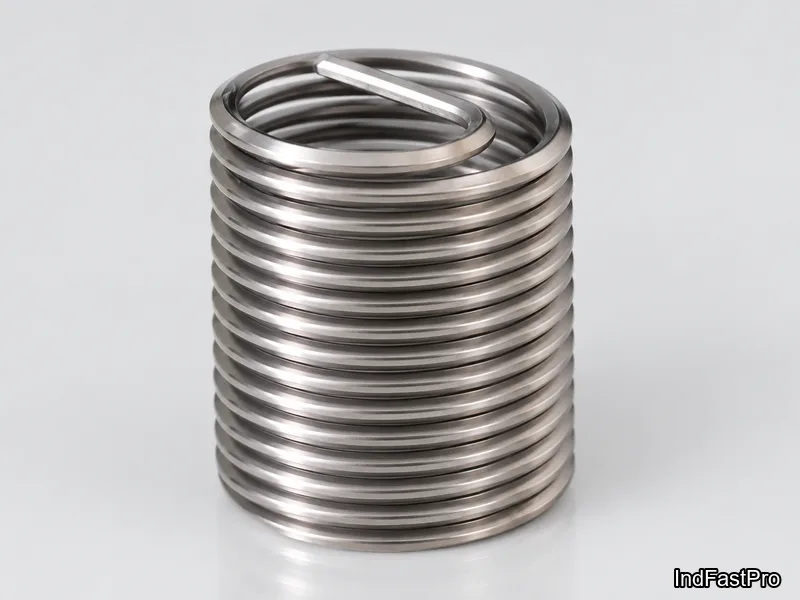
A wire thread insert does not thread into a normal tapped hole. It threads into an STI hole — Screw Thread Insert — tapped per ASME B18.29.1 with a diameter enlarged by exactly the wire cross-section of the coil, so that after the insert is installed the assembled thread reads as a standard ASME B1.1 internal thread of the nominal size. This page is that hole geometry: the collected chart carries, per thread from 1-64 through 1-14 in the UNC and UNF ladders (45 chart rows in the source grouping, coarse series first then fine), the STI hole major diameter minimum Dmin, pitch diameter limits D2min–D2max (Class 2B), and minor diameter limits D1min–D1max, plus the suggested tap drill per row — 17/64 for a 1/4-20 STI hole, #7 for a 10-32, and so on down the ladder. Two process notes from the source travel with the table: thread the hole with an STI tap (plug style, over 4 pitch chamfer, for through holes; bottoming style, 1–2 pitch chamfer, for blind holes close to the floor), and countersink the entry at 120° ± 5° with drilling depth that allows a 3/4 – 1 1/2 pitch insert set-down below the top surface. Acceptance is gauged with STI GO, NOT GO (HI) and plain cylindrical gages per System 21 of ANSI/ASME B1.3M — a normal 1/4-20 GO plug must NOT pass the un-inserted STI hole. The mechanics of why the hole is bigger are on the wire-thread-inserts pages of this family; this chart is what the machinist and the gage crib work from. Insert lengths, screw-locking versus free-running wire series and installed-depth selection are not tabulated by the collected specification — per RFQ.
| Standard | ASME B18.29.1-1993 — helical coil screw thread inserts, free running and screw locking, inch series (STI tapped hole geometry); assembled thread per ASME B1.1, gaging per System 21 of ANSI/ASME B1.3M |
|---|---|
| Chart coverage | UNC coarse 1-64 – 1 1/2-6 and UNF fine 2-64 – 1-14, 45 rows in the source grouping (coarse series first, then fine); per thread: TPI, Dmin (major, min), D2min–D2max (pitch, Class 2B), D1min–D1max (minor), suggested drill |
| STI principle | The tapped hole is diametrically larger than a standard internal thread by the insert wire cross-section; after insert installation the assembly reads as a standard internal thread of the nominal size (e.g. 1/4-20 STI hole: Dmin 0.315 vs a standard 1/4-20 minor ~0.207) |
| Tap styles | STI plug tap: over 4 pitch chamfer — through holes and blind holes with floor clearance; STI bottoming tap: 1–2 pitch chamfer — blind holes needing threads close to the floor (source definitions) |
| Entry prep | Countersink 120° ± 5° at the thread entry; minimum drilling depths allow the countersink plus a 3/4 – 1 1/2 pitch insert set-down below the top surface (source note) |
| Insert lengths / wire series | Not tabulated by the collected specification — per RFQ (state insert length in diameters, free-running vs screw-locking, material at quotation) |
| Thread | No./Nominal | TPI | Dmin (Major, min) | D2min (Pitch, min) | D2max (Pitch, max, 2B) | D1min (Minor, min) | D1max (Minor, max) | Suggested Drill (in) |
|---|---|---|---|---|---|---|---|---|
| 1-64 | 1 | 64 | 0.0933 | 0.0832 | 0.085 | 0.0764 | 0.0823 | #47 |
| 2-56 | 2 | 56 | 0.1092 | 0.0976 | 0.0996 | 0.0899 | 0.0961 | #42 |
| 3-48 | 3 | 48 | 0.1261 | 0.1126 | 0.1148 | 0.1036 | 0.1104 | #36 |
| 4-40 | 4 | 40 | 0.1445 | 0.1283 | 0.1308 | 0.1175 | 0.1252 | #31 |
| 5-40 | 5 | 40 | 0.1575 | 0.1413 | 0.1438 | 0.1305 | 0.1373 | #29 |
| 6-32 | 6 | 32 | 0.1786 | 0.1583 | 0.1611 | 0.1448 | 0.1527 | #25 |
| 8-32 | 8 | 32 | 0.2046 | 0.1843 | 0.1872 | 0.1708 | 0.1781 | #17 |
| 10-24 | 10 | 24 | 0.2441 | 0.217 | 0.2203 | 0.199 | 0.208 | 13/64 |
| 12-24 | 12 | 24 | 0.2701 | 0.243 | 0.2464 | 0.225 | 0.234 | #1 |
| 1/4-20 | 1/4 | 20 | 0.315 | 0.2825 | 0.2864 | 0.2608 | 0.2704 | 17/64 |
| 5/16-18 | 5/16 | 18 | 0.3847 | 0.3486 | 0.3529 | 0.3245 | 0.3342 | 21/64 |
| 3/8-16 | 3/8 | 16 | 0.4562 | 0.4156 | 0.4203 | 0.3885 | 0.3987 | 25/64 |
| 7/16-14 | 7/16 | 14 | 0.5303 | 0.4839 | 0.489 | 0.453 | 0.4639 | 29/64 |
| 1/2-13 | 1/2 | 13 | 0.5999 | 0.5499 | 0.5554 | 0.5166 | 0.5273 | 33/64 |
| 9/16-12 | 9/16 | 12 | 0.6708 | 0.6167 | 0.6225 | 0.5806 | 0.5918 | 19/32 |
| 5/8-11 | 5/8 | 11 | 0.7431 | 0.6841 | 0.6903 | 0.6447 | 0.6564 | 21/32 |
| 3/4-10 | 3/4 | 10 | 0.8799 | 0.8149 | 0.8216 | 0.7716 | 0.7838 | 25/32 |
| 7/8-9 | 7/8 | 9 | 1.0193 | 0.9471 | 0.9543 | 0.899 | 0.9119 | 29/32 |
| 1-8 | 1 | 8 | 1.1624 | 1.0812 | 1.089 | 1.0271 | 1.0421 | 1 |
| 1 1/8-7 | 1 1/8 | 7 | 1.3106 | 1.2178 | 1.2262 | 1.1559 | 1.173 | 1 |
| 1 1/4-7 | 1 1/4 | 7 | 1.4356 | 1.3428 | 1.3514 | 1.2809 | 1.298 | 1 |
| 1 3/8-6 | 1 3/8 | 6 | 1.5915 | 1.4832 | 1.4926 | 1.411 | 1.431 | 1 |
| 1 1/2-6 | 1 1/2 | 6 | 1.7165 | 1.6082 | 1.6177 | 1.536 | 1.556 | 1 |
- the source chart prints ten cells per row against nine named columns: an additional unlabeled numeric column sits between D1max and the suggested drill, and at every printed size its value equals the arithmetic midpoint of the printed D1min/D1max range — but the source names no such column. Carried fail-closed: the unlabeled cell is not rendered, and the suggested-drill value is taken from the final source token.
| Thread | No./Nominal | TPI | Dmin (Major, min) | D2min (Pitch, min) | D2max (Pitch, max, 2B) | D1min (Minor, min) | D1max (Minor, max) | Suggested Drill (in) |
|---|---|---|---|---|---|---|---|---|
| 2-64 | 2 | 64 | 0.1063 | 0.0962 | 0.0981 | 0.0894 | 0.0947 | #42 |
| 3-56 | 3 | 56 | 0.1222 | 0.1106 | 0.1126 | 0.1029 | 0.1086 | #36 |
| 4-48 | 4 | 48 | 0.1391 | 0.1256 | 0.1279 | 0.1166 | 0.1229 | #31 |
| 6-40 | 6 | 40 | 0.1705 | 0.1543 | 0.1569 | 0.1435 | 0.1503 | #26 |
| 8-36 | 8 | 36 | 0.2001 | 0.1821 | 0.1849 | 0.1701 | 0.1771 | #17 |
| 10-32 | 10 | 32 | 0.2306 | 0.2103 | 0.2133 | 0.1968 | 0.2041 | #7 |
| 1/4-28 | 1/4 | 28 | 0.2964 | 0.2732 | 0.2765 | 0.2577 | 0.2646 | G |
| 5/16-24 | 5/16 | 24 | 0.3666 | 0.3395 | 0.3433 | 0.3215 | 0.3288 | P |
| 3/8-24 | 3/8 | 24 | 0.4291 | 0.402 | 0.4059 | 0.384 | 0.391 | W |
| 7/16-20 | 7/16 | 20 | 0.5025 | 0.47 | 0.4744 | 0.4483 | 0.4561 | 29/64 |
| 1/2-20 | 1/2 | 20 | 0.565 | 0.5325 | 0.5371 | 0.5108 | 0.5186 | 33/64 |
| 9/16-18 | 9/16 | 18 | 0.6347 | 0.5986 | 0.6035 | 0.5745 | 0.5826 | 37/64 |
| 5/8-18 | 5/8 | 18 | 0.6972 | 0.6611 | 0.6661 | 0.637 | 0.6451 | 41/64 |
| 3/4-16 | 3/4 | 16 | 0.8312 | 0.7906 | 0.7961 | 0.7635 | 0.772 | 49/64 |
| 7/8-14 | 7/8 | 14 | 0.9678 | 0.9214 | 0.9274 | 0.8905 | 0.8994 | 57/64 |
| 1-12 | 1 | 12 | 1.1083 | 1.0542 | 1.0608 | 1.0181 | 1.0281 | 1 |
| 1 1/8-12 | 1 1/8 | 12 | 1.2333 | 1.1792 | 1.186 | 1.1431 | 1.1531 | 1 |
| 1 1/4-12 | 1 1/4 | 12 | 1.3583 | 1.3042 | 1.3112 | 1.2681 | 1.2781 | 1 |
| 1 3/8-12 | 1 3/8 | 12 | 1.4833 | 1.4292 | 1.4364 | 1.3931 | 1.4031 | 1 |
| 1 1/2-12 | 1 1/2 | 12 | 1.6083 | 1.5542 | 1.5615 | 1.5181 | 1.5281 | 1 |
| 1-14 | 1 | 14 | 1.0928 | 1.0464 | 1.0527 | 1.0155 | 1.0243 | 1 |
- the source chart prints ten cells per row against nine named columns: an additional unlabeled numeric column sits between D1max and the suggested drill, and at every printed size its value equals the arithmetic midpoint of the printed D1min/D1max range — but the source names no such column. Carried fail-closed: the unlabeled cell is not rendered, and the suggested-drill value is taken from the final source token.
Materials
- Insert material and wire series specified per RFQ — the tapped-hole chart is material-independent; the insert (and therefore the retained thread environment resistance) is the material decision
Ordering & documentation
Documents
Shipments are backed by Mill Test Certificate (MTC), Dimensional Report, Salt Spray Test Report on request, with full batch traceability from raw material to finished product. Quality management follows the owner-confirmed compliance list: ISO 9001:2015, RoHS, REACH. Exact document sets are confirmed on the order.
Quotation
- The fastener family (ASME B18.29.1 Helicoil (STI) Tapped Hole Chart (Inch Series)) plus the standard designation from your drawing — DIN / ISO / JIS / ASTM / ANSI, or a drawing for custom parts.
- Size (diameter and length), thread type (metric or inch), property class or grade, and coating or finish.
- Quantity per size and your target delivery date.
- Destination country, and any required documents (for example a mill test certificate) so the quote includes them.
Sample & supply
Minimum order quantities and lead times for this family are confirmed at quotation — send your sizes, grades and quantities on the RFQ and the quote will carry a firm schedule. Sample availability is confirmed with the quotation.
Storage & shipping
Parts are packed for export and shipped factory-direct to buyers in Europe, Asia, the Americas and the Middle East. Store fasteners dry and protected until installation, and keep coated parts in their packaging until use; specific packing and preservation requirements can be stated on the order and confirmed at quotation.
Frequently asked questions
Why is the STI tapped hole bigger than a normal 1/4-20 hole, and how do I check it?
Because the insert is wire, and the wire has to live somewhere. A helical coil insert is a diamond-cross-section coil of standard internal thread profile; when installed, its outer coils must seat into material that a standard 1/4-20 tap would have cut away. The collected chart shows the offset directly: a standard 1/4-20 minor diameter runs around 0.207 in, while the STI hole for the same thread starts at Dmin 0.315 in major with minor limits 0.2608–0.2704 — the wire cross-section occupies the band between. After the insert is in, the assembly presents a true 1/4-20 internal thread, so a standard bolt fits and the thread callout of the host drawing still works. Verification follows the standard, not feel: the hole is gauged before insert installation with STI GO and NOT GO (HI) thread gages plus a plain cylindrical gage, per System 21 of ANSI/ASME B1.3M. Two checks people skip: a normal 1/4-20 GO plug should NOT pass an STI hole — if it does, the wrong tap went in; and the D2 column is class-specific (Class 2B in this chart), so a different fit class is an RFQ line, not a field adjustment. The suggested-drill column (17/64 for 1/4-20 STI) sizes the pre-tap hole for the STI tap, and the 120° ± 5° countersink with set-down depth from the source note is what keeps the first coil and the chamfer from fighting at install.
Do I need this chart if I am buying the inserts rather than machining the holes?
Yes, for one paragraph of your drawing package. The insert supplier sizes inserts off your thread callout; the machine shop sizes the hole off ASME B18.29.1 — and the two meet only if the drawing says both. State on the drawing: the nominal thread the assembled insert must present (e.g. 1/4-20 UNC-2B after insert installation), the governing standard for the STI hole (ASME B18.29.1), the parent material (which drives tap style — bottoming for blind holes — and drill depth), and the insert length in nominal diameters, which this chart does not carry and which sets drilled depth together with the set-down note. The collected chart then does the rest: the shop picks the STI tap and suggested drill (the D2min–D2max and D1min–D1max limits govern acceptance), the gage crib orders STI GO/NOT GO gages per System 21, and inspection has objective limits instead of a trial-and-error fit against a loose insert. Quote the insert side with its own RFQ lines — free-running or screw-locking wire series, material, length — and the hole side is fully specified by the numbers on this page.
Request a Quote
Get factory-direct pricing from the manufacturer.
What to include in your inquiry
- ✓ Standard and property class (e.g. DIN 912, ISO 4762, class 8.8) — or a drawing for custom parts.
- ✓ Sizes, lengths and thread type (metric or inch).
- ✓ Quantity per size and your target delivery date.
- ✓ Destination country, plus any coating or finish requirement.
- ✓ Any documents you need with the shipment (e.g. mill test certificate) so the quote includes them.
- ✓ Your inquiry goes straight to the factory team by email and gets a reply within 24 hours.
- ✓ Factory-direct pricing
- ✓ Standard and custom specifications
- ✓ Factory-direct export to buyers in Europe, Asia, the Americas and the Middle East
- ✓ Full fastener family support