
Threaded Insert Drilling Depth (UNF Threads)
Per-thread drilling data for threaded insert installations in the UNF fine series from 2-64 through 1/2-20 — tap drill diameter, drilled-hole diameter limits, tap minimum outer diameter, and drilling depth for insert engagements from 1d to 3d.
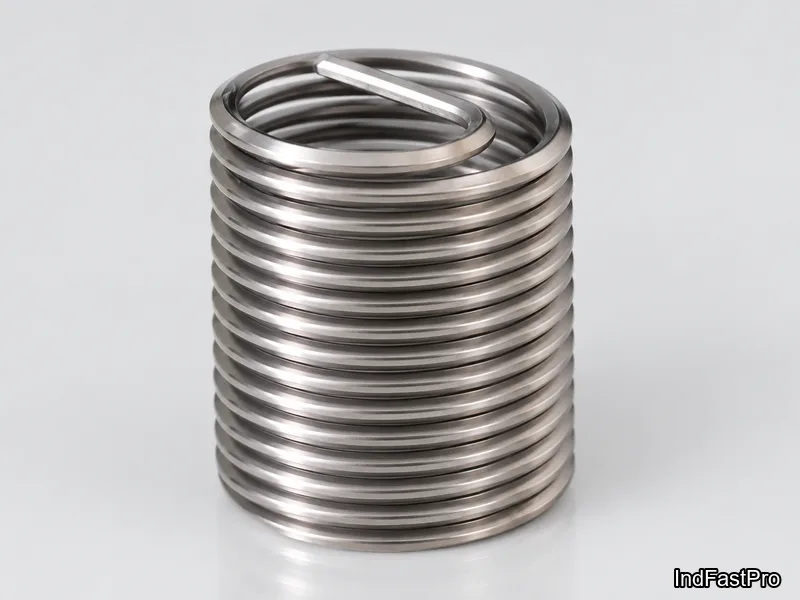
Specifications
The fine-pitch companion of the UNC chart: for each UNF designation from 2-64 through 1/2-20, the same four machining numbers — drill bit diameter, drilled diameter min./max., tap minimum outer diameter — plus drilling depth for 1d to 3d engagement, all in millimetres as the source prints them. Fine-pitch insert work is less forgiving on hole diameter than coarse: the UNF thread's shallower profile means the difference between a tap that cuts cleanly and one that galls sits in a narrower drilled-diameter band, which is exactly what the min./max. columns pin down. The engagement ladder again starts at 1d. Use this chart alongside its UNC sibling when a repair drawing mixes series (common on imported equipment), and take each row from the designation that matches the full callout — series substitution (UNC for UNF) is never a field decision. Insert length selection and parent-material drilling corrections are per RFQ.
| Coverage | 21 UNF fine designations, 2-64 through 1/2-20 (thread numbers 2-64, 3-56, 4-48, 5-44, 6-40, 8-36, 10-32, then 1/4-28 up to 1/2-20) |
|---|---|
| Columns | Pitch (mm); drill bit diameter; drilling diameter min./max.; tap minimum outer diameter; drilling depth at 1d / 1.5d / 2d / 2.5d / 3d engagement — all mm as printed |
| Engagement range | 1d to 3d (no sub-1d columns tabulated for UNF) |
| Series discipline | UNC and UNF rows do not interchange — match the full designation (nominal + TPI) from the drawing to the chart's first column |
| Not tabulated | Insert lengths, materials, parent-material corrections — per RFQ |
| Nominal Diameter | Pitch (mm) | Drill Bit Diameter (mm) | Drilling Diameter | Tap | Drilling Depth | |||||
|---|---|---|---|---|---|---|---|---|---|---|
| min. | max. | Min Outer Diameter | 1d | 1.5d | 2d | 2.5d | 3d | |||
| 2-64 | 0.396 | 2.3 | 2.29 | 2.44 | 2.70 | 4.0 | 5.0 | 6.2 | 7.3 | 8.3 |
| 3-56 | 0.453 | 2.7 | 2.62 | 2.77 | 3.10 | 4.6 | 5.8 | 7.1 | 8.4 | 9.6 |
| 4-48 | 0.529 | 3.0 | 2.97 | 3.14 | 3.53 | 5.2 | 6.7 | 8.1 | 9.5 | 10.9 |
| 6-40 | 0.635 | 3.8 | 3.66 | 3.81 | 4.33 | 6.4 | 8.1 | 9.9 | 11.6 | 13.4 |
| 8-36 | 0.706 | 4.4 | 4.32 | 4.47 | 5.08 | 7.3 | 9.4 | 11.5 | 13.6 | 15.7 |
| 10-32 | 0.794 | 5.1 | 5.00 | 5.16 | 5.86 | 8.4 | 10.8 | 13.2 | 15.6 | 18.0 |
| 1/4-28 | 0.907 | 6.7 | 6.55 | 6.72 | 7.53 | 10.4 | 13.6 | 16.8 | 20.0 | 23.2 |
| 5/16-24 | 1.058 | 8.3 | 8.17 | 8.35 | 9.31 | 12.7 | 16.7 | 20.6 | 24.6 | 28.6 |
| 3/8-24 | 1.058 | 9.9 | 9.75 | 9.93 | 10.90 | 14.3 | 19.1 | 23.8 | 28.6 | 33.3 |
| 7/16-20 | 1.270 | 11.5 | 11.39 | 11.59 | 12.76 | 16.8 | 22.4 | 27.9 | 33.5 | 39.0 |
| 1/2-20 | 1.270 | 13.1 | 12.97 | 13.16 | 14.35 | 18.4 | 24.8 | 31.1 | 37.5 | 43.8 |
| 9/16-18 | 1.411 | 14.7 | 14.59 | 14.79 | 16.12 | 20.6 | 27.8 | 34.9 | 42.1 | 49.2 |
| 5/8-18 | 1.411 | 16.3 | 16.18 | 16.38 | 17.71 | 22.2 | 30.2 | 38.1 | 46.0 | 54.0 |
| 3/4-16 | 1.588 | 19.5 | 19.39 | 19.60 | 21.11 | 26.2 | 35.7 | 45.2 | 54.8 | 64.3 |
| 7/8-14 | 1.814 | 22.7 | 22.62 | 22.84 | 24.58 | 30.4 | 41.5 | 52.6 | 63.7 | 74.8 |
| 1″-14 | 1.814 | 26.0 | 25.86 | 26.11 | 27.76 | 33.6 | 46.3 | 59.0 | 71.7 | 84.4 |
| 1″-12 | 2.117 | 26.0 | 25.86 | 26.11 | 28.15 | 34.9 | 47.6 | 60.3 | 73.0 | 85.7 |
| 1″ 1/8-12 | 2.117 | 29.2 | 29.03 | 29.29 | 31.33 | 38.1 | 52.4 | 66.7 | 81.0 | 95.3 |
| 1″ 1/4-12 | 2.117 | 32.4 | 32.21 | 32.21 | 34.50 | 41.3 | 57.2 | 73.0 | 88.9 | 104.8 |
| 1″ 3/8-12 | 2.117 | 35.5 | 35.38 | 35.38 | 37.68 | 44.5 | 61.9 | 79.4 | 96.8 | 114.3 |
| 1″ 1/2-12 | 2.117 | 38.7 | 38.56 | 38.56 | 40.85 | 47.6 | 66.7 | 85.7 | 104.8 | 123.8 |
Materials
- Same discipline as the UNC chart: the chart sizes the hole, the insert is the material decision. UNF inserts are the common choice where the parent wall is thin or vibration matters — the fine pitch buys thread turns per millimetre. State parent material, the full UNF callout and any certificate requirement on the RFQ
Ordering & documentation
Documents
Shipments are backed by Mill Test Certificate (MTC), Dimensional Report, Salt Spray Test Report on request, with full batch traceability from raw material to finished product. Quality management follows the owner-confirmed compliance list: ISO 9001:2015, RoHS, REACH. Exact document sets are confirmed on the order.
Quotation
- The fastener family (Threaded Insert Drilling Depth (UNF Threads)) plus the standard designation from your drawing — DIN / ISO / JIS / ASTM / ANSI, or a drawing for custom parts.
- Size (diameter and length), thread type (metric or inch), property class or grade, and coating or finish.
- Quantity per size and your target delivery date.
- Destination country, and any required documents (for example a mill test certificate) so the quote includes them.
Sample & supply
Minimum order quantities and lead times for this family are confirmed at quotation — send your sizes, grades and quantities on the RFQ and the quote will carry a firm schedule. Sample availability is confirmed with the quotation.
Storage & shipping
Parts are packed for export and shipped factory-direct to buyers in Europe, Asia, the Americas and the Middle East. Store fasteners dry and protected until installation, and keep coated parts in their packaging until use; specific packing and preservation requirements can be stated on the order and confirmed at quotation.
Frequently asked questions
Can I drill the hole from the UNC chart if the insert is UNF of the same nominal size?
No. Take 1/4-20 UNC against 1/4-28 UNF: the UNF pitch is 0.907 mm against the UNC 1.270 mm, the UNF tap cuts a shallower, tighter thread, and the chart's UNF drill column reflects that — the two drilled holes differ, and using the coarse-series drill leaves a fine-pitch tap overloaded or produces an undersized thread. Every column in the row is designation-specific: drill diameter, drilled-diameter limits, tap outer diameter and the depth ladder. The rule that prevents the error is to read the chart's first column as a string match, not a size match: 1/4-28 means the row whose first column prints 1/4-28. Mixed-series repair drawings are common enough that we quote them routinely — send the callout verbatim on the RFQ and the insert is supplied against the right series with the matching installation data.
Where is the 0.5d engagement column on the inch charts?
The source tabulates UNF and UNC drilling depth from 1d upward — sub-1d engagement is not a column because it is not a common practice on the inch series, where thread turns per inch already run higher than metric coarse at comparable sizes. If your application genuinely calls for sub-1d engagement (rare; usually a thin-floor casting), that is an engineering decision to take with the insert manufacturer's data, not something to extrapolate from the 1d column — the depth value includes tap approach that does not scale linearly. Quote the case per RFQ with the drawing and the engagement requirement stated, and the machining data is confirmed against the series' installation specification rather than guessed from this table.
Request a Quote
Get factory-direct pricing from the manufacturer.
What to include in your inquiry
- ✓ Standard and property class (e.g. DIN 912, ISO 4762, class 8.8) — or a drawing for custom parts.
- ✓ Sizes, lengths and thread type (metric or inch).
- ✓ Quantity per size and your target delivery date.
- ✓ Destination country, plus any coating or finish requirement.
- ✓ Any documents you need with the shipment (e.g. mill test certificate) so the quote includes them.
- ✓ Your inquiry goes straight to the factory team by email and gets a reply within 24 hours.
- ✓ Factory-direct pricing
- ✓ Standard and custom specifications
- ✓ Factory-direct export to buyers in Europe, Asia, the Americas and the Middle East
- ✓ Full fastener family support