
Key-Locking Thread Inserts
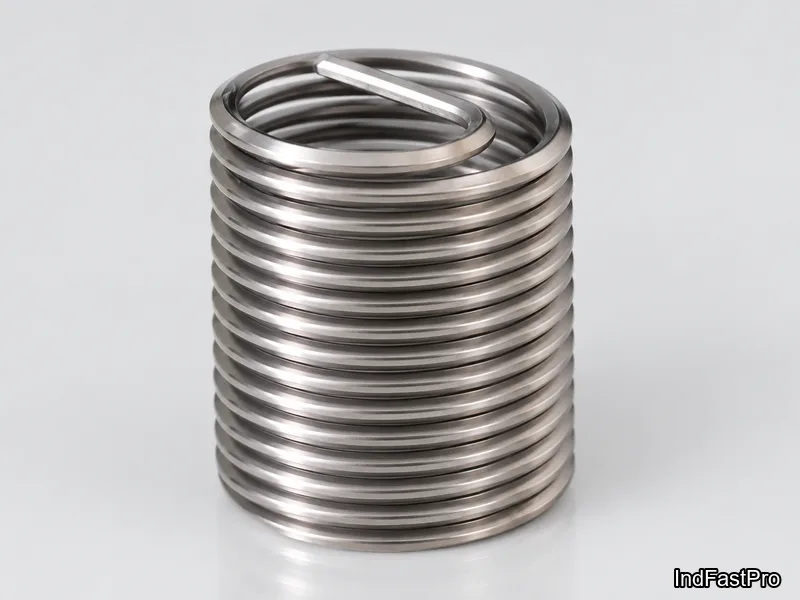
Solid inserts with locking keys driven into the parent material after installation — anti-rotation under torque and vibration for thread repair and reinforcement in aluminum and cast components.
Last updated: 2026-11
Specifications
Key-locking thread inserts are solid inserts with locking keys that are driven into the parent material after the insert is positioned in the prepared hole. The keys mechanically lock the insert against rotation — the collected sources tie them to joints where repeated tightening, loosening or vibration could otherwise rotate the insert, and to metal thread repair, high-strength reinforcement and vibration-prone mechanical assemblies: stripped-thread repair, reinforcement of aluminum or cast components, machine bases, fixture plates and maintenance-heavy machinery. The trade the sources name honestly: key-locking inserts usually require more careful hole preparation than simple self-tapping inserts — accurate hole preparation followed by insertion and setting of the locking keys, per the manufacturer's specification so the locking features engage correctly — and are best used where the added installation effort is justified by the anti-rotation benefit.
| Construction | Solid insert with external locking keys driven into the parent material after installation |
|---|---|
| Anti-rotation mechanism | Keys mechanically lock the insert against rotation under torque or vibration — the defining behaviour vs friction- or interference-retained designs |
| Primary applications | Stripped-metal-thread repair; high-strength reinforcement; aluminum and cast components; machine bases; fixture plates; maintenance-heavy machinery; high-load fastening points |
| Installation requirement | More careful hole preparation than simple self-tapping inserts: accurate hole dimensions, insertion, then key setting per manufacturer specification so the locking features engage correctly |
| Selection rule | Best where the added installation effort is justified by the strength and anti-rotation benefits (collected guide) |
| MOQ / lead time | Not owner-confirmed for this family — confirmed at quotation |
Materials
- Stainless steel
- Carbon steel
- Brass (material per collected guide; confirm required insert material on the RFQ)
Ordering & documentation
Documents
Shipments are backed by Mill Test Certificate (MTC), Dimensional Report, Salt Spray Test Report on request, with full batch traceability from raw material to finished product. Quality management follows the owner-confirmed compliance list: ISO 9001:2015, RoHS, REACH. Exact document sets are confirmed on the order.
Quotation
- The fastener family (Key-Locking Thread Inserts) plus the standard designation from your drawing — DIN / ISO / JIS / ASTM / ANSI, or a drawing for custom parts.
- Size (diameter and length), thread type (metric or inch), property class or grade, and coating or finish.
- Quantity per size and your target delivery date.
- Destination country, and any required documents (for example a mill test certificate) so the quote includes them.
Sample & supply
Minimum order quantities and lead times for this family are confirmed at quotation — send your sizes, grades and quantities on the RFQ and the quote will carry a firm schedule. Sample availability is confirmed with the quotation.
Storage & shipping
Parts are packed for export and shipped factory-direct to buyers in Europe, Asia, the Americas and the Middle East. Store fasteners dry and protected until installation, and keep coated parts in their packaging until use; specific packing and preservation requirements can be stated on the order and confirmed at quotation.
Frequently asked questions
Key-locking or heavy-duty self-tapping insert for a vibrating assembly?
The failure mode decides: if the risk is the insert rotating under torque or vibration, the collected sources point to key-locking — the keys are driven into the parent material specifically to stop rotation. If the risk is pull-out from insufficient engagement, the heavy-duty self-tapping branch is the lighter-installation option. High-load vibrating points can justify key-locking for both properties.
Can key-locking inserts repair a stripped cast-iron thread?
Reinforcement of cast components is among the collected sources' listed uses, and thread repair in metal is the primary case. Cast material is brittle — hole preparation matters more, and the sources require the hole dimensions and installation procedure to follow the insert manufacturer's specification so the keys engage correctly.
What should an RFQ for key-locking inserts state?
State the insert type, internal thread size and pitch, insert material, parent material (aluminum, cast, steel), hole accessibility for key setting, and the vibration/torque case. Commercial terms are confirmed at quotation.
Request a Quote
Get factory-direct pricing from the manufacturer.
What to include in your inquiry
- ✓ Standard and property class (e.g. DIN 912, ISO 4762, class 8.8) — or a drawing for custom parts.
- ✓ Sizes, lengths and thread type (metric or inch).
- ✓ Quantity per size and your target delivery date.
- ✓ Destination country, plus any coating or finish requirement.
- ✓ Any documents you need with the shipment (e.g. mill test certificate) so the quote includes them.
- ✓ Your inquiry goes straight to the factory team by email and gets a reply within 24 hours.
- ✓ Factory-direct pricing
- ✓ Standard and custom specifications
- ✓ Factory-direct export to buyers in Europe, Asia, the Americas and the Middle East
- ✓ Full fastener family support