
Chemical (Adhesive) Anchors
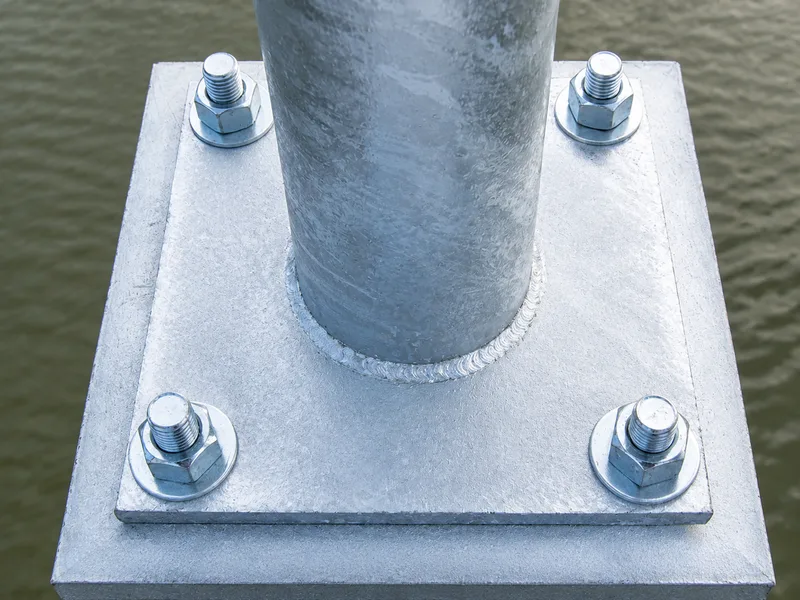
Bonded chemical anchors — threaded rods set in epoxy or vinyl ester for the highest capacity of the three post-installed families: M8–M24 rods at 80–210 mm embedment, ~29 kN cracked / ~54 kN uncracked tension on an M12 rod at 110 mm in C20/25. Deep embedment, tight spacing, sustained and seismic loads.
Last updated: 2026-11
Specifications
A chemical anchor is not an anchor body but a bond: a threaded rod is set into a hole filled with injected adhesive (epoxy or vinyl ester), and the load transfers through the bond layer into the concrete. That is why it is the capacity ceiling of the three post-installed families — roughly twice a comparable mechanical anchor at deep embedment — and why it wins the hard details: deep embedment, large diameters, tight spacing, sustained loads, near-free-edge positions and damp or water-filled holes (vinyl ester). The costs are procedural: the hole cleaning cycle is the installation (drill, brush, blow, brush — repeatedly), the cure window runs from minutes to hours depending on temperature, and loading waits for full cure. Sustained tension carries a reduction factor (ψ_sus = 0.64 in temperature range I), and the embedment window is bounded — outside 4d to 20d the approval no longer assumes a uniform bond stress. Qualification runs under EAD 330499 with the reference epoxy ETA-20/0533 covering rods M8–M24.
| Type | Bonded chemical anchor — threaded rod set in injected epoxy or vinyl ester; load transfers through the bond layer |
|---|---|
| Rod sizes | M8–M24 on a typical ETA; larger rods product-specific — EAD 330499 fixes only the minimum thread size, M6 |
| Embedment window | 80–210 mm on the reference epoxy ETA, bounded by h_ef ≥ 4d and h_ef ≤ 20d (an M8 rod caps at 160 mm, M12 at 240 mm, M16 at 320 mm) |
| Bond stresses (reference) | τ Rk,cr = 7.0 N/mm² cracked, τ Rk,ucr = 13.0 N/mm² uncracked (temperature range I) |
| Characteristic tension | ≈ 29 kN cracked / ≈ 54 kN uncracked on an M12 rod at 110 mm in C20/25 (τ × π × d × h_ef); roughly twice a comparable mechanical anchor at deep embedment |
| Sustained-load factor | ψ_sus = 0.64 (temperature range I) / 0.63 (range II) applied to sustained tension |
| Temperature ranges | Range I: −40 to +40 °C (long-term ≤ +24 °C); range II: −40 to +80 °C (long-term ≤ +50 °C) |
| Cure & loading | Cure time from minutes to hours, temperature-dependent; load only after full cure |
| Installation | Drill, brush, blow, brush — repeated; the cleaning cycle is part of the qualified system |
| Qualification | EAD 330499-00-0601; reference epoxy ETA-20/0533 (rods M8–M24); design to EN 1992-4:2018 / ACI 318-25 Ch. 17 |
| Seismic | Widely qualified including sustained-load and seismic categories — reference epoxy carries C1 across its full rod range; the adhesive must match the approved product exactly |
| Hole condition | Vinyl ester for damp or water-filled holes; epoxy for the rest — check hole-condition qualification on the report |
| Fire | Coverage narrower and product-specific, carried in the ETA and ACI 355.4-24 assessments |
| Relative installed cost | Highest of the three families — dispensing tool, cleaning cycle and cure window add trade time; wins where capacity per anchor shrinks the drill programme |
| MOQ / lead time | 500–1,000 pieces; standard production 15–30 days |
Materials
- Epoxy adhesive (standard, highest bond; dry holes)
- Vinyl ester adhesive (damp or water-filled holes)
- Threaded rods: carbon steel, HDG or stainless per environment — rod grade per the approval
Ordering & documentation
Documents
Shipments are backed by Mill Test Certificate (MTC), Dimensional Report, Salt Spray Test Report on request, with full batch traceability from raw material to finished product. Quality management follows the owner-confirmed compliance list: ISO 9001:2015, RoHS, REACH. Exact document sets are confirmed on the order.
Quotation
- The fastener family (Chemical (Adhesive) Anchors) plus the standard designation from your drawing — DIN / ISO / JIS / ASTM / ANSI, or a drawing for custom parts.
- Size (diameter and length), thread type (metric or inch), property class or grade, and coating or finish.
- Quantity per size and your target delivery date.
- Destination country, and any required documents (for example a mill test certificate) so the quote includes them.
Sample & supply
Minimum order quantity is 500–1,000 pieces. Standard production run 15–30 days. Quantities or variants outside the standard range are confirmed at quotation.
Storage & shipping
Parts are packed for export and shipped factory-direct to buyers in Europe, Asia, the Americas and the Middle East. Store fasteners dry and protected until installation, and keep coated parts in their packaging until use; specific packing and preservation requirements can be stated on the order and confirmed at quotation.
Frequently asked questions
Why does the embedment window matter so much on chemical anchors?
Because the capacity math assumes a uniform bond stress along the embedded length, and that assumption only holds between 4d and 20d embedment. Too shallow and cone breakout — not bond — controls before the adhesive earns its rating; too deep and the approval stops letting you multiply the bond stress by the full length (an M12 rod caps at 240 mm even though a 300 mm hole is drillable). Stay inside the window and the published τ values apply; outside it you are designing a different anchor than the one that was tested.
Cracked or uncracked — how much capacity is at stake?
Roughly a factor of two on the bond: the reference values are 7.0 N/mm² cracked against 13.0 N/mm² uncracked, which is about 29 kN versus 54 kN on an M12 rod at 110 mm embedment. A slab in tension — post-tensioned, over a support, with restraint-to-shrinkage cracking — is cracked concrete, and quoting the uncracked number into it is not a rounding error but a different anchor. Where you cannot certify the slab condition, design to the cracked value.
Why is hole cleaning treated as part of the anchor system?
The bond is only as good as the adhesive-to-concrete contact, and drilling dust is the separator. That is why the qualified installation is a repeated cycle — drill, brush, blow, brush — and why capacity values in the ETA were measured with that cycle performed. A hole that was drilled but never cleaned can lose the margin the approval rests on, which makes cleaning the one installation step that must be named in the specification and policed on site.
What is the MOQ and lead time for these anchors?
The minimum order quantity is 500–1,000 pieces. Standard production runs 15–30 days. Bent or custom geometries are quoted against the drawing.
What should an RFQ for these anchors state?
State the anchor family and designation, diameter, embedment or length, base-material condition (cracked or uncracked concrete, moisture), coating, and quantity per size — plus destination country and any required documents such as a mill test certificate. If your detail carries an ETA or ICC-ES report number, quote it so the anchor matches the approval.
Request a Quote
Get factory-direct pricing from the manufacturer.
What to include in your inquiry
- ✓ Standard and property class (e.g. DIN 912, ISO 4762, class 8.8) — or a drawing for custom parts.
- ✓ Sizes, lengths and thread type (metric or inch).
- ✓ Quantity per size and your target delivery date.
- ✓ Destination country, plus any coating or finish requirement.
- ✓ Any documents you need with the shipment (e.g. mill test certificate) so the quote includes them.
- ✓ Your inquiry goes straight to the factory team by email and gets a reply within 24 hours.
- ✓ Factory-direct pricing
- ✓ Standard and custom specifications
- ✓ Factory-direct export to buyers in Europe, Asia, the Americas and the Middle East
- ✓ Full fastener family support