
CFBSOA Self-Clinching Blind Standoffs (Aluminum)
7075-T6 aluminum blind self-clinching standoff, no finish — pressed flush into soft sheets from 0.040 in. (1.0 mm) up to Rockwell B-50, unified #4-40 to #10-32 and metric M3 to M5, closed threaded end controlling screw penetration, with aluminum-standoff performance rows and the steel-sheet "not recommended" caveat.
Last updated: 2026-11
Specifications
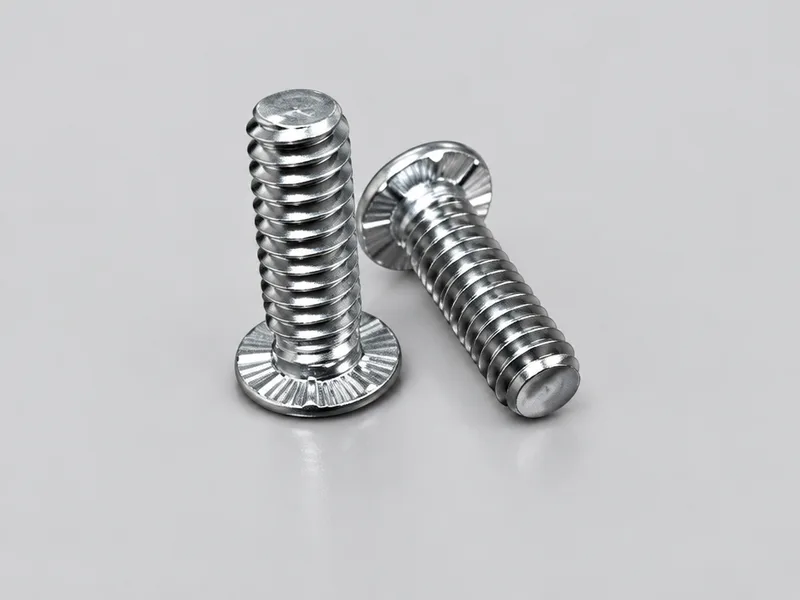
CFBSOA is the aluminum member of the blind self-clinching standoff series: 7075-T6 aluminum, no finish, pressed flush into a thin panel — no reaming, deburring or welding — and holding a fixed spacing while its closed end stops the mounting screw at a controlled depth. The catalog rates CFBSOA for panels of Rockwell B-50 hardness or less — the softest panel ceiling of the three series, matched to the softest standoff material: an aluminum standoff clinches into aluminum and other soft panels, and the collected performance table marks aluminum standoffs "nr" (not recommended) in steel sheet, so CFBSOA is a soft-panel part by design. Most sizes come in two body diameters (small-body 440-style and large-body 6440-style codes). A typical designation reads CFBSOA 6440-10: aluminum blind standoff, large body, #4-40, length code -10.
| Series | CFBSOA — 7075-T6 aluminum, no finish; installs into panels of Rockwell B-50 hardness or less (softest ceiling of the CFBSO/CFBSOS/CFBSOA series) |
|---|---|
| Threads | Internal 2B per ANSI B1.1 (6H per ANSI/ASME B1.13M for metric): #4-40, #6-32, #8-32, #10-32; M3 x 0.5, M3.5 x 0.6, M4 x 0.7, M5 x 0.8 |
| Minimum sheet thickness | 0.040 in. (1.0 mm) and up |
| Length ladders | Inch .312–1.062 in. (length codes -10 to -34 by thread), tolerance +.002/-.005 in.; metric 6–25 mm (codes -6 to -25), tolerance +.05/-.13 mm |
| Unified geometry, small body (sampled) | #4-40: A .166 +.003/-.000, H .165 +.000/-.005, C .187; #6-32: .213 / .212 / .250; #8-32 and #10-32: .281 / .280 / .312 |
| Unified geometry, large body (sampled) | #4-40: A .213, H .212, C .250; #6-32: .281 / .280 / .312; #8-32 and #10-32: .281 / .280 / .312 |
| Metric geometry (sampled) | M3: A 4.22 +.08/-.00, H 4.2 +.00/-.13, C 4.8; large body 5.41 / 5.39 / 6.4; M3.5: 5.41 / 5.39 / 6.4; M4: 7.14 / 7.12 / 7.9; M5: 7.14 / 7.12 / 7.9 (mm) |
| Trailing minimum columns (sampled) | Two trailing "Min." columns align positionally with the through-series table's minimum-edge-distance and minimum-sheet entries: #4-40 small body .23 in. edge / .040 in. sheet; large body .27 / .040; #6-32 and up .31 / .05; metric M3 6.0 mm / 1.0 mm, M3 large & M3.5 6.8 / 1.0, M4 & M5 8.0 / 1.27 — the printed sub-headers did not survive text extraction (see evidence note) |
| Effective thread depth (blind) | T minimum ladder .156 / .187 / .25 / .375 in. (3.2 / 4.0 / 5.0 / 6.5 / 9.5 mm) across the length ladders; the per-length assignment is not recoverable from the text layer — the metric ladder matches the effective-thread-depth ladder published on the BSO/BSOS/BSOA family page from a second collected source (see evidence note) |
| Part number structure | CFBSOS 6440-10 = series CFBSOS, body code 6 (large body), thread code 440 (#4-40), length code -10; small body uses body code 4 |
| Performance (aluminum standoff, .060 in. 5052-H34 aluminum sheet) | 440 group: 1100 lbs installation, 160 lbs pushout, 11 in.-lbs torque-out, 168 lbs pull-through, max tighten 2.85 in.-lbs; 6440/632: 1700 / 300 / 25 / 186 (max tighten 2.85, 5.25); 8632/832/1032: 2400 / 400 / 45 / 348 (max tighten 5.25, 11, 19) |
| Performance (aluminum standoff, steel sheet) | Marked "nr" (not recommended) across the collected table — quote CFBSOA only into aluminum or other soft panels; for steel panels use CFBSO or CFBSOS |
| MOQ / lead time | Not owner-confirmed for this family — confirmed at quotation |
Materials
- 7075-T6 aluminum, no finish (CFBSOA)
Ordering & documentation
Documents
Shipments are backed by Mill Test Certificate (MTC), Dimensional Report, Salt Spray Test Report on request, with full batch traceability from raw material to finished product. Quality management follows the owner-confirmed compliance list: ISO 9001:2015, RoHS, REACH. Exact document sets are confirmed on the order.
Quotation
- The fastener family (CFBSOA Self-Clinching Blind Standoffs (Aluminum)) plus the standard designation from your drawing — DIN / ISO / JIS / ASTM / ANSI, or a drawing for custom parts.
- Size (diameter and length), thread type (metric or inch), property class or grade, and coating or finish.
- Quantity per size and your target delivery date.
- Destination country, and any required documents (for example a mill test certificate) so the quote includes them.
Sample & supply
Minimum order quantities and lead times for this family are confirmed at quotation — send your sizes, grades and quantities on the RFQ and the quote will carry a firm schedule. Sample availability is confirmed with the quotation.
Storage & shipping
Parts are packed for export and shipped factory-direct to buyers in Europe, Asia, the Americas and the Middle East. Store fasteners dry and protected until installation, and keep coated parts in their packaging until use; specific packing and preservation requirements can be stated on the order and confirmed at quotation.
Frequently asked questions
Why is CFBSOA restricted to soft panels?
Clinching works by cold-flowing the panel material into the standoff's clinching feature, and the material pairing decides whether that flow forms correctly. The catalog maps CFBSOA (7075-T6 aluminum) to panels of Rockwell B-50 or less, and the collected performance table marks aluminum standoffs "nr" (not recommended) in the steel-sheet columns — an aluminum standoff in a steel panel does not clinch reliably and would not reach the tabulated pushout anyway. In its home condition, 0.060 in. 5052-H34 aluminum, the large-body #4-40 group shows 1700 lbs installation force, 300 lbs pushout, 25 in.-lbs torque-out and 186 lbs pull-through — lower than the steel numbers, as expected for a softer fastener in a softer panel, and sufficient for the electronics-chassis service these panels typically see.
What do the performance figures for a CFBSOA include?
The collected catalog's performance table covers all six standoff series and splits by standoff material; the CFBSOA rows are the aluminum-standoff rows, tabulated in 0.060 in. 5052-H34 aluminum sheet — the steel-sheet columns are "nr" for this material. The strongest group, 8632/832/1032, reaches 2400 lbs installation force, 400 lbs pushout, 45 in.-lbs torque-out and 348 lbs pull-through, with maximum recommended tightening from 5.25 to 19 in.-lbs depending on thread. These are tested figures at that sheet thickness for that standoff material — ask for the row of your exact thread, body and sheet at quotation.
What should an RFQ for CFBSOA blind standoffs state?
State the series (CFBSOA 7075-T6 aluminum), thread size (for example #6-32 or M3.5 x 0.6), body size (small or large), nominal length L, sheet material (aluminum or another soft panel), thickness and hardness, and quantity per size — plus destination country. For a blind standoff also state the required effective thread depth and the maximum permitted screw penetration. Commercial terms are confirmed at quotation.
Request a Quote
Get factory-direct pricing from the manufacturer.
What to include in your inquiry
- ✓ Standard and property class (e.g. DIN 912, ISO 4762, class 8.8) — or a drawing for custom parts.
- ✓ Sizes, lengths and thread type (metric or inch).
- ✓ Quantity per size and your target delivery date.
- ✓ Destination country, plus any coating or finish requirement.
- ✓ Any documents you need with the shipment (e.g. mill test certificate) so the quote includes them.
- ✓ Your inquiry goes straight to the factory team by email and gets a reply within 24 hours.
- ✓ Factory-direct pricing
- ✓ Standard and custom specifications
- ✓ Factory-direct export to buyers in Europe, Asia, the Americas and the Middle East
- ✓ Full fastener family support