
H / HNL High Pushout Self-Clinching Nuts
High pushout self-clinching nuts — H non-locking and HNL self-locking (prevailing torque) — for steel sheets HRB 80 or less (H) and HRB 60 or less (HNL), with conformance to IFI 100/107 Grade B and ANSI B18.16.1M prevailing-torque requirements.
Last updated: 2026-11
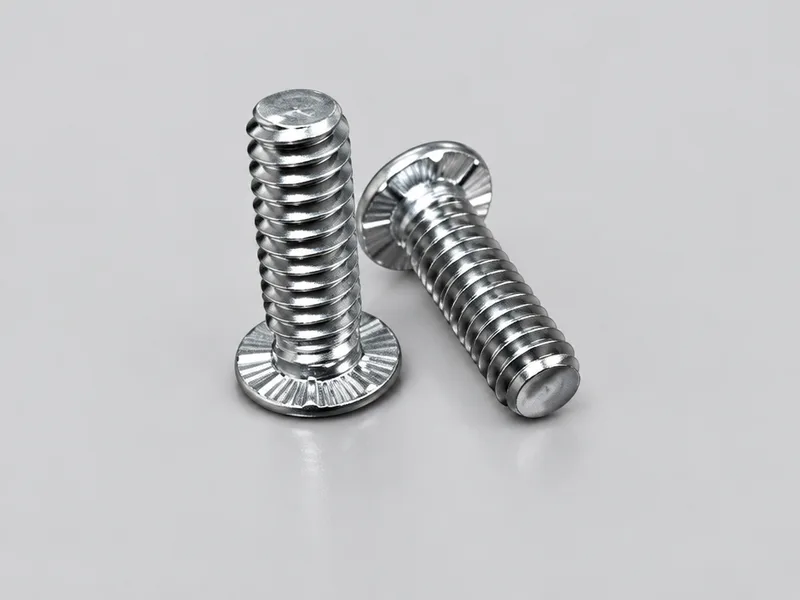
Specifications
The H series is the high-pushout variant of the clinching nut: where a standard S nut is specified by its installation performance, H is built so the clinch resists higher pushout loads and higher torque-out once it is in the sheet — the two failure modes that matter when a mounted nut will see repeated service tightening. The HNL variant adds a self-locking (prevailing-torque) thread on the same clinch. The collected bulletin states H nuts meet prevailing torque requirements for IFI 100/107 Grade B (unified) and ANSI B18.16.1M (metric), and that HNL head projections may flatten during installation without harm to self-locking or self-clinching performance — a useful practical note for tight squeeze cycles. H is rated for sheets of HRB 80 (HB 150) or less; HNL for HRB 60 (HB 107) or less. The geometry runs a thick single-shank ladder — shank and minimum sheet are both 1.48 mm metric (.058 in. unified) across the tabulated M6–M10 / 1/4-20–3/8-16 range — and the performance table samples H at M10: 22 kN installation, 1760 N pushout, 21.5 N·m torque-out in 2.29 mm 5052-H34 aluminum, 33 kN / 2020 N / 27.1 N·m in 2.24 mm cold-rolled steel.
| Type | H: non-locking clinch nut with high pushout and torque-out resistance; HNL: self-locking (prevailing-torque) variant |
|---|---|
| Standards conformance | Meets prevailing torque requirements of IFI 100/107 Grade B (unified) and ANSI B18.16.1M (metric), as stated in the collected bulletin |
| Unified sizes (type availability in collected table) | .250-20, .312-18, .375-16; HNL available in all three; H also listed at .375-16 |
| Metric sizes (type availability in collected table) | M6, M8, M10; HNL available in all three; H also listed at M10 |
| Shank A max / minimum sheet thickness | Unified: .058 in. shank into .058 in. minimum sheet across .250-20 to .375-16; metric: 1.48 mm shank into 1.48 mm minimum sheet across M6 to M10 (single-shank ladder — no code ladder in the collected table) |
| Hole diameter (sampled, max / min) | 1/4-20: .344 / .343 in.; 5/16-18: .413 / .412; 3/8-16: .500 / .499; M6: 8.75 / 8.72 mm; M8: 10.5 / 10.47; M10: 12.7 / 12.67 |
| Head C / E, sampled | 1/4-20: .500 / .189 in.; 3/8-16: .650 / .300; M6: 12.7 / 5 mm; M10: 16.5 / 7.9 — head-height (T) columns are not cleanly aligned in the text layer and stay unrendered |
| Performance (sampled, H at M10 / .375-16) | 2.29 mm 5052-H34 aluminum sheet: 22 kN installation, 1760 N pushout, 21.5 N·m torque-out; 2.24 mm cold-rolled steel (.088 in.): 33 kN (7400 lbs), 2020 N (460 lbs), 27.1 N·m (240 in.-lbs) (collected CL performance table) |
| Panel limits | H: sheets HRB 80 / HB 150 or less; HNL: sheets HRB 60 / HB 107 or less |
| Installation note | HNL head projections may flatten during installation without harm to self-locking or self-clinching performance |
| MOQ / lead time | Not owner-confirmed for this family — confirmed at quotation |
| Type | Thread | Test sheet | Installation force | Pushout | Torque-out |
|---|---|---|---|---|---|
| H | .375-16 (3/8-16) | .090 in. 5052-H34 aluminum | 4900 lbs | 380 lbs | 190 in.-lbs |
| H | .375-16 (3/8-16) | .088 in. cold-rolled steel | 7400 lbs | 460 lbs | 240 in.-lbs |
| H | M10 x 1.5 | 2.29 mm 5052-H34 aluminum | 22 kN | 1760 N | 21.5 N·m |
| H | M10 x 1.5 | 2.24 mm cold-rolled steel | 33 kN | 2020 N | 27.1 N·m |
Materials
- Per RFQ — the collected bulletin section covers type availability and conformance; material/finish codes were not tabulated in the extracted text layer
Ordering & documentation
Documents
Shipments are backed by Mill Test Certificate (MTC), Dimensional Report, Salt Spray Test Report on request, with full batch traceability from raw material to finished product. Quality management follows the owner-confirmed compliance list: ISO 9001:2015, RoHS, REACH. Exact document sets are confirmed on the order.
Quotation
- The fastener family (H / HNL High Pushout Self-Clinching Nuts) plus the standard designation from your drawing — DIN / ISO / JIS / ASTM / ANSI, or a drawing for custom parts.
- Size (diameter and length), thread type (metric or inch), property class or grade, and coating or finish.
- Quantity per size and your target delivery date.
- Destination country, and any required documents (for example a mill test certificate) so the quote includes them.
Sample & supply
Minimum order quantities and lead times for this family are confirmed at quotation — send your sizes, grades and quantities on the RFQ and the quote will carry a firm schedule. Sample availability is confirmed with the quotation.
Storage & shipping
Parts are packed for export and shipped factory-direct to buyers in Europe, Asia, the Americas and the Middle East. Store fasteners dry and protected until installation, and keep coated parts in their packaging until use; specific packing and preservation requirements can be stated on the order and confirmed at quotation.
Frequently asked questions
When is an H nut the right choice over a standard S clinch nut?
When the mounted nut will be tightened repeatedly in service. Pushout is the axial force that can drive the clinch back out of the sheet and torque-out is the rotation resistance of the installed nut — H is specified for higher values of both, so joints with frequent service tightening, heavy accessories, or high installed-torque requirements are the natural fit. HNL adds a self-locking thread to the same clinch when the joint also has to hold without clamp load. Note the panel hardness split: the collected bulletin rates H for HRB 80 or less but HNL only for HRB 60 or less, so the softer-panel constraint applies if you need the locking variant.
What does IFI 100/107 Grade B conformance actually buy me?
It means the prevailing-torque performance of the locking variants is held to a published, testable standard rather than a manufacturer-internal number — IFI 100/107 for unified threads and ANSI B18.16.1M for metric, at Grade B in both. For a design review or a customer spec that references those standards, an HNL selection maps to a documented requirement instead of requiring a custom test. The collected bulletin states the conformance claim; the grade-specific torque values themselves live in the standards, not in this page.
What should an RFQ for these self-clinching standoffs state?
State the series (CFSO steel, CFSOS stainless, or CFSOA aluminum), thread size (for example #10-32 or M4 x 0.7), body size (small or large), nominal length L, sheet material, thickness and hardness, and quantity per size — plus destination country. Commercial terms are confirmed at quotation.
Request a Quote
Get factory-direct pricing from the manufacturer.
What to include in your inquiry
- ✓ Standard and property class (e.g. DIN 912, ISO 4762, class 8.8) — or a drawing for custom parts.
- ✓ Sizes, lengths and thread type (metric or inch).
- ✓ Quantity per size and your target delivery date.
- ✓ Destination country, plus any coating or finish requirement.
- ✓ Any documents you need with the shipment (e.g. mill test certificate) so the quote includes them.
- ✓ Your inquiry goes straight to the factory team by email and gets a reply within 24 hours.
- ✓ Factory-direct pricing
- ✓ Standard and custom specifications
- ✓ Factory-direct export to buyers in Europe, Asia, the Americas and the Middle East
- ✓ Full fastener family support