
Series S / CLS / SP Self-Clinching Nuts
The standard self-clinching nut series — S in zinc-plated steel for steel or aluminium sheets, CLS in stainless for softer steel or aluminium, SP in hardened stainless for stainless-steel panels — internal 2B / 6H threads, M2 to M12 metric and #2-56 to 1/2-20 unified.
Last updated: 2026-11
Specifications
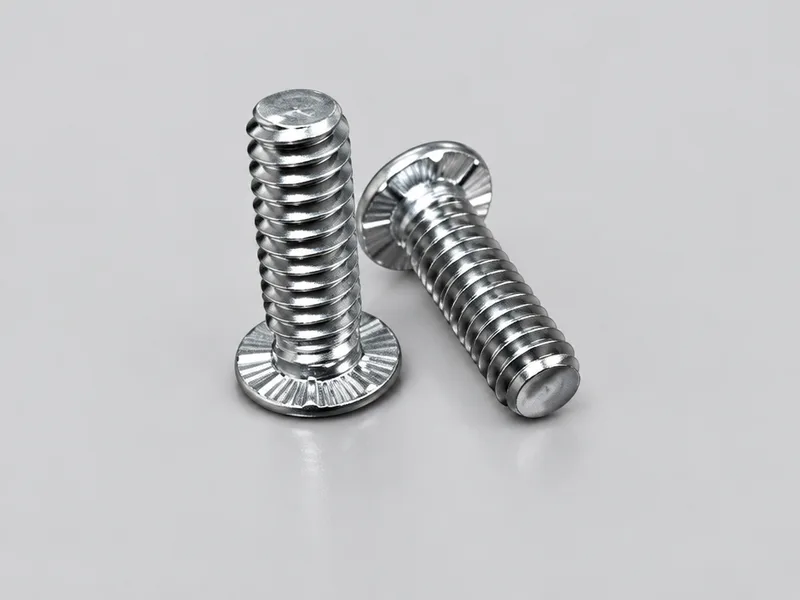
Series S, CLS and SP are the baseline self-clinching nuts: a knurled shank with an internal thread that presses into a pre-punched hole and cold-flows the sheet into a groove, giving a flush, permanent, reusable thread in sheet too thin to tap. The series differ by the panel they are meant for: S is the carbon-steel, zinc-plated version recommended for steel or aluminium sheets at HRB 80 / HB 150 hardness or less; CLS is the stainless version for the same panels at HRB 70 / HB 125 or less; and SP, in hardened stainless, is recommended for stainless-steel sheets at HRB 90 / HB 192 or less. Threads are internal 2B per ASME B1.1 (unified) and 6H per ASME B1.13M (metric), with inch sizes from #2-56 to 1/2-20 and metric from M2 x 0.4 to M12 x 1.75 tabulated, each with per-shank-length minimum sheet thickness and mounting-hole columns. Where the panel is aluminium and weight matters most, the all-aluminium CLA variant serves the same holes at a lower sheet-hardness ceiling (HRB 50 / HB 82 or less).
| Series | S (steel, zinc plated) / CLS (stainless) / SP (hardened stainless) — standard self-clinching nuts |
|---|---|
| Recommended panels | S and CLS: steel or aluminium sheets HRB 80 / HB 150 or less (CLS: HRB 70 / HB 125 or less); SP: stainless-steel sheets HRB 90 / HB 192 or less |
| Thread range (metric) | M2 x 0.4 to M12 x 1.75 — internal 6H per ASME B1.13M |
| Thread range (unified) | #2-56 to 1/2-20 — internal 2B per ASME B1.1 |
| Hole diameter, sampled (max / min, mm) | M4: 5.41 / 5.38 · M6: 8.75 / 8.73 · M10: 14.0 / 13.97 |
| Head C / E / T, sampled (mm) | M4: 7.87 / 2.0 / 6.9 · M6: 11.18 / 4.08 / 8.6 · M10: 17.35 / 7.48 / 13.5 |
| Shank length A vs min sheet, sampled (mm) | M4: 0.97 shank into 1.0 mm sheet (code 1) / 1.38 into 1.4 (code 2); M6: 2.21 into 2.29 (code 2); M10: 2.21 into 2.29 (code 1) |
| Finish (steel) | Zinc plated per ASTM B633 (SC1); optional colourless plus / yellow per the collected catalog |
| Performance (sampled, S, 5052-H34 aluminum sheet) | M4 (shank code 1): 11.2–13.4 kN installation, 470 N pushout, 2.6 N·m torque-out (cold-rolled steel: 18–27 kN installation); M10: 22–36 kN installation, 1760 N pushout, 32.7 N·m torque-out (collected CL performance tables, batch x85) |
| Performance (sampled, SP, stainless sheet) | #4-40 in 304 stainless: 8000 lbs installation, 130 lbs pushout, 14 in.-lbs torque-out (cold-rolled steel: 9000 / 165 / 17); M3: 40 kN, 725 N, 1.92 N·m (collected CL performance table, batch x85) |
| MOQ / lead time | Not owner-confirmed for this family — confirmed at quotation |
| Thread code | Shank code | Installation force (lbs) | Pushout (lbs) | Torque-out (in.-lbs) |
|---|---|---|---|---|
| #2-56 (.086-56) | 0 | 8000 | 130 | 14 |
| #2-56 (.086-56) | 1 | 9000 | 165 | 17 |
| #2-56 (.086-56) | 2 | 10000 | 290 | 18 |
| #4-40 (.112-40) | 0 | 8000 | 130 | 14 |
| #4-40 (.112-40) | 1 | 9000 | 165 | 17 |
| #4-40 (.112-40) | 2 | 10000 | 290 | 18 |
| #6-32 (.138-32) | 0 | 8500 | 140 | 18 |
| #6-32 (.138-32) | 1 | 9500 | 170 | 24 |
| #6-32 (.138-32) | 2 | 10500 | 340 | 28 |
| #8-32 (.164-32) | 0 | 9000 | 145 | 30 |
| #8-32 (.164-32) | 1 | 10000 | 180 | 37 |
| #8-32 (.164-32) | 2 | 11000 | 360 | 45 |
| #10-24/.190-24, #10-32/.190-32 | 0 | 9500 | 180 | 35 |
| #10-24/.190-24, #10-32/.190-32 | 1 | 10500 | 230 | 45 |
| #10-24/.190-24, #10-32/.190-32 | 2 | 11500 | 400 | 60 |
| 1/4-20 (.250-20) | 1 | 13500 | 450 | 150 |
| 1/4-20 (.250-20) | 2 | 13500 | 600 | 170 |
| 5/16-18 (.313-18) | 1 | 14800 | 470 | 170 |
| 5/16-18 (.313-18) | 2 | 14800 | 750 | 250 |
| 5/16-24 (.313-24) | 1 | 14800 | 470 | 170 |
| 5/16-24 (.313-24) | 2 | 14800 | 750 | 250 |
| 3/8-16/.375-16, 3/8-24/.375-24 | 1 | 16000 | 600 | 300 |
| 3/8-16/.375-16, 3/8-24/.375-24 | 2 | 20000 | 700 | 370 |
- Row 16 (1/4-20 (.250-20)): Shank code 0 is not printed for 1/4-20 through 3/8 in the collected table — the ladder starts at code 1.
| Thread | Shank code | Installation force (kN) | Pushout (N) | Torque-out (N·m) |
|---|---|---|---|---|
| M2 x 0.4 | 1 | 40 | 725 | 1.92 |
| M2 x 0.4 | 2 | 44.5 | 1290 | 2.03 |
| M2 x 0.4 | 0 | 35.6 | 575 | 1.58 |
| M2.5 x 0.45 | 1 | 40 | 725 | 1.92 |
| M2.5 x 0.45 | 2 | 44.5 | 1290 | 2.03 |
| M2.5 x 0.45 | 0 | 35.6 | 575 | 1.58 |
| M3 x 0.5 | 1 | 40 | 725 | 1.92 |
| M3 x 0.5 | 2 | 44.5 | 1290 | 2.03 |
| M3 x 0.5 | 0 | 35.6 | 575 | 1.58 |
| M4 x 0.7 | 1 | 44.5 | 800 | 4.18 |
| M4 x 0.7 | 2 | 49 | 1600 | 5.08 |
| M4 x 0.7 | 0 | 40 | 645 | 3.38 |
| M5 x 0.8 | 1 | 46.7 | 1025 | 5.08 |
| M5 x 0.8 | 2 | 51.2 | 1775 | 6.77 |
| M6 x 1 | 1 | 60 | 2000 | 17 |
| M6 x 1 | 2 | 60 | 2600 | 19 |
| M8 x 1.25 | 1 | 66 | 2100 | 19 |
| M8 x 1.25 | 2 | 80 | 4500 | 23 |
| M10 x 1.5 | 1 | 80 | 2150 | 38 |
- Row 19 (M10 x 1.5): The M10 steel-sheet row prints with no values in the collected text layer and is not rendered; the M10 row above is the printed 304-stainless-sheet figure.
Materials
- Steel, zinc plated (S)
- Stainless steel (CLS)
- Hardened stainless steel (SP)
Ordering & documentation
Documents
Shipments are backed by Mill Test Certificate (MTC), Dimensional Report, Salt Spray Test Report on request, with full batch traceability from raw material to finished product. Quality management follows the owner-confirmed compliance list: ISO 9001:2015, RoHS, REACH. Exact document sets are confirmed on the order.
Quotation
- The fastener family (Series S / CLS / SP Self-Clinching Nuts) plus the standard designation from your drawing — DIN / ISO / JIS / ASTM / ANSI, or a drawing for custom parts.
- Size (diameter and length), thread type (metric or inch), property class or grade, and coating or finish.
- Quantity per size and your target delivery date.
- Destination country, and any required documents (for example a mill test certificate) so the quote includes them.
Sample & supply
Minimum order quantities and lead times for this family are confirmed at quotation — send your sizes, grades and quantities on the RFQ and the quote will carry a firm schedule. Sample availability is confirmed with the quotation.
Storage & shipping
Parts are packed for export and shipped factory-direct to buyers in Europe, Asia, the Americas and the Middle East. Store fasteners dry and protected until installation, and keep coated parts in their packaging until use; specific packing and preservation requirements can be stated on the order and confirmed at quotation.
Frequently asked questions
S, CLS or SP — which series for my panel?
Match the series to the sheet, not the screw. Carbon-steel or aluminium panels take S (zinc-plated steel) as the default, or CLS (stainless) where the panel hardness sits at the top of the S range — the collected catalog rates CLS one hardness band lower (HRB 70 / HB 125 vs HRB 80 / HB 150). Stainless-steel panels are the SP series' territory, rated for sheet at HRB 90 / HB 192 or less. The three share the same installation practice and hole preparation, so the panel material and hardness decide the quote.
How is the mounting hole sized and why does shank length matter?
Each thread size has a tabulated hole column — sampled at M4: 5.41 mm maximum / 5.38 mm minimum; M6: 8.75 / 8.73. The nut ships in shank-length codes, and the catalog's standing recommendation is to use the maximum shank length your sheet thickness allows: the longer shank puts more cold-flowed material into the groove, which is what carries push-out and torque-out. Sample pairs from the table: an M4 with the code-1 shank (0.97 mm) serves sheets down to 1.0 mm; the code-2 shank (1.38 mm) serves sheets down to 1.4 mm.
What should an RFQ for these self-clinching nuts state?
State the series (self-locking CFE/CFEO or non-locking CFEX/CFEOX), thread size and pitch (for example #10-32, 1/4-28, M4 x 0.7), sheet material and thickness, and sheet hardness where known (the collected sheet rates use in materials up to Rockwell B-70), plus quantity per size and destination country. Commercial terms are confirmed at quotation.
Request a Quote
Get factory-direct pricing from the manufacturer.
What to include in your inquiry
- ✓ Standard and property class (e.g. DIN 912, ISO 4762, class 8.8) — or a drawing for custom parts.
- ✓ Sizes, lengths and thread type (metric or inch).
- ✓ Quantity per size and your target delivery date.
- ✓ Destination country, plus any coating or finish requirement.
- ✓ Any documents you need with the shipment (e.g. mill test certificate) so the quote includes them.
- ✓ Your inquiry goes straight to the factory team by email and gets a reply within 24 hours.
- ✓ Factory-direct pricing
- ✓ Standard and custom specifications
- ✓ Factory-direct export to buyers in Europe, Asia, the Americas and the Middle East
- ✓ Full fastener family support