
Heli-Coil Insert Length Selection — by Parent-Material and Screw Strength (AS7245)
The Heli-Coil catalogue selection matrix: insert length in nominal thread diameters, by parent-material ultimate strength (70–350 MPa rows) against screw ultimate strength (300–1000 MPa columns), so the insert — not the weakened parent thread — carries the bolt load. Transcribed row-for-row from the collected chart.
Last updated: 2026-11
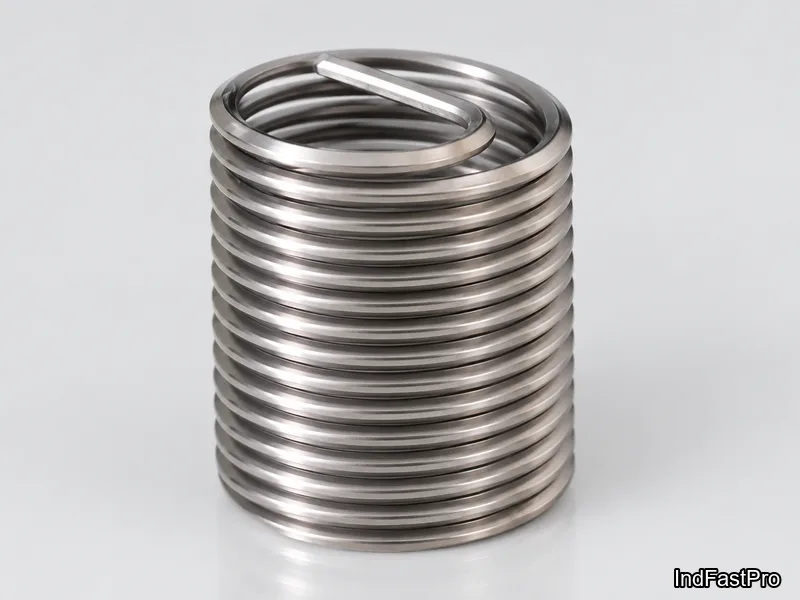
Specifications
A wire insert is only worth installing if it is long enough that the insert, not the soft parent thread around it, becomes the load path — and its catalogue answers that with one small matrix. The collected chart prints insert length in nominal diameters (AS7245 material spec): seven rows of parent-material ultimate strength from 70 to 350 MPa, six columns of screw ultimate strength from 300 to 1000 MPa, each cell the minimum length — in multiples of the thread diameter — that distributes the screw's preload over enough coils to exhaust the screw's strength before the parent thread strips. The gradient tells the design story: weak parents demand long inserts (a 300 MPa screw into 70 MPa material needs 3.5×D; the same screw into 350 MPa material needs 1×D), and strong screws push lengths up everywhere (a 1000 MPa screw never gets below 1.5×D). Above the diagonal the chart refuses: at 70 MPa parent strength, the 800 and 1000 MPa screw columns print "-" — the pairing is not offered, because no reasonable insert length rescues a parent that soft; the design needs a stronger boss material or a different fastening strategy, not a longer coil. Reading notes carried from the source: decimal commas are reproduced verbatim, and the matrix is a selection aid, not a per-size dimension ladder — free length and tapped-hole drill data per thread size are not tabulated here and stay on the RFQ (that gap is a registered acquisition gap). Installation tooling, screw torque and locking variants are likewise RFQ items.
| Chart type | Insert length selection matrix — rows: parent-material UTS 70/100/150/200/250/300/350 MPa; columns: screw UTS 300/400/500/600/800/1000 MPa |
|---|---|
| Cell value | Minimum insert length in nominal thread diameters (×D), AS7245 material spec — e.g. 70 MPa parent / 300 MPa screw → 1,5×D; 100 MPa / 1000 MPa → 3×D (decimal commas as printed) |
| Selection rule | Insert long enough that the screw fails before the parent thread strips — read the cell at your parent strength row and screw strength column |
| Uncharted pairings | 70 MPa parent with 800/1000 MPa screws prints "-" — no insert length offered; change boss material or fastening strategy (per RFQ) |
| Not tabulated | Per-thread-size free lengths, tapped-hole dimensions, installation tooling, screw engagement torque — per RFQ (registered acquisition gap) |
| Parent Material UTS (MPa) | Screw UTS 300 MPa | Screw UTS 400 MPa | Screw UTS 500 MPa | Screw UTS 600 MPa | Screw UTS 800 MPa | Screw UTS 1000 MPa |
|---|---|---|---|---|---|---|
| 70 | 1,5 | 2 | 2,5 | 3,5 | - | - |
| 100 | 1 | 1,5 | 1,5 | 2 | 2,5 | 3 |
| 150 | 1 | 1 | 1,5 | 1,5 | 2 | 2 |
| 200 | 1 | 1 | 1 | 1 | 1,5 | 1,5 |
| 250 | 1 | 1 | 1 | 1 | 1 | 1,5 |
| 300 | 1 | 1 | 1 | 1 | 1 | 1,5 |
| 350 | 1 | 1 | 1 | 1 | 1 | 1,5 |
- Row 1 (70): At 70 MPa parent strength the two highest screw-strength columns print "-" — the source lists no insert length for that combination (the parent is too weak for the pairing); the design needs a different strategy, per RFQ.
Materials
- Insert wire per AS7245 (stainless as standard in the spec line); parent alloys are the row variable — state parent material and its strength at RFQ
Ordering & documentation
Documents
Shipments are backed by Mill Test Certificate (MTC), Dimensional Report, Salt Spray Test Report on request, with full batch traceability from raw material to finished product. Quality management follows the owner-confirmed compliance list: ISO 9001:2015, RoHS, REACH. Exact document sets are confirmed on the order.
Quotation
- The fastener family (Heli-Coil Insert Length Selection — by Parent-Material and Screw Strength (AS7245)) plus the standard designation from your drawing — DIN / ISO / JIS / ASTM / ANSI, or a drawing for custom parts.
- Size (diameter and length), thread type (metric or inch), property class or grade, and coating or finish.
- Quantity per size and your target delivery date.
- Destination country, and any required documents (for example a mill test certificate) so the quote includes them.
Sample & supply
Minimum order quantities and lead times for this family are confirmed at quotation — send your sizes, grades and quantities on the RFQ and the quote will carry a firm schedule. Sample availability is confirmed with the quotation.
Storage & shipping
Parts are packed for export and shipped factory-direct to buyers in Europe, Asia, the Americas and the Middle East. Store fasteners dry and protected until installation, and keep coated parts in their packaging until use; specific packing and preservation requirements can be stated on the order and confirmed at quotation.
Frequently asked questions
How do I use the ×D length figure once I have it, and why does the chart refuse some combinations outright?
The cell value is a multiplier on your thread diameter: a 1,5×D figure on an M8 bolt calls a 12 mm engaged insert length (decimal commas as printed), which then selects the catalogue's nearest standard length and, with it, the tapped-hole depth the installation needs. Read the matrix at the honest row: the parent material's actual ultimate strength, not its grade name — a "cast iron" row at 150 MPa behaves like the 100 MPa row if the boss is thin. The refusals are the chart teaching its own limit: the "-" cells at 70 MPa parent strength under 800–1000 MPa screws mean the parent is so weak that no practical insert length distributes the load before the parent shears — every added coil adds load to the same soft material. There the design moves, not the insert: increase the boss section, switch to a harder parent alloy, or move to a pressed-in key-locking insert whose mechanical anchoring does not rely on thread flank contact. What the chart cannot decide: the per-thread-size dimension ladder (free length, drill and tap data — not tabulated in published references (a registered gap)), the screw's own torque limit after insertion, and locking vs free-running variants — bring the bolt size and parent spec to the RFQ and those come back with the quote.
Commercial terms for wire thread inserts?
Commercial terms are confirmed at quotation.
Request a Quote
Get factory-direct pricing from the manufacturer.
What to include in your inquiry
- ✓ Standard and property class (e.g. DIN 912, ISO 4762, class 8.8) — or a drawing for custom parts.
- ✓ Sizes, lengths and thread type (metric or inch).
- ✓ Quantity per size and your target delivery date.
- ✓ Destination country, plus any coating or finish requirement.
- ✓ Any documents you need with the shipment (e.g. mill test certificate) so the quote includes them.
- ✓ Your inquiry goes straight to the factory team by email and gets a reply within 24 hours.
- ✓ Factory-direct pricing
- ✓ Standard and custom specifications
- ✓ Factory-direct export to buyers in Europe, Asia, the Americas and the Middle East
- ✓ Full fastener family support