
Internal Self-Locking Retaining Rings — Thrust Load (Inch Series)
Internal self-locking retaining rings for inch housings 5/16 to 1-1/2 in: ring thickness, ring diameter, margin and static thrust load per housing bore — the grooveless retaining ladder for bores.
Last updated: 2026-11
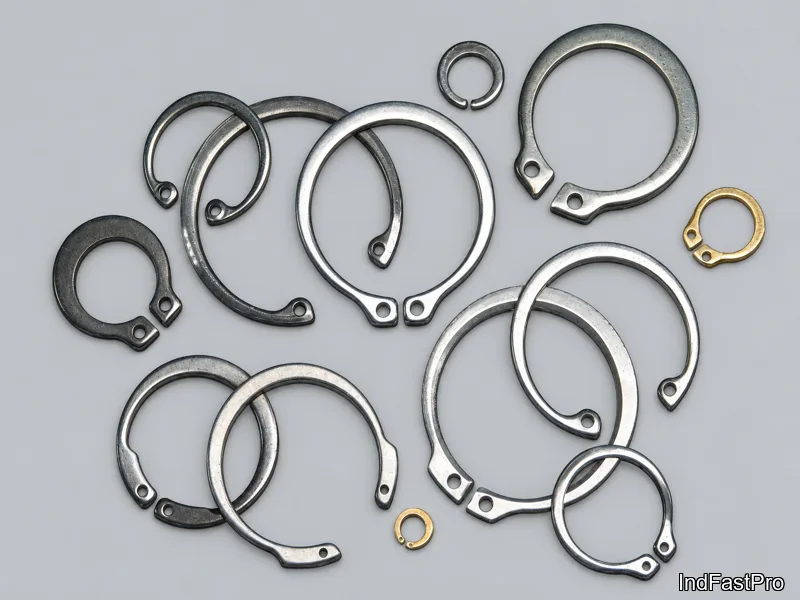
Specifications
The internal counterpart of the push-on shaft ring springs into a plain bore and holds by tension — no groove machining in the housing. The collected ladder runs housing bores 0.311-0.313 through 1.498-1.502 in: thickness 0.010 in through the 0.627 size, 0.015 from 0.748 up, ring diameter D from 0.136 up to 1.188 in (the ring sits inside the bore, so its free diameter is smaller than the housing), margin E again 0.040/0.060 by thickness, and static thrust loads of a different character than the external series — 80 lb at the smallest bore, stepping down to 45-50 lb mid-ladder, then 75/70/60 lb on the 0.015 rings. The non-monotonic load column is the collected page's own data: thinner rings at small bores carry more static thrust than at mid bores because the load scales with ring section relative to circumference, and the table prints it as measured, not smoothed. Applications are the plastic-housing, die-cast and sheet-metal-bore cases where cutting a groove would cost the housing its integrity — and where the 45-80 lb static ceiling is comfortably above the axial load a light mechanism sees.
| Series / scope | Internal self-locking retaining rings, inch housing bores 0.311 to 1.502 in — ring dimensions and static thrust load per bore size band (Min./Max. D) |
|---|---|
| Ring thickness T | 0.010 in through the 0.627 bore, 0.015 in from 0.748 up — as printed |
| Ring diameter D / margin E | D 0.136 (0.311 bore) to 1.188 (1.500 bore); E 0.040 on 0.010 rings, 0.060 on 0.015 rings |
| Static thrust load | 80 lb at 5/16 bore, 75/70/60/50/45 stepping down through 0.627, then 75 (0.748), 70, 70, 70 (1.000), 60 (1.250-1.500) — the non-monotonic ladder as printed |
| Not tabulated | Grooved internal rings (DIN 472 / inch grooved identities), housing material limits, material/tempers — per RFQ |
Materials
- Spring-temper carbon or stainless, installed expanded into the bore; the thrust figures assume a plain bore of the tabulated diameter in a housing that does not relax under ring pressure — soft plastics may need a heavier ring or a different retaining method. Specify material and bore tolerance on the RFQ; the collected page carries dimensions and static load only
Ordering & documentation
Documents
Shipments are backed by Mill Test Certificate (MTC), Dimensional Report, Salt Spray Test Report on request, with full batch traceability from raw material to finished product. Quality management follows the owner-confirmed compliance list: ISO 9001:2015, RoHS, REACH. Exact document sets are confirmed on the order.
Quotation
- The fastener family (Internal Self-Locking Retaining Rings — Thrust Load (Inch Series)) plus the standard designation from your drawing — DIN / ISO / JIS / ASTM / ANSI, or a drawing for custom parts.
- Size (diameter and length), thread type (metric or inch), property class or grade, and coating or finish.
- Quantity per size and your target delivery date.
- Destination country, and any required documents (for example a mill test certificate) so the quote includes them.
Sample & supply
Minimum order quantities and lead times for this family are confirmed at quotation — send your sizes, grades and quantities on the RFQ and the quote will carry a firm schedule. Sample availability is confirmed with the quotation.
Storage & shipping
Parts are packed for export and shipped factory-direct to buyers in Europe, Asia, the Americas and the Middle East. Store fasteners dry and protected until installation, and keep coated parts in their packaging until use; specific packing and preservation requirements can be stated on the order and confirmed at quotation.
Frequently asked questions
Why does the thrust column go down then back up across the size ladder?
Because two effects pull against each other and the collected table prints the net result. Thrust capacity scales with ring cross-section relative to its circumference: at the smallest bores the 0.010 ring is proportionally stout (80 lb at 5/16), mid-bores dilute the same strip around more circumference (down to 45 lb at 0.627), and from 0.748 the strip steps to 0.015 in — the thicker section lifts the rating back to 75/70 before the circumference catches up again and it settles at 60 lb by 1-1/4 to 1-1/2. It is measured data, not a smoothing error, and the practical read is not to interpolate: a 0.62 bore ring is rated 45 lb while the 0.75 bore ring next to it is rated 75. Check the exact bore row against the ladder and keep the application's static load — plus shock allowance — under the printed figure.
How does an internal self-locking ring stay in a bore without a groove?
On radial spring force. The ring is installed expanded (internal rings are wound to a free diameter smaller than the bore) and the resulting outward push generates friction and a light axial bite against the bore wall — enough for the 45-80 lb static ratings on this ladder in a housing that holds its dimensions. That assumption is the series' weak point: a soft plastic bore that cold-flows under ring pressure, or a bore at the loose end of its tolerance, can let the ring spin or walk. The collected page gives geometry and static load, not housing-material guidance, so treat soft housings as an engineering question — and where the load, shock or housing softness exceeds what the ladder supports, the grooved internal ring (DIN 472 and the inch grooved identities) is the retaining method that actually anchors into the part.
Request a Quote
Get factory-direct pricing from the manufacturer.
What to include in your inquiry
- ✓ Standard and property class (e.g. DIN 912, ISO 4762, class 8.8) — or a drawing for custom parts.
- ✓ Sizes, lengths and thread type (metric or inch).
- ✓ Quantity per size and your target delivery date.
- ✓ Destination country, plus any coating or finish requirement.
- ✓ Any documents you need with the shipment (e.g. mill test certificate) so the quote includes them.
- ✓ Your inquiry goes straight to the factory team by email and gets a reply within 24 hours.
- ✓ Factory-direct pricing
- ✓ Standard and custom specifications
- ✓ Factory-direct export to buyers in Europe, Asia, the Americas and the Middle East
- ✓ Full fastener family support