
Retaining Ring Thrust Load Capacity (Ring vs Groove)
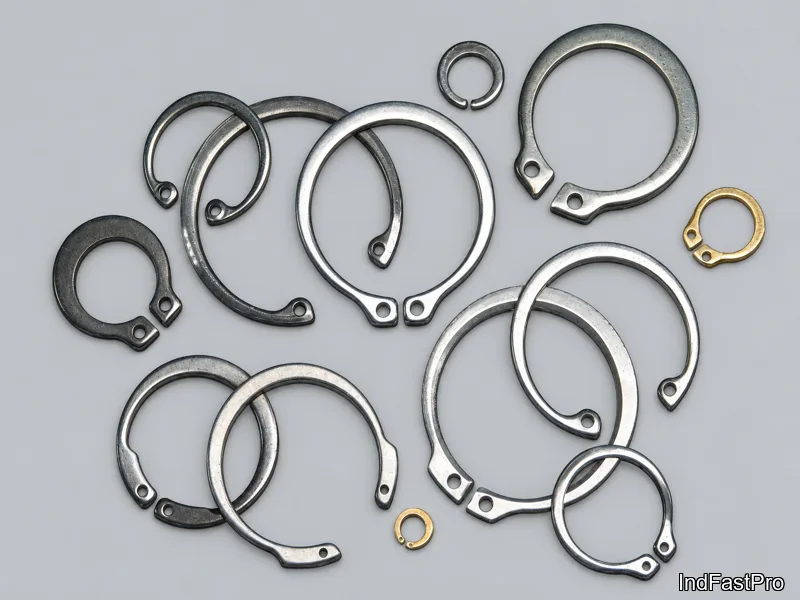
Inch-series retaining ring thrust capacity ladder, 5/64 to 3/4 in shafts: ring free diameter and thickness, groove diameter/width/margin, and static thrust load split ring-side vs groove-side — where small shafts carry the load on the ring and larger ones on the groove.
Last updated: 2026-11
Specifications
This collected ladder answers the question the other thrust tables leave open: when the shaft is tiny, the groove — not the ring — is the weak link. For shafts 0.078 to 0.158 in, the grid prints no groove geometry at all: the groove cells carry the source's own note, "The use of grooves with these shaft sizes is not suggested," and the thrust rating is ring-side only, 10 to 22 lb. From 0.185 in the groove columns open up — groove diameter G, width W, margin E — and the split becomes explicit: at 0.250 shaft the ring carries 35 lb while the groove assembly carries 90; at 1/2 in, 65 vs 390; at 3/4 in, 90 vs 845. The groove, not the ring, is what a grooved installation is actually rated through, and the ratio widens with size. The page also shows the series' geometry: free diameter A runs under shaft nominal (0.470 at 1/2) so the ring snaps to grip, thickness T steps 0.025 to 0.062, and groove width W (0.041-0.069) is slightly larger than T. The source's "Optical Groove" header spelling and the "1Static" footnote marker stuck to the thrust header are carried verbatim and flagged.
| Series / scope | Inch-series retaining rings with grooves, shafts 0.078 to 0.755 in — ring geometry, groove geometry and static thrust load carried separately for ring and groove |
|---|---|
| Shaft D (min/max) / ring | Free diameter A and thickness T per band: A 0.074 at 0.079 shaft to 0.706 at 0.750; T 0.025 (small shafts) / 0.035 / 0.042 / 0.050 / 0.062 (0.622+) as printed |
| Groove geometry | Diameter G / width W / margin E from 0.185 shaft up: G 0.240 / W 0.041 / E 0.030 at 0.250 shaft; G 0.478 / W 0.056 / E 0.040 at 0.500; G 0.718 / W 0.069 / E 0.050 at 0.750. Shafts 0.078-0.158: grooves not suggested (source note spanning the cells, carried verbatim) |
| Static thrust load — ring | 10 lb at 0.079 shaft, 20-22 through 0.158, 25 (0.187), 35 (0.250), 50 (0.310), 55 (0.373), 60 (0.434), 65 (0.500), 85 (0.622), 90 lb (0.750) |
| Static thrust load — groove | 0 for the no-groove small shafts as printed; 90 lb at 0.250, 110 (0.310), 185 (0.373), 280 (0.434), 390 (0.500), 570 (0.622), 845 lb (0.750) — the grooved-assembly rating |
| Not tabulated | Housing-side (internal) grooved ratings, materials, dynamic/shock derating — per RFQ |
Materials
- Spring-temper carbon and stainless rings; the thrust split assumes the groove is cut to the tabulated G/W/E in a shaft material that does not plasticly flow under the groove's edge loading — in soft shafts the groove itself can be the early failure even above 0.25 in. Keep shock loads well under the static figures and specify material pairings on the RFQ; the collected page carries geometry and static ratings only
Ordering & documentation
Documents
Shipments are backed by Mill Test Certificate (MTC), Dimensional Report, Salt Spray Test Report on request, with full batch traceability from raw material to finished product. Quality management follows the owner-confirmed compliance list: ISO 9001:2015, RoHS, REACH. Exact document sets are confirmed on the order.
Quotation
- The fastener family (Retaining Ring Thrust Load Capacity (Ring vs Groove)) plus the standard designation from your drawing — DIN / ISO / JIS / ASTM / ANSI, or a drawing for custom parts.
- Size (diameter and length), thread type (metric or inch), property class or grade, and coating or finish.
- Quantity per size and your target delivery date.
- Destination country, and any required documents (for example a mill test certificate) so the quote includes them.
Sample & supply
Minimum order quantities and lead times for this family are confirmed at quotation — send your sizes, grades and quantities on the RFQ and the quote will carry a firm schedule. Sample availability is confirmed with the quotation.
Storage & shipping
Parts are packed for export and shipped factory-direct to buyers in Europe, Asia, the Americas and the Middle East. Store fasteners dry and protected until installation, and keep coated parts in their packaging until use; specific packing and preservation requirements can be stated on the order and confirmed at quotation.
Frequently asked questions
Why does the table say grooves are "not suggested" below 0.158 in — and what replaces them?
Scale, on both sides of the joint. A groove 0.025 in wide and a few thousandths deep in a 1/8 in shaft removes a large fraction of the shaft's section — the stress concentration lands on a part that no longer has spare material — and the groove itself is too small to cut and inspect reliably in production. So the collected ladder gives those shafts ring geometry only and rates the assembly through the ring (10-22 lb static). What replaces the groove: the self-locking push-on rings for plain-shaft retention (a separate identity on this ladder's external side), or a redesign that moves the retaining function to a shoulder, a clip or a larger shaft. The engineering rule the table encodes: below a threshold, do not thin the shaft to gain retention — choose a retaining method that does not cut the shaft at all.
The load columns split "Ring" and "Groove" — which number applies to my assembly?
Both, sequentially — the assembly rating is the smaller of the two, and the table exists to show which one governs. A grooved installation fails either by the ring breaking/unthreading (ring rating: 65 lb at 1/2 in) or by the groove shearing, spreading or its edge flowing (groove rating: 390 lb at the same size). Above roughly 0.25 in shaft the groove governs by a widening margin — 90 vs 845 lb at 3/4 — because a properly cut groove in steel is a robust feature while the spring ring stays a light snap-fit part. So: the ring number is what you get if the groove is missing, undersized or soft; the groove number is the assembly rating in a correct steel groove. Below 0.185 in the grid collapses to ring-only because the source declines to recommend grooves at all at those sizes.
Request a Quote
Get factory-direct pricing from the manufacturer.
What to include in your inquiry
- ✓ Standard and property class (e.g. DIN 912, ISO 4762, class 8.8) — or a drawing for custom parts.
- ✓ Sizes, lengths and thread type (metric or inch).
- ✓ Quantity per size and your target delivery date.
- ✓ Destination country, plus any coating or finish requirement.
- ✓ Any documents you need with the shipment (e.g. mill test certificate) so the quote includes them.
- ✓ Your inquiry goes straight to the factory team by email and gets a reply within 24 hours.
- ✓ Factory-direct pricing
- ✓ Standard and custom specifications
- ✓ Factory-direct export to buyers in Europe, Asia, the Americas and the Middle East
- ✓ Full fastener family support