
Retaining Rings
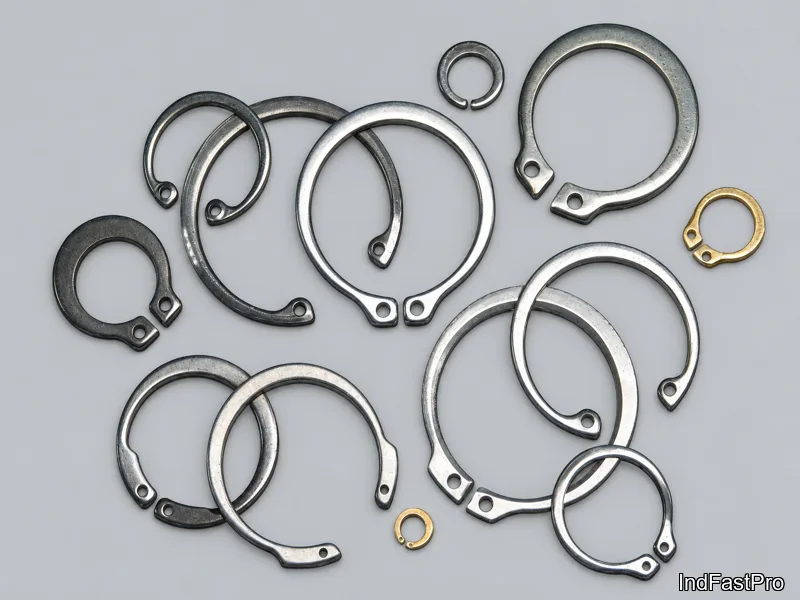
Metric DIN 471 external and DIN 472 internal retaining rings (circlips) are thin, circular, metal stampings used to prevent movement between mating components, reducing vibration and maintaining proper position while permitting easy disassembly.
Last updated: 2026-11
Specifications
Industry-standard reference ranges — availability confirmed per quotation; not a stocked-range claim.
| types | Metric DIN 472 Internal Retaining Rings (aka circlips) are thin, circular, metal stampings that are used to prevent movement between mating components.; Metric DIN 471 External Retaining Rings (aka circlips) are thin, circular, metal stampings that are used to prevent movement between mating components. |
|---|---|
| sizes | ring d1 16; 1; 14.7; 3.7; 2.2; 1.7; 0.7; 15.2; 1.1; 0.4; 1.2; 23.8; 3.26; 7.4; 1; 2.4; 45000; ring d1 210; 5; 198; 14; 14; 4; 248; 204; 5.15; 3; 9; 240; 325; 598; 6; 59.9; 1835; ring d1 9; 0.8; 9.8; 2.5; 1.3; 1; 0.15; 9.4; 0.11; 0.9; 0.2; 0.6; 3.7; 0.96; 2; 1; 1.5; ring d1 290; 5; 305; 16.2; 16; 5; 415; 298; 5.2; 4; 12; 256; 615; 482; 4; 72 |
| standard | Standard note (verbatim): "DIN standards continue to be used for parts which do not have ISO equivalents or for which there is no need for standardization like DIN 472 Retaining Rings.; Standard note (verbatim): "DIN standards continue to be used for parts which do not have ISO equivalents or for which there is no need for standardization like DIN 471 Retaining Rings. |
Materials
- A2 stainless steel
Selection guidance
External versus internal retaining rings, the groove data a drawing must carry, and what to confirm before ordering.
External (DIN 471) or internal (DIN 472)
Both standards cover thin, circular metal stampings that prevent movement between mating components; the difference is where the groove sits. DIN 471 external rings are assembled axially onto a shaft and seat into a groove machined on the outside of the shaft. DIN 472 internal rings are assembled axially into machined grooves in housings and bores, and the tapered section design allows uniform circular deformation and even contact with the groove surface. Both permit easy disassembly by removing the ring.
The collected specification sheets attribute A2 stainless steel to the rings and note that neither DIN 471 nor DIN 472 has an ISO equivalent, so the DIN designations remain the ordering vocabulary. Quote the standard that matches where your groove is machined — shaft groove takes DIN 471, bore groove takes DIN 472.
Groove data and load columns
Every dimension row in the collected sheets pairs the ring geometry (thickness s, clip diameter d3, edge distance d5) with the groove data the drawing must machine: groove diameter d2 and groove width m. The sheets print an H13 tolerance band for the groove diameter column on the 471 sheet, with per-size band markers (h10)/(h11)/(h12)/(h13) on the smaller sizes, and (H11)/(H12)/(H13) markers on the 472 sheet. Sampled verbatim: at nominal shaft diameter 16 mm the 471 sheet lists groove d2 = 15.2 mm and width m = 1.1 mm; at 80 mm, d2 = 76.5 mm and m = 2.65 mm; the 472 sheet lists groove d2 = 9.4 mm at nominal bore 9 mm and d2 = 104 mm at nominal bore 100 mm.
The sheets also tabulate supplementary load columns per size (FN, FR, FRg and the nabl column). In the collected extraction the supplementary column order is layout-ambiguous, so those figures are quoted as whole rows on request rather than rendered as labeled values — ask for the row for your size and it is confirmed from the sheet before quotation. The sheets also list the nominal size of retaining-ring pliers per DIN 5254 per size band.
Ordering & documentation
Documents
Shipments are backed by Mill Test Certificate (MTC), Dimensional Report, Salt Spray Test Report on request, with full batch traceability from raw material to finished product. Quality management follows the owner-confirmed compliance list: ISO 9001:2015, RoHS, REACH. Exact document sets are confirmed on the order.
Quotation
- The fastener family (Retaining Rings) plus the standard designation from your drawing — DIN / ISO / JIS / ASTM / ANSI, or a drawing for custom parts.
- Size (diameter and length), thread type (metric or inch), property class or grade, and coating or finish.
- Quantity per size and your target delivery date.
- Destination country, and any required documents (for example a mill test certificate) so the quote includes them.
Sample & supply
Minimum order quantities and lead times for this family are confirmed at quotation — send your sizes, grades and quantities on the RFQ and the quote will carry a firm schedule. Sample availability is confirmed with the quotation.
Storage & shipping
Parts are packed for export and shipped factory-direct to buyers in Europe, Asia, the Americas and the Middle East. Store fasteners dry and protected until installation, and keep coated parts in their packaging until use; specific packing and preservation requirements can be stated on the order and confirmed at quotation.
Available grades
Each retaining-ring standard has its own specification page — sampled dimension rows, groove diameter and width data, tolerance bands and RFQ guidance per standard.
- DIN 471 External Retaining Rings (for Shafts)
- DIN 472 Internal Retaining Rings (for Bores)
- DIN 6799 Retaining Rings for Shafts (E-Clips)
- External Retaining Rings (Imperial, Series 2100-5100)
- Internal Retaining Rings (Imperial, Series 2000-5000)
- Crescent Retaining Rings for Shafts (Series 2103–5103)
- E-Rings for Shafts, Heavy Duty (Series 2144–5144)
- Heavy Duty External Retaining Rings (Series 2160–5160)
- External Inverted Retaining Rings
- External Shaft Rings, Poodle Style
- DIN 705 Adjusting Rings
- DIN 984 Internal Retaining Rings with Lugs
- External Self-Locking Retaining Rings — Thrust Load (Inch Series)
- Internal Self-Locking Retaining Rings — Thrust Load (Inch Series)
- Retaining Ring Thrust Load Capacity (Ring vs Groove)
Frequently asked questions
DIN 471 or DIN 472 — which do I quote?
It follows the groove: DIN 471 external rings seat into a groove machined on the outside of a shaft; DIN 472 internal rings seat into a groove machined inside a housing or bore. Both assemble axially and remove with retaining-ring pliers, and the collected specification sheets attribute A2 stainless steel to both and note neither has an ISO equivalent.
What groove data does a retaining-ring drawing need?
Groove diameter and groove width, machined to the tolerance band the standard prints for your size — the collected sheets carry an H13 band for the 471 groove column with per-size markers on smaller sizes, and (H11)/(H12)/(H13) markers on the 472 sheet. For example, a 16 mm shaft takes a 15.2 mm groove at 1.1 mm width per the collected sheet; a 100 mm bore takes a 104 mm groove at 3.2 mm width. Sampled rows per standard are on the DIN 471 and DIN 472 specification pages.
What is the MOQ and lead time for retaining rings?
Commercial terms for this family are confirmed at quotation together with sizes and material — state the standard (DIN 471 or DIN 472), the shaft or bore nominal diameter, groove diameter and width, material, and quantity per size on the RFQ.
Request a Quote
Get factory-direct pricing from the manufacturer.
What to include in your inquiry
- ✓ Standard and property class (e.g. DIN 912, ISO 4762, class 8.8) — or a drawing for custom parts.
- ✓ Sizes, lengths and thread type (metric or inch).
- ✓ Quantity per size and your target delivery date.
- ✓ Destination country, plus any coating or finish requirement.
- ✓ Any documents you need with the shipment (e.g. mill test certificate) so the quote includes them.
- ✓ Your inquiry goes straight to the factory team by email and gets a reply within 24 hours.
- ✓ Factory-direct pricing
- ✓ Standard and custom specifications
- ✓ Factory-direct export to buyers in Europe, Asia, the Americas and the Middle East
- ✓ Full fastener family support