
Self-Clinching Nut Dimensions — Inch Series Ladder (#4-40 to 1/4-20)
Head, sheet and installation data for self-clinching nuts across the six-size inch ladder #4-40, #6-32, #8-32, #10-24, #10-32 and 1/4-20 — head diameter, unthreaded length, minimum sheet thickness, edge distance, installation hole size and tightening torque — transcribed row-for-row from the collected chart.
Last updated: 2026-11
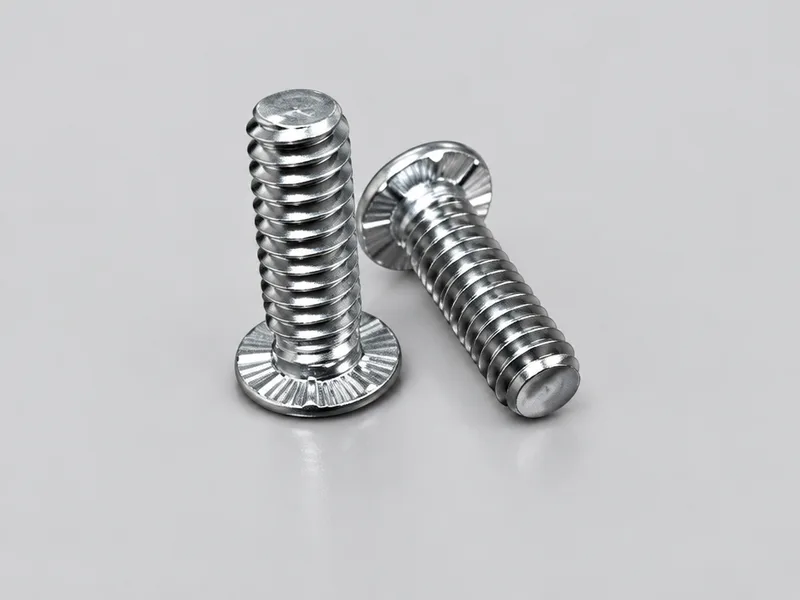
Specifications
A self-clinching nut turns a thin sheet into a threaded boss: the nut is pressed into a punched or drilled hole, its knurled or serrated shoulder displaces sheet material into a retaining groove, and the sheet — as thin as 0.040 in on the small sizes in this chart — carries a reusable machine thread it could never hold tapped. The collected chart tabulates the six-size inch ladder a design needs to lay the hole out: #4-40, #6-32, #8-32, #10-24, #10-32 and 1/4-20, each with head diameter max/min, unthreaded length max/min, minimum sheet thickness, minimum edge distance from hole centre to panel edge, the installation hole size (a +.003/-.000 tolerance band — the clinch depends on hole size within a few thousandths) and the maximum recommended tightening torque in service. Reading the ladder: head diameters run from 0.204/0.172 in on #4 up to 0.344/0.312 on 1/4; the #4 needs only a 7/32 in hole and 0.040 in sheet; 1/4-20 steps up to a 5/16 in hole, 0.062 in sheet and 58 in-lb of torque. Two reading notes carried from the source: the size column prints "10" twice — TPI 24 and 32 distinguish the 10-24 and 10-32 variants (flagged) — and the 1/4 row's unthreaded-length cell prints "135" where the rest of the column runs decimals, almost certainly a lost decimal point (.135), reproduced verbatim and flagged rather than silently repaired. Push-out and torque-out performance, plating and the metric ladder are not tabulated here — per RFQ.
| Family | Self-clinching nuts, inch series; 6-size ladder #4-40 through 1/4-20 (TPI 40/32/32/24/32/20) |
|---|---|
| Per-row data (in) | Head diameter max/min, unthreaded length max/min, min sheet thickness, min edge distance to hole centre, hole size +.003/-.000, max tightening torque (in-lb) |
| Installation hole | Chart-printed sizes: 7/32 (#4) up to 5/16 (1/4-20), tolerance +.003/-.000 — hole accuracy is the clinch, so the printed band governs the panel layout |
| Sheet thickness | Minimum 0.040 in on #4–#10, 0.062 in on 1/4-20 — thinner sheet needs the thin-sheet variant series, per RFQ |
| Torque ceiling (in service) | 5 in-lb (#4) scaling to 58 in-lb (1/4-20) as printed — assembly torque above this risks spin-out of the clinch |
| Not tabulated | Push-out/torque-out performance, plating, metric ladder, stainless/steel variants — per RFQ |
| Nominal Size | Threads Per In. | Head Dia. (A) Max | Head Dia. (A) Min | Unthreaded Length (B) Max | Unthreaded Length (B) Min | Min. Sheet Thickness | Min. Edge Distance to Hole Centre | Hole in Sheet +.003/-.000 | Max. Tightening Torque (in.-lb) |
|---|---|---|---|---|---|---|---|---|---|
| 4 | 40 | .204 | .172 | .085 | .075 | .040 | 7/32 | .111 | 5 |
| 6 | 32 | .235 | .203 | .090 | .080 | .040 | 1/4 | .137 | 9 |
| 8 | 32 | .266 | .234 | .090 | .080 | .040 | 9/32 | .163 | 17 |
| 10 | 24 | .282 | .250 | .090 | .080 | .040 | 9/32 | .189 | 24 |
| 10 | 32 | .282 | .250 | .090 | .080 | .040 | 9/32 | .189 | 27 |
| 1/4 | 20 | .344 | .312 | 135 | .125 | .062 | 5/16 | .249 | 58 |
- Row 5 (10): The size column prints "10" twice (TPI 24 and 32 distinguish the two #10 variants, i.e. 10-24 and 10-32); designation suffixes are the standard reading of the ladder.
- Row 3 (8): The #4 (row 0) B-max column prints "135" for the 1/4 size where the rest of the column runs decimals (.085–.090) — the source cell almost certainly lost its decimal point (.135); reproduced verbatim, flagged.
Materials
- Steel and stainless body variants exist across the family; the chart is geometry data — state panel material and hardness at RFQ (clinching needs the panel softer than the insert)
Ordering & documentation
Documents
Shipments are backed by Mill Test Certificate (MTC), Dimensional Report, Salt Spray Test Report on request, with full batch traceability from raw material to finished product. Quality management follows the owner-confirmed compliance list: ISO 9001:2015, RoHS, REACH. Exact document sets are confirmed on the order.
Quotation
- The fastener family (Self-Clinching Nut Dimensions — Inch Series Ladder (#4-40 to 1/4-20)) plus the standard designation from your drawing — DIN / ISO / JIS / ASTM / ANSI, or a drawing for custom parts.
- Size (diameter and length), thread type (metric or inch), property class or grade, and coating or finish.
- Quantity per size and your target delivery date.
- Destination country, and any required documents (for example a mill test certificate) so the quote includes them.
Sample & supply
Minimum order quantities and lead times for this family are confirmed at quotation — send your sizes, grades and quantities on the RFQ and the quote will carry a firm schedule. Sample availability is confirmed with the quotation.
Storage & shipping
Parts are packed for export and shipped factory-direct to buyers in Europe, Asia, the Americas and the Middle East. Store fasteners dry and protected until installation, and keep coated parts in their packaging until use; specific packing and preservation requirements can be stated on the order and confirmed at quotation.
Frequently asked questions
Why is the installation hole tolerance so tight on a self-clinching nut, and what happens at the panel-design level if it is missed?
The clinch is a cold-flow operation: pressing the nut displaces the panel material around the hole into the nut's retaining groove, and the amount of displacement — the whole strength of the joint — is set by the gap between hole and nut. The chart's +.003/-.000 band exists because a hole even a few thousandths large leaves the groove under-filled and the nut can push out or spin under torque; a hole too small over-presses, flares the head or cracks hard panels. So the hole is a machined feature, not a clearance cutout: the panel drawing should carry the printed size with its tolerance (7/32 on #4 up to 5/16 on 1/4-20), ideally punched and sized or drilled, with the edge-distance minimum respected so the displaced material has somewhere to go without bulging the panel edge. The other chart figure that matters at design time is the torque ceiling — 5 in-lb at #4 scaling to 58 in-lb at 1/4-20 — which is the in-service limit for the assembly screw, not the installation press force. What the chart cannot decide: whether the panel alloy clinches cleanly (hardened or high-strength panels need a different insert family), the push-out/torque-out numbers for a load-case calculation, or plating stack-ups that change hole size — those come back as RFQ answers with the panel spec.
Commercial terms for clinch nuts?
Commercial terms are confirmed at quotation.
Request a Quote
Get factory-direct pricing from the manufacturer.
What to include in your inquiry
- ✓ Standard and property class (e.g. DIN 912, ISO 4762, class 8.8) — or a drawing for custom parts.
- ✓ Sizes, lengths and thread type (metric or inch).
- ✓ Quantity per size and your target delivery date.
- ✓ Destination country, plus any coating or finish requirement.
- ✓ Any documents you need with the shipment (e.g. mill test certificate) so the quote includes them.
- ✓ Your inquiry goes straight to the factory team by email and gets a reply within 24 hours.
- ✓ Factory-direct pricing
- ✓ Standard and custom specifications
- ✓ Factory-direct export to buyers in Europe, Asia, the Americas and the Middle East
- ✓ Full fastener family support