
Commercial Solid Rivets (Inch Series, Per-Head-Type)
Commercial solid rivets, inch series body 1/16–1 in — one-piece rivets driven with a hammer or press, tabulated per head style: round, flat/nail, truss, universal, pan and countersunk, with head diameter and height min/max at every body diameter, countersink angles and the suggested clinch allowance.
Last updated: 2026-11
Specifications
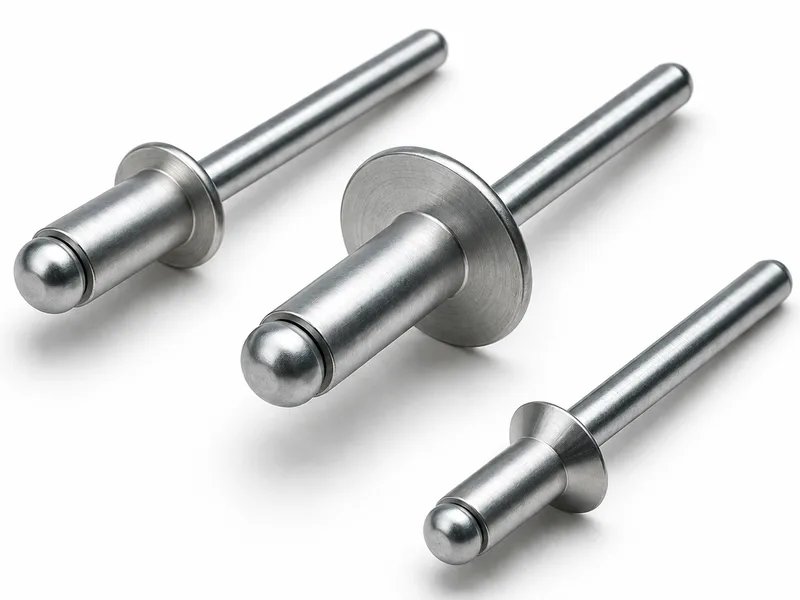
A solid rivet is the original permanent fastener: a plain shank with a formed head, set by deforming the plain end into a second head with a hammer, rivet set or press — no thread, no separate nut, a joint that cannot loosen because it has nothing to unwind. The commercial (non-aerospace) inch series is tabulated here across six head styles in one grid, body diameters 1/16 through 1 in, and reading the grid is the whole skill of specifying one. Head style follows the joint: round head for general-purpose visible work; the flat/nail head for the shallow profile nail-and-plate work the name implies; truss and pan heads for wide-bearing or higher-domed applications on softer base material; universal head — the double-radius profile that became the aerospace standard — where smooth airflow or clean appearance matters; countersunk head where the rivet must sit flush. The table carries head diameter B and height C as min/max pairs per style per size, so tooling (the set die that shapes the shop head) can be sized to the head envelope, and the suggested clinch allowance F — the extra grip length consumed in forming the closing head, from .062 at 1/16 to 1.000 at 1 in — sets the minimum rivet length: grip plus F. Two source quirks matter at the bench: the countersink angle switches from 90° to 78° at 1/2 in body diameter, so a 78° countersink must be cut for the larger flush rivets; and the truss, universal and pan styles stop being offered above 7/16 — the larger commercial body diameters carry round, flat/nail and countersunk heads only. The first per-head-type solid-rivet ladder in the site's rivets coverage (the DIN 660/661 pages cover the metric round and countersunk designations).
| Pattern | One-piece solid rivet, driven (hammer/press-set), inch commercial series — six head styles in one grid: round, flat/nail, truss, universal, pan, countersunk |
|---|---|
| Size range | Body diameters 1/16 – 1 in, fourteen sizes; truss/universal/pan styles offered through 7/16 (7/16 for truss/universal, 3/8 for pan) — larger bodies carry round, flat/nail and countersunk heads only |
| Tabulated geometry | Per size and style: head diameter B and head height C (min/max); body diameter A (min/max); countersink angle D (90° through 3/8, 78° at 1/2 and above); suggested clinch allowance F (Ref) from .062 at 1/16 to 1.000 at 1 in |
| Setting data | Minimum rivet length = grip + clinch allowance F; the clinch allowance is the length consumed forming the closing head |
| Materials / shear ratings | Not tabulated by the collected source — per RFQ (state the rivet material — steel, aluminium, brass, copper — and the joint shear requirement with the order); the MIL-spec material grid is on the aerospace series page |
| Nominal Body Dia. (A) | Body Dia. Min/Max | Round Head Dia. (B) | Round Head Height (C) | Flat/Nail Head Dia. (B) | Flat/Nail Head Height (C) | Truss Head Dia. (B) | Truss Head Height (C) | Universal Head Dia. (B) | Universal Head Height (C) | Pan Head Dia. (B) | Pan Head Height (C) | Countersunk Head Dia. (B) | Countersunk Head Height (C) | C.S. Degree (D) | Suggested Clinch Allowance (F) |
|---|---|---|---|---|---|---|---|---|---|---|---|---|---|---|---|
| 1/16 | .059/.064 | .102/.122 | .042/.052 | .120/.140 | .017/.027 | .115/.135 | .027/.037 | .098/.118 | .030/.040 | .110/.118 | .027 | 90° | .062 | ||
| 3/32 | .090/.096 | .162/.182 | .065/.077 | .180/.200 | .026/.038 | .206/.226 | .026/.038 | .177/.197 | .039/.051 | .153/.173 | .048/.060 | .163/.176 | .040 | 90° | .094 |
| 1/8 | .121/.127 | .215/.235 | .088/.100 | .240/.260 | .036/.048 | .277/.297 | .036/.048 | .240/.260 | .053/.065 | .205/.225 | .066/.078 | .217/.235 | .053 | 90° | .125 |
| 5/32 | .152/.158 | .268/.290 | .110/.124 | .301/.323 | .045/.059 | .348/.368 | .045/.059 | .301/.323 | .065/.079 | .257/.279 | .082/.096 | .272/.293 | .066 | 90° | .156 |
| 3/16 | .182/.191 | .322/.348 | .133/.147 | .361/.387 | .055/.069 | .422/.442 | .055/.069 | .361/.387 | .078/.092 | .308/.334 | .100/.114 | .326/.351 | .079 | 90° | .187 |
| 1/4 | .244/.253 | .430/.460 | .180/.196 | .485/.515 | .075/.091 | .560/.590 | .075/.091 | .485/.515 | .104/.120 | .414/.444 | .135/.151 | .437/.469 | .106 | 90° | .250 |
| 5/16 | .304/.316 | .538/.572 | .225/.243 | .607/.641 | .095/.113 | .702/.732 | .095/.113 | .607/.641 | .129/.147 | .518/.552 | .169/.187 | .547/.588 | .133 | 90° | .312 |
| 3/8 | .365/.380 | .646/.684 | .271/.291 | .731/.769 | .115/.135 | .848/.878 | .115/.135 | .731/.769 | .156/.176 | .625/.663 | .205/.225 | .656/.704 | .159 | 90° | .375 |
| 7/16 | .428/.443 | .754/.798 | .317/.339 | .852/.896 | .135/.157 | .990/1.020 | .135/.157 | .728/.772 | .239/.261 | .765/.823 | .186 | 90° | .438 | ||
| 1/2 | .478/.520 | .844/.938 | .375/.406 | .844/.938 | .250/.281 | .872/.936 | .260 | 78° | .500 | ||||||
| 5/8 | .600/.655 | 1.063/1.157 | .469/.500 | 1.063/1.157 | .313/.344 | 1.112/1.194 | .339 | 78° | .625 | ||||||
| 3/4 | .725/.780 | 1.281/1.390 | .562/.593 | 1.281/1.390 | .375/.406 | 1.322/1.421 | .400 | 78° | .750 | ||||||
| 7/8 | .850/.905 | 1.500/1.609 | .656/.687 | 1.500/1.609 | .438/.469 | 1.532/1.647 | .460 | 78° | .875 | ||||||
| 1 | .975/1.030 | 1.719/1.828 | .750/.781 | 1.719/1.828 | .500/.531 | 1.745/1.873 | .520 | 78° | 1.000 |
- Row 1 (1/16): Empty cells are verbatim: the truss-head cells are blank at 1/16, and truss/universal/pan cells are blank above 7/16 (those styles stop being offered at larger body diameters). Materials, lengths and shear ratings are not tabulated — per RFQ.
- Row 9 (7/16): At 7/16 the universal-head cells are blank (the style's last offered size is 3/8) — reproduced verbatim.
- Row 10 (1/2): The countersink angle switches from 90° to 78° at 1/2 body diameter in the source — verbatim as rendered; confirm the angle matches the mating countersink when ordering countersunk rivets at 1/2 in and above.
Materials
- Rivet material specified per RFQ — the commercial series is commonly quoted in steel, aluminium, brass and copper; name the base materials being joined (galvanic pairing) and the load, and the material and finish will be confirmed at quotation
Ordering & documentation
Documents
Shipments are backed by Mill Test Certificate (MTC), Dimensional Report, Salt Spray Test Report on request, with full batch traceability from raw material to finished product. Quality management follows the owner-confirmed compliance list: ISO 9001:2015, RoHS, REACH. Exact document sets are confirmed on the order.
Quotation
- The fastener family (Commercial Solid Rivets (Inch Series, Per-Head-Type)) plus the standard designation from your drawing — DIN / ISO / JIS / ASTM / ANSI, or a drawing for custom parts.
- Size (diameter and length), thread type (metric or inch), property class or grade, and coating or finish.
- Quantity per size and your target delivery date.
- Destination country, and any required documents (for example a mill test certificate) so the quote includes them.
Sample & supply
Minimum order quantity is 10,000–50,000 pieces depending on size. Standard production run 10–20 days. Quantities or variants outside the standard range are confirmed at quotation.
Storage & shipping
Parts are packed for export and shipped factory-direct to buyers in Europe, Asia, the Americas and the Middle East. Store fasteners dry and protected until installation, and keep coated parts in their packaging until use; specific packing and preservation requirements can be stated on the order and confirmed at quotation.
Frequently asked questions
How do I size a solid rivet, and why does the head style change what is available?
Two decisions: diameter and length. Diameter follows the joint, not the rivet chart — pick the body size to suit the plies (rule of thumb in the trade is a rivet about three times the thickest ply's thickness, but the real constraint is hole size: drill for a clearance hole at the suggested work-hole diameter, then the rivet fills it). Length is grip plus clinch allowance — the collected table's F column is that allowance, the length consumed forming the second head: at 1/8 body it is .125, at 1/2 it is .500, and it scales to 1.000 at the 1 in bodies. Under-cut a rivet and the closing head forms incompletely; over-cut and the surplus bulges beside the head. Head style then narrows the size range: the grid shows truss, universal and pan heads offered through 7/16 (pan through 3/8) — above that the commercial series carries round, flat/nail and countersunk only, so a 5/8 universal-head rivet is not a commercial-series part and the aerospace series page is the place to look. One trap to check before cutting the countersink: the angle column switches 90° to 78° at 1/2 body — cutting a 90° sink for a 78° rivet leaves the head standing proud and the bearing on the wrong face. Every figure on this page is the collected table itself; where a cell is empty the style is simply not offered at that size in the source.
What is the MOQ and lead time for these rivets?
The minimum order quantity is 10,000–50,000 pieces depending on size. Standard production runs 10–20 days. Common sizes in these series are widely stocked; confirm the exact schedule against quantity and size mix at quotation.
Request a Quote
Get factory-direct pricing from the manufacturer.
What to include in your inquiry
- ✓ Standard and property class (e.g. DIN 912, ISO 4762, class 8.8) — or a drawing for custom parts.
- ✓ Sizes, lengths and thread type (metric or inch).
- ✓ Quantity per size and your target delivery date.
- ✓ Destination country, plus any coating or finish requirement.
- ✓ Any documents you need with the shipment (e.g. mill test certificate) so the quote includes them.
- ✓ Your inquiry goes straight to the factory team by email and gets a reply within 24 hours.
- ✓ Factory-direct pricing
- ✓ Standard and custom specifications
- ✓ Factory-direct export to buyers in Europe, Asia, the Americas and the Middle East
- ✓ Full fastener family support