
Self-Piercing Rivets — Inch Work-Thickness Series
Self-piercing rivets sized in inch diameters against total work thickness: 1/8 in (hardened and unhardened), 9/64, 5/32 and 3/16 in hardened lines stepping from .030 up to .200 in of work, with .250 in and beyond as a special-quote range. The published piercing envelope depends on material hardness, thickness and layer count.
Last updated: 2026-11
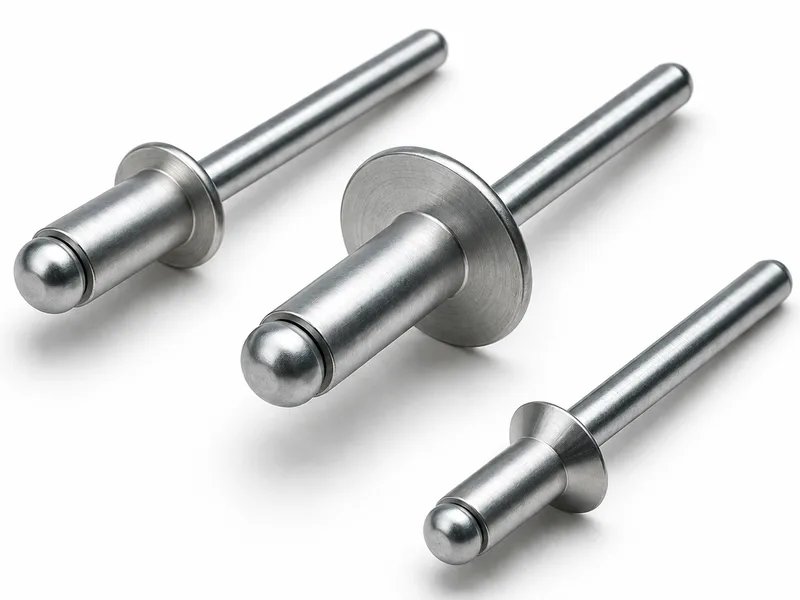
Specifications
Inch-tool production lines size self-piercing rivets by diameter against the total work thickness they can pierce, and the collected supplier table reads as a straight ladder: a 1/8 in rivet in unhardened form covers .015–.035 in of total work, the same diameter hardened steps up to .030–.060 in, then 9/64 in and 5/32 in hardened reach .060–.100 in, and the 3/16 in hardened line takes .100–.200 in. Beyond the table, the supplier quotes specials to .250 in and above — a consultation, not a catalog size. Two things in the source deserve emphasis rather than smoothing over. First, the table is explicitly based on steel rivets in typical sheet-metal applications — it is a piercing envelope, not a joint rating. Second, the supplier states the physics behind the ladder: piercing ability depends on material hardness, material thickness and the number of layers being joined, so the same rivet diameter covers different stacks depending on whether it is punching one hard sheet or four soft ones. Use the table to bracket the diameter, then confirm the specific stack — total thickness, layer count and hardness of each layer — at quotation, the same trial-fastening discipline the metric series publishes.
| Type | Self-piercing rivet, inch-diameter series — selected by total work thickness pierced, steel rivets, typical sheet-metal basis |
|---|---|
| 1/8 in — unhardened | Total work thickness .015–.035 in |
| 1/8 in — hardened | Total work thickness .030–.060 in |
| 9/64 in — hardened | Total work thickness .060–.100 in |
| 5/32 in — hardened | Total work thickness .060–.100 in |
| 3/16 in — hardened | Total work thickness .100–.200 in |
| Beyond the table | .250 in total work and above — special quote / custom rivet consultation |
| Selection caveat (source-stated) | Piercing ability depends on material hardness, material thickness and the number of layers being joined — the published ranges are typical sheet-metal envelopes, not guarantees for every stack |
| MOQ / lead time | 10,000–50,000 pieces by size; 10–20 days |
Materials
- Steel — hardened (1/8 through 3/16 in series)
- Steel — unhardened (1/8 in, lightest work range)
Ordering & documentation
Documents
Shipments are backed by Mill Test Certificate (MTC), Dimensional Report, Salt Spray Test Report on request, with full batch traceability from raw material to finished product. Quality management follows the owner-confirmed compliance list: ISO 9001:2015, RoHS, REACH. Exact document sets are confirmed on the order.
Quotation
- The fastener family (Self-Piercing Rivets — Inch Work-Thickness Series) plus the standard designation from your drawing — DIN / ISO / JIS / ASTM / ANSI, or a drawing for custom parts.
- Size (diameter and length), thread type (metric or inch), property class or grade, and coating or finish.
- Quantity per size and your target delivery date.
- Destination country, and any required documents (for example a mill test certificate) so the quote includes them.
Sample & supply
Minimum order quantity is 10,000–50,000 pieces depending on size. Standard production run 10–20 days. Quantities or variants outside the standard range are confirmed at quotation.
Storage & shipping
Parts are packed for export and shipped factory-direct to buyers in Europe, Asia, the Americas and the Middle East. Store fasteners dry and protected until installation, and keep coated parts in their packaging until use; specific packing and preservation requirements can be stated on the order and confirmed at quotation.
Frequently asked questions
Why does hardening roughly double the work-thickness range of a 1/8 in SPR?
Because the limit is the punch, not the fastener. In its working range an SPR must shear through the top sheet before it can flare, and an unhardened rivet body starts deforming under press load before a harder stack yields — the collected table shows the ceiling at .035 in of total work. Heat-treated, the same 1/8 in body keeps its shape through .060 in of work, roughly doubling the envelope. The doubling has a floor, not just a ceiling: hardness that is excessive for the stack is what cracks the flared tail or pierces the bottom sheet, which is why hardened and unhardened forms overlap rather than replace each other — the unhardened rivet stays the right choice for the very lightest work.
How do I convert between the inch series and the metric SPR tables?
Convert the diameter brackets, not one-for-one sizes. The inch ladder runs 1/8 in (3.2 mm), 9/64 in (3.6 mm), 5/32 in (4.0 mm) and 3/16 in (4.8 mm) — the same shank family as the metric 3–5 mm series, because the underlying process is identical. What does not translate is the table basis: the metric published tables carry per-length fastening ranges against an assumed parent hardness, while the inch series publishes total work thickness against typical sheet-metal stacks, with the supplier stating that hardness, thickness and layer count decide the actual piercing ability. Pick the series your tooling and drawings speak, then validate the exact stack at quotation either way — the two tables bracket the same physics from different directions.
What is the MOQ and lead time for these rivets?
Minimum order quantity is 10,000–50,000 pieces depending on size and material. Standard production lead time is 10–20 days. Common blind rivet sizes are widely stocked — confirm the exact schedule against quantity and size mix at quotation.
What should an RFQ for these rivets state?
State the rivet subtype (open-end, closed-end, structural blind rivet or rivet nut), body diameter, grip range or total material thickness, head style (dome, countersunk or large flange), body and mandrel materials (for example aluminum body with steel mandrel, or all-stainless), finish, required certificates such as a mill test report per EN 10204 3.1, and quantity per size — plus destination country.
Request a Quote
Get factory-direct pricing from the manufacturer.
What to include in your inquiry
- ✓ Standard and property class (e.g. DIN 912, ISO 4762, class 8.8) — or a drawing for custom parts.
- ✓ Sizes, lengths and thread type (metric or inch).
- ✓ Quantity per size and your target delivery date.
- ✓ Destination country, plus any coating or finish requirement.
- ✓ Any documents you need with the shipment (e.g. mill test certificate) so the quote includes them.
- ✓ Your inquiry goes straight to the factory team by email and gets a reply within 24 hours.
- ✓ Factory-direct pricing
- ✓ Standard and custom specifications
- ✓ Factory-direct export to buyers in Europe, Asia, the Americas and the Middle East
- ✓ Full fastener family support