
Semi-Tubular Rivets
Semi-tubular rivets — solid rivets with a partial hole at the tail that cuts the setting force to about a quarter of a solid rivet of the same size. Truss and domed heads from Ø 1.5 to 6.0 mm, lengths to 55 mm, in aluminium, steel, brass, copper and stainless; also usable as pivots for mobile joints.
Last updated: 2026-11
Specifications
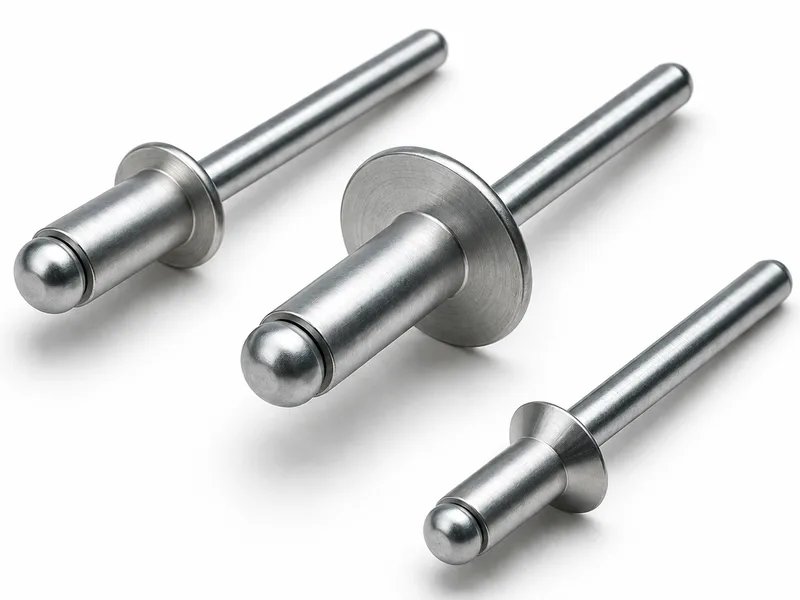
A semi-tubular rivet is a solid rivet with one modification that changes how it is set: the shank is pierced partway at the tail (opposite the head), so the tail curls with about a quarter of the force a full solid shank needs. The collected manufacturer line explains both consequences of that hole — the reduced setting force, and the second life these rivets have as pivots, since the swelling on setting occurs only at the tail and the shank stays free enough to act as the axle of a mobile joint. The distinction from the tubular rivet is process depth: a tubular rivet is drilled end to end in the cold-forming process, while the semi-tubular carries only the partial tail hole — more shank cross-section than a tubular, far less setting force than a solid. The collected line runs truss and domed heads from Ø 1.5 to 6.0 mm bodies (head diameters 3.0 to 10.0 mm with per-size tolerances), body lengths from 2 to 55 mm depending on size, in aluminium, steel, brass, copper and stainless steel — the material spread of the solid line with a setting press that a solid rivet of the same diameter would not need. Position in the family: choose it where the joint load is light-to-moderate, the parent material is thin or soft, and the setting equipment cannot form a full solid head; step up to solid DIN 660/661 when the shank must carry structural shear.
| Type | Semi-tubular rivet — partial hole at the tail (opposite the head); tail curls on setting instead of forming a full solid head |
|---|---|
| Setting force | About 1/4 of the force needed to set a solid rivet (manufacturer line) — the working reason for the type |
| Pivot use | Usable as pivots for mobile joints — swelling occurs only at the tail, leaving the shank free as an axle |
| Distinction from tubular | Tubular rivets are drilled end to end during cold-forming; semi-tubular carry only the partial tail hole — more shank cross-section |
| Truss-head series (Ø body / Ø head / head thickness / length range) | 1.5 → 3.0 ± 0.15 / 0.7 ± 0.10 / 3–12; 2.0 → 4.0 / 0.7 / 2–30; 2.5 → 5.0 / 0.8 / 3–30; 3.0 → 5.5 / 0.9 / 4–50; 4.0 → 7.9 / 1.0 / 4–50; 5.0 → 8.5 / 1.5 / 5–55; 6.0 → 10.0 / 1.5 / 6–55 mm |
| Domed-head series (Ø body / Ø head / head thickness / length range) | 1.5 → 3.0 ± 0.15 / 1.0 ± 0.10 / 3–12; 2.0 → 3.5 / 1.5 / 2–30; 2.5 → 5.0 / 1.8 / 3–30; 3.0 → 5.5 / 2.0 / 4–35; 4.0 → 7.6 / 3.0 / 4–45; 5.0 → 8.5 / 4.0 / 5–50; 6.0 → 10.0 ± 0.25 / 4.5 / 6–55 mm |
| Length tolerance | Body length tolerance +0.50/−0 mm for lengths over 5.0 mm (per collected table note) |
| Applications (manufacturer line) | Marine, household appliances, water sports, furniture, automotive and construction equipment, medical and recreational equipment, warehouse material |
| MOQ / lead time | 10,000–50,000 pieces by size; 10–20 days |
Materials
- Aluminium
- Steel
- Brass
- Copper
- Stainless steel
Ordering & documentation
Documents
Shipments are backed by Mill Test Certificate (MTC), Dimensional Report, Salt Spray Test Report on request, with full batch traceability from raw material to finished product. Quality management follows the owner-confirmed compliance list: ISO 9001:2015, RoHS, REACH. Exact document sets are confirmed on the order.
Quotation
- The fastener family (Semi-Tubular Rivets) plus the standard designation from your drawing — DIN / ISO / JIS / ASTM / ANSI, or a drawing for custom parts.
- Size (diameter and length), thread type (metric or inch), property class or grade, and coating or finish.
- Quantity per size and your target delivery date.
- Destination country, and any required documents (for example a mill test certificate) so the quote includes them.
Sample & supply
Minimum order quantity is 10,000–50,000 pieces depending on size. Standard production run 10–20 days. Quantities or variants outside the standard range are confirmed at quotation.
Storage & shipping
Parts are packed for export and shipped factory-direct to buyers in Europe, Asia, the Americas and the Middle East. Store fasteners dry and protected until installation, and keep coated parts in their packaging until use; specific packing and preservation requirements can be stated on the order and confirmed at quotation.
Frequently asked questions
Semi-tubular, tubular or solid — how do I place these three in one decision?
By setting force against shank strength. The solid rivet keeps its whole cross-section and carries the most shear, but needs the full forming force on a press or with a bucking bar. The tubular rivet is drilled end to end, sets with the least force, and gives up the most shank — light trim, electrical and enclosure duty. The semi-tubular sits deliberately in the middle: the partial tail hole cuts the setting force to about a quarter of solid, while the shank stays mostly intact, so it takes the moderate loads a tubular should not. Add one extra option from the same property: because swelling happens only at the tail, a semi-tubular rivet can double as a pivot for a moving joint — something neither the solid nor the fully tubular form does well.
What is the MOQ and lead time for these rivets?
Minimum order quantity is 10,000–50,000 pieces depending on size and material. Standard production lead time is 10–20 days. Common blind rivet sizes are widely stocked — confirm the exact schedule against quantity and size mix at quotation.
What should an RFQ for these rivets state?
State the rivet subtype (open-end, closed-end, structural blind rivet or rivet nut), body diameter, grip range or total material thickness, head style (dome, countersunk or large flange), body and mandrel materials (for example aluminum body with steel mandrel, or all-stainless), finish, required certificates such as a mill test report per EN 10204 3.1, and quantity per size — plus destination country.
Request a Quote
Get factory-direct pricing from the manufacturer.
What to include in your inquiry
- ✓ Standard and property class (e.g. DIN 912, ISO 4762, class 8.8) — or a drawing for custom parts.
- ✓ Sizes, lengths and thread type (metric or inch).
- ✓ Quantity per size and your target delivery date.
- ✓ Destination country, plus any coating or finish requirement.
- ✓ Any documents you need with the shipment (e.g. mill test certificate) so the quote includes them.
- ✓ Your inquiry goes straight to the factory team by email and gets a reply within 24 hours.
- ✓ Factory-direct pricing
- ✓ Standard and custom specifications
- ✓ Factory-direct export to buyers in Europe, Asia, the Americas and the Middle East
- ✓ Full fastener family support