
DIN 7339 Hollow Rivets, One Piece, Drawn from Strip
DIN 7339 one-piece hollow rivets drawn from strip, d1 1.5 to 6: body and bore geometry with ±10% wall tolerance, and the commercial-length mass ladder to 20 mm.
Last updated: 2026-11
Specifications
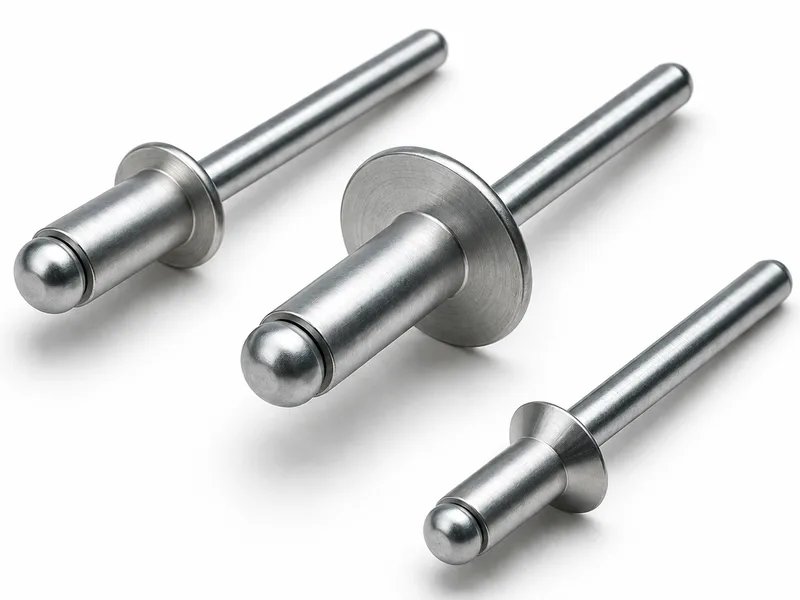
DIN 7339 is the one-piece hollow rivet rolled from strip — the cheapest tubular rivet there is, because the whole body including the head is drawn from a single strip thickness s (±10% as the table prints): electrical contacts, small hinges, card and leather work, any light clamp joint set in a press. The collected 02/2011-edition table runs d1 1.5 to 6 with head d2 nom (10 at d6), bore d3 0/-0.4 (5.02 at d6 — the bore is the sizing dimension for contacts and pins through it), head side e max (3), strip thickness s ±10% (0.4) and burr r max (0.6); the superseded 05/1993 edition is transcribed beside it, both verbatim. The mass ladder runs lengths 2 to 20 mm per diameter, ordered by strip thickness s nom. No mandrel, no solid core: the joint is the curled rim, and the open bore through the rivet is often the point (pivots, contacts, lacing).
| Standard / scope | DIN 7339 hollow rivets, one piece, drawn from strip — d1 1.5 to 6, edition 02/2011; superseded 05/1993 edition transcribed as separate tables |
|---|---|
| Body geometry | Head d2 nom to 10, head side e max 3, burr r max 0.6 at d1 6 |
| Bore / strip | Bore d3 0/-0.4 = 5.02 at d1 6 — the through-bore dimension; strip thickness s ±10%, s nom 0.4 at the large end |
| Commercial lengths | Mass ladder (kg per 1000 pcs, ρ=7,85 kg/dm³) l 2 to 20 across d1 1.5–6; ordered by d1 × s nom × length |
| Not tabulated | Strip material/coating, setting force, die data — per RFQ |
Materials
- Drawn from strip means the material is the coil: brass and copper strip for electrical work (the bore takes contacts), tinned or galvanized steel for general light work, aluminium for weight-critical small assemblies. Order as d1 × s nom × length — the strip thickness is a first-class order dimension here, not a hidden tolerance, and the ±10% band in the table is what the setting force calculation uses
Ordering & documentation
Documents
Shipments are backed by Mill Test Certificate (MTC), Dimensional Report, Salt Spray Test Report on request, with full batch traceability from raw material to finished product. Quality management follows the owner-confirmed compliance list: ISO 9001:2015, RoHS, REACH. Exact document sets are confirmed on the order.
Quotation
- The fastener family (DIN 7339 Hollow Rivets, One Piece, Drawn from Strip) plus the standard designation from your drawing — DIN / ISO / JIS / ASTM / ANSI, or a drawing for custom parts.
- Size (diameter and length), thread type (metric or inch), property class or grade, and coating or finish.
- Quantity per size and your target delivery date.
- Destination country, and any required documents (for example a mill test certificate) so the quote includes them.
Sample & supply
Minimum order quantity is 10,000–50,000 pieces depending on size. Standard production run 10–20 days. Quantities or variants outside the standard range are confirmed at quotation.
Storage & shipping
Parts are packed for export and shipped factory-direct to buyers in Europe, Asia, the Americas and the Middle East. Store fasteners dry and protected until installation, and keep coated parts in their packaging until use; specific packing and preservation requirements can be stated on the order and confirmed at quotation.
Frequently asked questions
Why would I use a strip-drawn hollow rivet instead of a semi-tubular one?
Cost and the open bore. Both set by curling, but DIN 7339 is drawn complete from a strip of thickness s — no machined or punched cavity — so at small sizes it is the least expensive tubular rivet per piece, in exactly the volumes electrical and small-hinge work runs. The fully open bore is the second reason: a pin, contact or thread passes straight through, which is why the d3 0/-0.4 bore column is printed with its own tolerance — it is a working diameter, not a leftover. What it gives up is strength: the wall is the strip thickness (±10%), so structural or shear-loaded joints step up to the semi-tubular DIN 6791/6792 class or solid rivets.
What does the ±10% on strip thickness s mean for setting and ordering?
It is the only wall dimension the rivet has, so it carries both the spring of the curl and the strength of the joint: order by the s nom value in the table (0.4 at the 6 mm end) and expect the delivered wall anywhere in ±10% of it — the standard's own band, carried verbatim. For setting force, size the die around the nominal s and let the band be the variation; for joints at the limit of the rivet's capacity, specify the tighter half of the band on the order (we quote against it) or step up a diameter. The bore d3 moves opposite to s within the same outer d1, which is why contact-fit applications state which dimension governs — the bore tolerance 0/-0.4 stays fixed either way.
Request a Quote
Get factory-direct pricing from the manufacturer.
What to include in your inquiry
- ✓ Standard and property class (e.g. DIN 912, ISO 4762, class 8.8) — or a drawing for custom parts.
- ✓ Sizes, lengths and thread type (metric or inch).
- ✓ Quantity per size and your target delivery date.
- ✓ Destination country, plus any coating or finish requirement.
- ✓ Any documents you need with the shipment (e.g. mill test certificate) so the quote includes them.
- ✓ Your inquiry goes straight to the factory team by email and gets a reply within 24 hours.
- ✓ Factory-direct pricing
- ✓ Standard and custom specifications
- ✓ Factory-direct export to buyers in Europe, Asia, the Americas and the Middle East
- ✓ Full fastener family support