
Rivet Nuts (Blind Threaded Inserts)
Rivet nuts — blind internally threaded inserts that create a reusable load-bearing thread in thin sheet from 0.5 to 6.0 mm. Round-body flat or countersunk heads, closed-end, knurled thin-wall, half-hex and full-hex bodies in steel, stainless and aluminum. The removable thread where blind rivets are permanent.
Last updated: 2026-11
Specifications
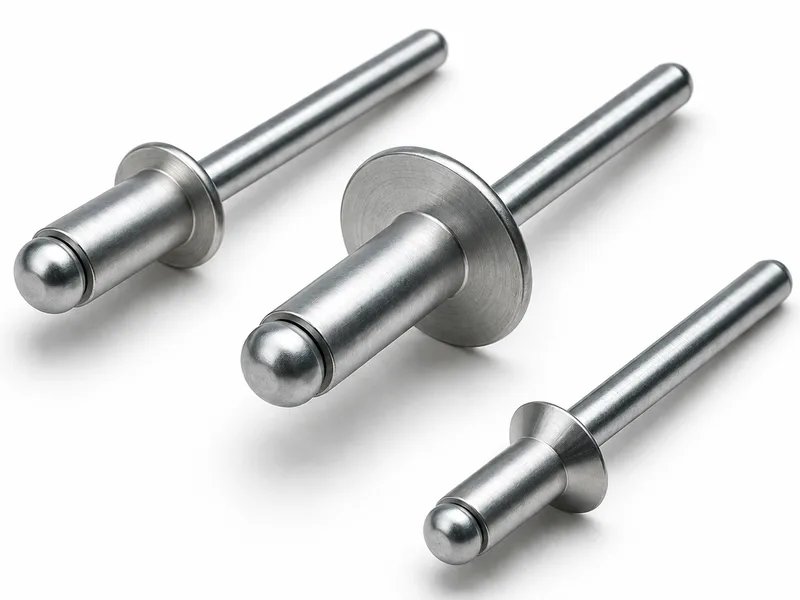
A rivet nut is a threaded insert set from one side like a blind rivet: the body collapses on the blind side of the sheet and clamps itself in the hole, leaving a load-bearing internal thread that screws survive repeatedly. That removability is the whole point — where a blind rivet makes a permanent joint, the rivet nut makes a fastener point that can be opened for maintenance, which is why the industry guide pairs them in the same enclosures: rivets for permanent assembly points, rivet nuts for parts that come back off, such as motors, control boards and filters. The collected range runs from thin-wall round-body inserts for close hole spacings to full-hex bodies that resist spin-out in torque, with flat, countersunk and closed-end heads — the closed end sealing the thread from the blind side. The lineage is real: the type originated as the B.F. Goodrich RIVNUT in 1936, a trademark now carried by Bollhoff, and the category still answers to names like Nutsert® and blind internally threaded insert. Set them with hand, battery or hydro-pneumatic tools matched to the body size.
| Type | Rivet nut (blind internally threaded insert) — one-sided installation, reusable internal thread |
|---|---|
| Sheet thickness scope | Rivet nuts generally serve 0.5–6.0 mm sheet (industry selection guide); thread provides the fastening where tapping thin sheet fails |
| Body styles | Round body — flat head; countersunk head; closed end; knurled thin-wall ("low profile"); half-hex body; heavy-duty full hex body; pre-bulbed specialty type |
| Spin-out resistance | Hex and knurled bodies key into the hole against torque; select the body shape from the applied torque, not head style alone |
| Removability | Threaded point is removable and reusable — suitable for maintenance access; contrast with permanent blind rivets |
| Lineage | Type originated as B.F. Goodrich RIVNUT (1936); RIVNUT® trademark now carried by Bollhoff; also sold as Nutsert® and blind internally threaded inserts |
| Installation | Hand, battery or hydro-pneumatic installation tools matched to body size — no rear access needed |
| MOQ / lead time | 10,000–50,000 pieces by size; 10–20 days |
Materials
- Steel
- Stainless steel (A2 / A4)
- Aluminum
Ordering & documentation
Documents
Shipments are backed by Mill Test Certificate (MTC), Dimensional Report, Salt Spray Test Report on request, with full batch traceability from raw material to finished product. Quality management follows the owner-confirmed compliance list: ISO 9001:2015, RoHS, REACH. Exact document sets are confirmed on the order.
Quotation
- The fastener family (Rivet Nuts (Blind Threaded Inserts)) plus the standard designation from your drawing — DIN / ISO / JIS / ASTM / ANSI, or a drawing for custom parts.
- Size (diameter and length), thread type (metric or inch), property class or grade, and coating or finish.
- Quantity per size and your target delivery date.
- Destination country, and any required documents (for example a mill test certificate) so the quote includes them.
Sample & supply
Minimum order quantity is 10,000–50,000 pieces depending on size. Standard production run 10–20 days. Quantities or variants outside the standard range are confirmed at quotation.
Storage & shipping
Parts are packed for export and shipped factory-direct to buyers in Europe, Asia, the Americas and the Middle East. Store fasteners dry and protected until installation, and keep coated parts in their packaging until use; specific packing and preservation requirements can be stated on the order and confirmed at quotation.
Frequently asked questions
Rivet nut or blind rivet — which one for a sheet-metal enclosure?
Decide by whether the joint ever opens. A blind rivet is permanent and cheap per point — right for assembly that stays shut. A rivet nut costs more per point but gives a threaded hole that survives repeated screw removal — right for anything serviced in the field. The industry pairing reflects exactly this split: rivets for permanent points, rivet nuts for motors, control boards and filters that come back out. In the same enclosure both appear, and a closed-end rivet nut adds a sealed thread where the blind side must stay clean.
Which rivet nut body resists spin-out best?
Spin-out is torque turning the insert in its hole, and the body shape answers it. A smooth round body grips by radial bulge alone and suits low-torque, thin-wall applications. Knurled bodies add circumferential bite; half-hex and full-hex bodies key flat faces into the hole and take the highest torque — the full hex body is the heavy-duty line. Match the body shape to the installation torque of the screw it will carry, and check the sheet thickness range: the insert clamps the sheet, and a body set outside its thickness window loses both clamp and torque resistance.
What is the MOQ and lead time for these rivets?
Minimum order quantity is 10,000–50,000 pieces depending on size and material. Standard production lead time is 10–20 days. Common blind rivet sizes are widely stocked — confirm the exact schedule against quantity and size mix at quotation.
What should an RFQ for these rivets state?
State the rivet subtype (open-end, closed-end, structural blind rivet or rivet nut), body diameter, grip range or total material thickness, head style (dome, countersunk or large flange), body and mandrel materials (for example aluminum body with steel mandrel, or all-stainless), finish, required certificates such as a mill test report per EN 10204 3.1, and quantity per size — plus destination country.
Request a Quote
Get factory-direct pricing from the manufacturer.
What to include in your inquiry
- ✓ Standard and property class (e.g. DIN 912, ISO 4762, class 8.8) — or a drawing for custom parts.
- ✓ Sizes, lengths and thread type (metric or inch).
- ✓ Quantity per size and your target delivery date.
- ✓ Destination country, plus any coating or finish requirement.
- ✓ Any documents you need with the shipment (e.g. mill test certificate) so the quote includes them.
- ✓ Your inquiry goes straight to the factory team by email and gets a reply within 24 hours.
- ✓ Factory-direct pricing
- ✓ Standard and custom specifications
- ✓ Factory-direct export to buyers in Europe, Asia, the Americas and the Middle East
- ✓ Full fastener family support