
DIN 6792 Semi-Tubular Countersunk Head Rivets
DIN 6792 semi-tubular countersunk head rivets, d1 1.6 to 10: flush head geometry with js14/H13 tolerances and the commercial-length mass ladder to 50 mm.
Last updated: 2026-11
Specifications
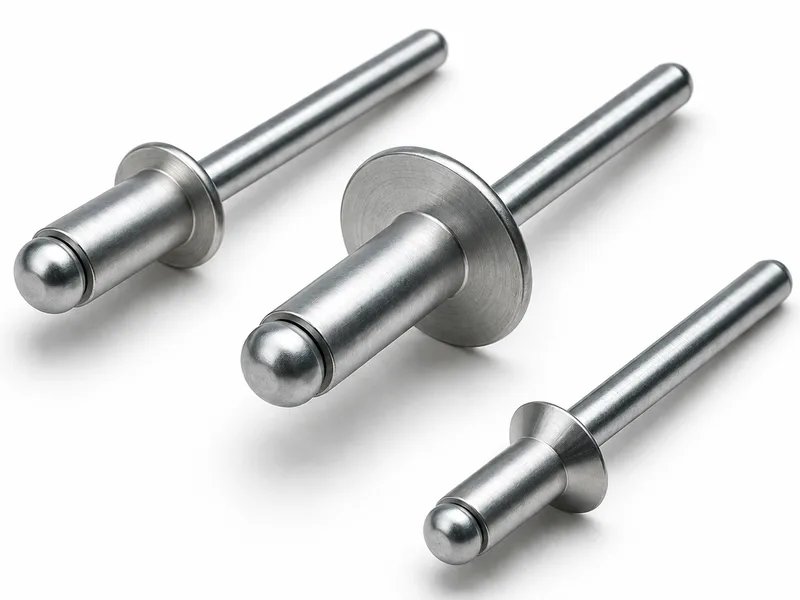
DIN 6792 is the flush-finish member of the semi-tubular pair: the same cavity-setting principle as DIN 6791 with a countersunk head that sits at or below the surface — the choice where the riveted face is a sliding, wearing or visible surface. The collected 2012-edition table (the source marks the series withdrawn) runs d1 1.6 to 10: head diameter d2 nom (20 at d10), head height k js14 (4.4 current edition — the superseded table the source prints beside it carries k 3 at the top size, an edition difference kept visible), material min d3 (9.4), cavity diameter d4 H13 (7.6) and cavity depth t +0.5/0 (10). The mass ladder runs lengths 3 to 50 mm per diameter. Note the flush result needs the matched countersink on the top sheet, exactly as with solid csk rivets — the head geometry columns are the countersink specification.
| Standard / scope | DIN 6792 semi-tubular countersunk head rivets — d1 1.6 to 10, withdrawn (source label); 2012 edition with a superseded edition table transcribed beside it |
|---|---|
| Head geometry | d2 nom to 20; k js14 4.4 (2012) vs 3 (superseded table at the top size) — edition difference carried verbatim |
| Cavity geometry | Cavity depth t +0.5/0 to 10, cavity diameter d4 H13 7.6, material min d3 9.4 at d1 10 |
| Commercial lengths | Mass ladder (kg per 1000 pcs, ρ=7,85 kg/dm³) l 3 to 50 across d1 1.6–10 |
| Not tabulated | Countersink angle/tooling data, material families, setting force — per RFQ |
Materials
- Same material families as the pan-head DIN 6791 — steel, brass, copper, aluminium — selected by the surface duty: csk rivets in sliding or wearing faces want the harder tempers, decorative flush work takes brass and aluminium. Provide the plate stack and which sheet carries the countersink; the head columns (d2, k) define the csk geometry the tooling must produce
Ordering & documentation
Documents
Shipments are backed by Mill Test Certificate (MTC), Dimensional Report, Salt Spray Test Report on request, with full batch traceability from raw material to finished product. Quality management follows the owner-confirmed compliance list: ISO 9001:2015, RoHS, REACH. Exact document sets are confirmed on the order.
Quotation
- The fastener family (DIN 6792 Semi-Tubular Countersunk Head Rivets) plus the standard designation from your drawing — DIN / ISO / JIS / ASTM / ANSI, or a drawing for custom parts.
- Size (diameter and length), thread type (metric or inch), property class or grade, and coating or finish.
- Quantity per size and your target delivery date.
- Destination country, and any required documents (for example a mill test certificate) so the quote includes them.
Sample & supply
Minimum order quantity is 10,000–50,000 pieces depending on size. Standard production run 10–20 days. Quantities or variants outside the standard range are confirmed at quotation.
Storage & shipping
Parts are packed for export and shipped factory-direct to buyers in Europe, Asia, the Americas and the Middle East. Store fasteners dry and protected until installation, and keep coated parts in their packaging until use; specific packing and preservation requirements can be stated on the order and confirmed at quotation.
Frequently asked questions
DIN 6791 or DIN 6792 — what decides the head form?
The surface after setting. The pan head of DIN 6791 stands proud and spreads its load on the sheet — the stronger, simpler joint for internal work; the countersunk head of DIN 6792 buries itself for sliding parts, wear surfaces, aerodynamic or visual faces, at the cost of the countersinking operation and a slightly reduced head section. The tables share cavity geometry (d4 H13, t depth) at the same diameters, so the setting tooling follows the same bands — only the die face changes. Where sheets are thin and both forms fit the joint, production cost usually settles it: the csk head adds a countersink step per hole, which is why pan head dominates volume work and csk dominates the exposed ones.
The standard is marked withdrawn — what changes for my order?
Nothing on the shop floor: the withdrawn label is the source standard's status, and DIN 6792 parts are supplied against the historical call-out as the installed base demands. The one thing to watch is the edition detail the page makes visible — the transcribed tables show the head height k printed 4.4 in the 2012 edition against 3 in the superseded table at the top size, so a die built for old stock will not seat new stock identically at the large diameters. Quote the standard plus size and length, add the edition your tooling assumes, and we match the supply to it; for new drawings the current semi-tubular ISO series is the forward path and we map sizes on request.
Request a Quote
Get factory-direct pricing from the manufacturer.
What to include in your inquiry
- ✓ Standard and property class (e.g. DIN 912, ISO 4762, class 8.8) — or a drawing for custom parts.
- ✓ Sizes, lengths and thread type (metric or inch).
- ✓ Quantity per size and your target delivery date.
- ✓ Destination country, plus any coating or finish requirement.
- ✓ Any documents you need with the shipment (e.g. mill test certificate) so the quote includes them.
- ✓ Your inquiry goes straight to the factory team by email and gets a reply within 24 hours.
- ✓ Factory-direct pricing
- ✓ Standard and custom specifications
- ✓ Factory-direct export to buyers in Europe, Asia, the Americas and the Middle East
- ✓ Full fastener family support