
DIN 6791 Semi-Tubular Pan Head Rivets
DIN 6791 semi-tubular pan head rivets, d 1.6 to 10: head geometry with js14/H13 tolerances, cavity depth, and the commercial-length mass ladder to 50 mm.
Last updated: 2026-11
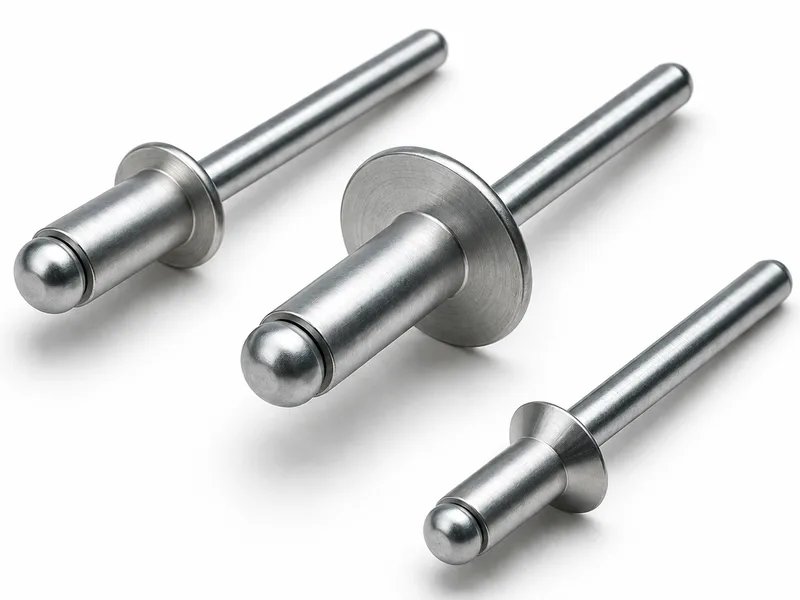
Specifications
DIN 6791 is the semi-tubular rivet with pan head — the self-piercing-class fastener of leather, belt, textile and light metal work: the hollow cavity end rolls outward under the setter and clamps without full shank upsetting, at a fraction of the force a solid rivet needs. The collected 05/2012-edition table runs d 1.6 to 10 with head diameter dk nom (20 at d10), head height k js14 (4.4), cavity depth t +0.5/0 (10), cavity diameter d4 H13 (7.6) and material min d3 (9.4) — the tolerance designations (js14 on the head, H13 on the cavity) are part of the print and tell the toolmaker what the setting die must hold. The mass ladder runs lengths 3 to 50 mm per diameter; the superseded 1993 geometry/mass pair is transcribed beside the current edition, both verbatim.
| Standard / scope | DIN 6791 semi-tubular pan head rivets — d 1.6 to 10, edition 05/2012; superseded 05/1993 edition transcribed as separate tables |
|---|---|
| Head geometry | dk nom to 20, k js14 4.4 at d 10 — js14 head tolerance as printed |
| Cavity geometry | Cavity depth t +0.5/0 to 10, cavity diameter d4 H13 7.6, material min d3 9.4 — the H13 cavity is the die-side dimension |
| Commercial lengths | Mass ladder (kg per 1000 pcs, ρ=7,85 kg/dm³) l 3 to 50 across d 1.6–10, current and 1993 editions |
| Not tabulated | Material (steel/Cu/brass/Al), temper, setting force and die data — per RFQ |
Materials
- Semi-tubular rivets order in mild steel, brass, copper and aluminium; the cavity end forms rather than upsets, so softer tempers set cleaner and the die set follows the printed cavity diameter (H13) and depth (t). State the total grip, the die equipment in use (manual setter, press, impact) and corrosion environment — leather and belt work traditionally brass or copper, general fabrication steel with finish
Ordering & documentation
Documents
Shipments are backed by Mill Test Certificate (MTC), Dimensional Report, Salt Spray Test Report on request, with full batch traceability from raw material to finished product. Quality management follows the owner-confirmed compliance list: ISO 9001:2015, RoHS, REACH. Exact document sets are confirmed on the order.
Quotation
- The fastener family (DIN 6791 Semi-Tubular Pan Head Rivets) plus the standard designation from your drawing — DIN / ISO / JIS / ASTM / ANSI, or a drawing for custom parts.
- Size (diameter and length), thread type (metric or inch), property class or grade, and coating or finish.
- Quantity per size and your target delivery date.
- Destination country, and any required documents (for example a mill test certificate) so the quote includes them.
Sample & supply
Minimum order quantity is 10,000–50,000 pieces depending on size. Standard production run 10–20 days. Quantities or variants outside the standard range are confirmed at quotation.
Storage & shipping
Parts are packed for export and shipped factory-direct to buyers in Europe, Asia, the Americas and the Middle East. Store fasteners dry and protected until installation, and keep coated parts in their packaging until use; specific packing and preservation requirements can be stated on the order and confirmed at quotation.
Frequently asked questions
Why choose semi-tubular over a solid rivet of the same size?
Force and workpiece protection. The cavity means the closing side curls instead of spreading, so setting force drops dramatically — thin or layered work (leather stacks, belt laps, fabric-reinforced sheets, plastics laminates) sets without the blow that would distort or crush it, and the joint still cannot pull apart because the curled rim is captive. What it gives up is shear strength: the shank section is reduced by the cavity, so structural shear joints stay with solid rivets (DIN 660/662/302 class). The geometry that makes this concrete is in the table — the cavity depth t 10 against a 20 mm head at d 10 shows how much of the length is designed to curl, not to bear.
What do the js14 and H13 call-outs in the table mean for tooling?
They are the tolerance classes the setting die must expect: the head height k carries js14 (a symmetric machining-grade band), and the cavity diameter d4 carries H13 (a standard hole-basis band) — in practice, the die punch that forms the cavity side is made to these bands, not to nominal alone. If your setter tooling was built against the 1993 edition, check it against the current tables before a production changeover: the transcribed 1993 pair lets you diff the two editions directly. For volume setting we match die tolerance to the printed bands and confirm on the order — mixed-edition rivets plus a single fixed die is the usual source of cavity depth drift in production.
Request a Quote
Get factory-direct pricing from the manufacturer.
What to include in your inquiry
- ✓ Standard and property class (e.g. DIN 912, ISO 4762, class 8.8) — or a drawing for custom parts.
- ✓ Sizes, lengths and thread type (metric or inch).
- ✓ Quantity per size and your target delivery date.
- ✓ Destination country, plus any coating or finish requirement.
- ✓ Any documents you need with the shipment (e.g. mill test certificate) so the quote includes them.
- ✓ Your inquiry goes straight to the factory team by email and gets a reply within 24 hours.
- ✓ Factory-direct pricing
- ✓ Standard and custom specifications
- ✓ Factory-direct export to buyers in Europe, Asia, the Americas and the Middle East
- ✓ Full fastener family support