
Hardened Steel Self-Piercing Rivets
Hardened steel SPR — the piercing side of the selection: high-carbon and boron-treated steel rivets cold-formed and heat-treated to a hardness window that must pierce the top sheet yet flare without cracking. Published rivet materials include boron steel SAE 10B35 at 480 ± 30 HV; hardness is chosen against the sheets, in discrete manufacturer levels.
Last updated: 2026-11
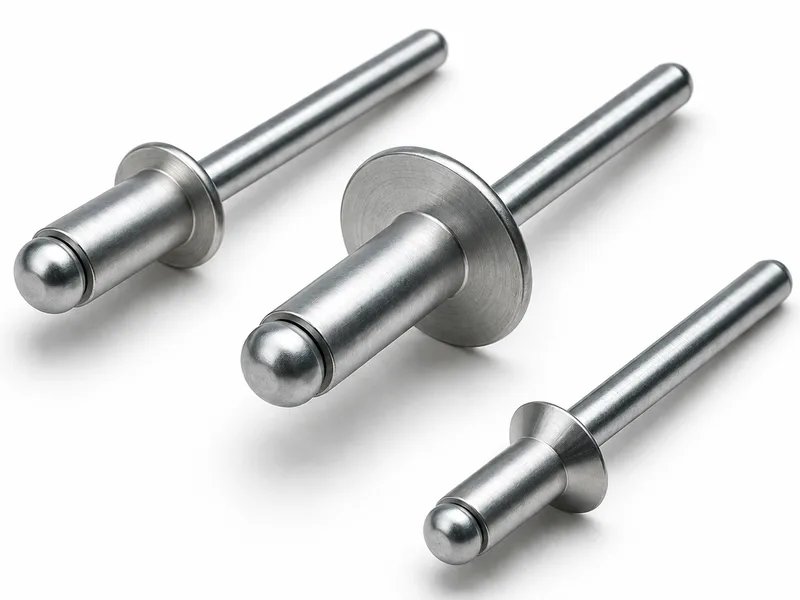
Specifications
Hardness is the working property of a self-piercing rivet, and it is a window, not a maximum. The rivet must be hard enough to pierce the top sheet, yet ductile enough to flare properly in the bottom sheet: too soft and the rivet collapses under the press before it pierces; too hard and it flares badly — thinning or piercing the bottom sheet, or cracking the flared tail. The collected industry guidance puts the choice explicitly against the sheets being joined, so the button (the flared interlock) forms correctly, with rivets offered in discrete hardness levels by each manufacturer. The collected published material is concrete about the hard end: boron steel SAE 10B35, whose only published property is 480 ± 30 HV — boron raising hardenability without costing ductility — used for SPR in automotive body joining. Process-side simulation makes the same point from both ends: at too low a rivet yield strength the rivet deforms before piercing the top sheet; at too high a yield it cannot deform, so no interlock forms. Selection is therefore a materials conversation, not a size lookup: state your sheet materials, thicknesses and stack order, and take the hardness level (and any coating against galvanic corrosion — a live issue when steel rivets join aluminum) from the manufacturer's level ladder or a trial fastening.
| Type | Hardened steel self-piercing rivet — hardness heat-treated into a cold-formed semi-hollow body; level chosen against the sheets being joined |
|---|---|
| Hardness window | Hard enough to pierce the top sheet, ductile enough to flare in the bottom sheet — too low collapses under the press; too high thins or pierces the bottom sheet or cracks the flared tail (industry guidance) |
| Published rivet material | Boron steel SAE 10B35 — 480 ± 30 HV (the published hardness; boron increases hardenability without loss of ductility) |
| Process window (simulation finding) | Rivet yield strength too low → rivet deforms before piercing; too high → rivet cannot deform and no interlock forms — hardness selection brackets the process |
| Base materials | Typically medium-carbon or boron-treated steel wire, multi-blow cold formed, hardness set by heat treatment; stainless steel, aluminum or copper in special circumstances |
| Hardness levels | Rivets offered in discrete hardness levels appropriate to the manufacturer — specify by application, not by a universal grade number |
| Coatings | Selected for corrosion resistance (galvanic corrosion is the key issue when steel rivets join aluminum, as in automotive) and appearance where the head stays unpainted — zinc, nickel, chrome plating, Geomet or baked-head finishes in the collected line |
| Piercing envelope (inch reference line) | Hardened 1/8 in rivets pierce .030–.060 in total work; 9/64 and 5/32 in hardened reach .060–.100 in; 3/16 in hardened reaches .100–.200 in — against an unhardened 1/8 in at .015–.035 in (typical sheet-metal basis) |
| MOQ / lead time | 10,000–50,000 pieces by size; 10–20 days |
Materials
- High-carbon steel (heat-treated)
- Boron steel (e.g. SAE 10B35, 480 ± 30 HV)
- Stainless steel / aluminum — special specification on request
Ordering & documentation
Documents
Shipments are backed by Mill Test Certificate (MTC), Dimensional Report, Salt Spray Test Report on request, with full batch traceability from raw material to finished product. Quality management follows the owner-confirmed compliance list: ISO 9001:2015, RoHS, REACH. Exact document sets are confirmed on the order.
Quotation
- The fastener family (Hardened Steel Self-Piercing Rivets) plus the standard designation from your drawing — DIN / ISO / JIS / ASTM / ANSI, or a drawing for custom parts.
- Size (diameter and length), thread type (metric or inch), property class or grade, and coating or finish.
- Quantity per size and your target delivery date.
- Destination country, and any required documents (for example a mill test certificate) so the quote includes them.
Sample & supply
Minimum order quantity is 10,000–50,000 pieces depending on size. Standard production run 10–20 days. Quantities or variants outside the standard range are confirmed at quotation.
Storage & shipping
Parts are packed for export and shipped factory-direct to buyers in Europe, Asia, the Americas and the Middle East. Store fasteners dry and protected until installation, and keep coated parts in their packaging until use; specific packing and preservation requirements can be stated on the order and confirmed at quotation.
Frequently asked questions
Why does rivet hardness matter more for SPR than for other rivets?
Because the rivet does two contradictory jobs in one stroke. It must act as a punch — hard enough to shear through the top sheet without itself deforming — and then immediately act as a rivet, flaring in the die without cracking. A blind or solid rivet never punches anything, so its hardness only matters for strength; an SPR's hardness is the process parameter. That is why the industry guidance ties the choice to the sheets being joined and why manufacturers ship discrete hardness levels: stack a harder top sheet and you step up a level — but past the window the flare cracks or the bottom sheet is pierced, so the level is validated by trial fastening on the real stack, not extrapolated.
Is 480 HV the hardness of all SPR rivets?
No — it is the published hardness of one specific rivet material, boron steel SAE 10B35, quoted at 480 ± 30 HV in the collected process literature. It is best read as the benchmark for the hard end of automotive structural SPR: hard enough to pierce advanced high-strength and aluminum-alloy body sheet. Other rivets in a manufacturer's ladder sit at lower hardness levels for softer or thinner stacks, and stainless, aluminum or copper rivets exist for special joints at much lower hardness again. Treat 480 HV as a reference point for the class, and take the actual level for your joint from the manufacturer's ladder or a trial on your sheets.
What is the MOQ and lead time for these rivets?
Minimum order quantity is 10,000–50,000 pieces depending on size and material. Standard production lead time is 10–20 days. Common blind rivet sizes are widely stocked — confirm the exact schedule against quantity and size mix at quotation.
What should an RFQ for these rivets state?
State the rivet subtype (open-end, closed-end, structural blind rivet or rivet nut), body diameter, grip range or total material thickness, head style (dome, countersunk or large flange), body and mandrel materials (for example aluminum body with steel mandrel, or all-stainless), finish, required certificates such as a mill test report per EN 10204 3.1, and quantity per size — plus destination country.
Request a Quote
Get factory-direct pricing from the manufacturer.
What to include in your inquiry
- ✓ Standard and property class (e.g. DIN 912, ISO 4762, class 8.8) — or a drawing for custom parts.
- ✓ Sizes, lengths and thread type (metric or inch).
- ✓ Quantity per size and your target delivery date.
- ✓ Destination country, plus any coating or finish requirement.
- ✓ Any documents you need with the shipment (e.g. mill test certificate) so the quote includes them.
- ✓ Your inquiry goes straight to the factory team by email and gets a reply within 24 hours.
- ✓ Factory-direct pricing
- ✓ Standard and custom specifications
- ✓ Factory-direct export to buyers in Europe, Asia, the Americas and the Middle East
- ✓ Full fastener family support