
DIN 302 Countersunk Head Rivets
DIN 302 countersunk head solid rivets, d1 10 to 36: 2011 and superseded 1993 editions with head geometry, and the commercial-length mass ladders to 160 mm.
Last updated: 2026-11
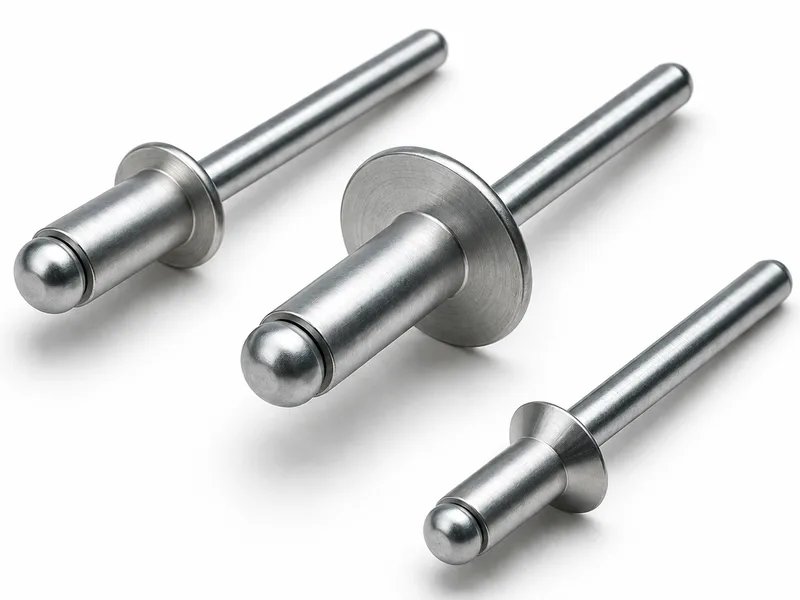
Specifications
DIN 302 is the large countersunk solid rivet — hot or cold set flush work in structural plate, shipbuilding and heavy fabrication. The collected 03/2011-edition table runs d1 10 to 36: head diameter dk nom (51 at d36), shank d min (34.6), head side e max (18), head height k ≈ (18) and the row r 2 (170 at d36); the superseded 05/1993 edition is transcribed as a second geometry table carrying its own tolerance style (d min/max 35.7/36.3, countersink angle a 45°/50°) — both verbatim, because legacy drawings split between the editions. The mass ladders (2011 and 1993 each split over two column blocks) price the commercial lengths from 10 up to 160 mm per diameter. The flush joint is the point of the standard: the countersink angle and e/k geometry in these tables are what the die and the hole preparation must reproduce.
| Standard / scope | DIN 302 countersunk head rivets — d1 10 to 36, edition 03/2011 (supersedes 05/1993; the 1993 edition transcribed as separate tables) |
|---|---|
| Head geometry 2011 | dk nom to 51, d min 34.6, e max 18, k ≈ 18, r 2 to 170 at d1 36 |
| Head geometry 1993 | dk nom 51, d min/max 35.7/36.3, k ≈ 18, countersink angle a min/max 45°/50° at d1 36 |
| Commercial lengths | Mass ladders (kg per 1000 pcs, ρ=7,85 kg/dm³) from l 10 to 160 across d1 10–36, current and 1993 editions each in two column blocks |
| Not tabulated | Material (steel/Cu/Al alloys), setting method (hot/cold), hole and countersink preparation — per RFQ |
Materials
- Solid rivets order by material family: steel grades for structural plate work (hot-set), copper and aluminium alloys where the joint wants ductility or corrosion pairing. The countersunk head sets flush only against a matched countersink — state the plate thickness stack and whether setting is hot or cold, because material choice follows the process. Mass tables give the exact order weight per 1000 pcs
Ordering & documentation
Documents
Shipments are backed by Mill Test Certificate (MTC), Dimensional Report, Salt Spray Test Report on request, with full batch traceability from raw material to finished product. Quality management follows the owner-confirmed compliance list: ISO 9001:2015, RoHS, REACH. Exact document sets are confirmed on the order.
Quotation
- The fastener family (DIN 302 Countersunk Head Rivets) plus the standard designation from your drawing — DIN / ISO / JIS / ASTM / ANSI, or a drawing for custom parts.
- Size (diameter and length), thread type (metric or inch), property class or grade, and coating or finish.
- Quantity per size and your target delivery date.
- Destination country, and any required documents (for example a mill test certificate) so the quote includes them.
Sample & supply
Minimum order quantity is 10,000–50,000 pieces depending on size. Standard production run 10–20 days. Quantities or variants outside the standard range are confirmed at quotation.
Storage & shipping
Parts are packed for export and shipped factory-direct to buyers in Europe, Asia, the Americas and the Middle East. Store fasteners dry and protected until installation, and keep coated parts in their packaging until use; specific packing and preservation requirements can be stated on the order and confirmed at quotation.
Frequently asked questions
Why are both the 2011 and 1993 editions on the page?
Because the source page prints the current 03/2011 edition and the superseded 05/1993 edition as separate tables, and the collected corpus transcribed both verbatim — the two editions differ in tolerance style (the 1993 table carries d min/max pairs and the countersink angle a 45°/50°, the 2011 table the r-row style), and fabrication drawings in service still reference both. For new work the 2011 edition governs; for replacing rivets against a legacy drawing, read the edition the drawing cites and order to it — the head diameters agree, the tolerancing does not. Send the drawing extract if the joint is qualification-controlled, and we set the order against the cited edition.
How do I size the countersink for a DIN 302 rivet?
From the head columns: the countersink must accept dk nom at the printed head height k ≈ and side e max — the hole is drilled to the shank d and countersunk deep enough that the flush result comes from the head sitting just below the plate surface before setting closes it. The 1993 table makes the angle explicit (a 45°/50° at the large sizes) and that is the practical check for tooling: match the countersink cutter angle to the edition the rivet is ordered to. The mass ladders then let you compute plate-thickness per length: rivet length ≈ grip plus the closing allowance the setting process dictates — state the grip on the RFQ and we confirm the length step from the printed ladder.
Request a Quote
Get factory-direct pricing from the manufacturer.
What to include in your inquiry
- ✓ Standard and property class (e.g. DIN 912, ISO 4762, class 8.8) — or a drawing for custom parts.
- ✓ Sizes, lengths and thread type (metric or inch).
- ✓ Quantity per size and your target delivery date.
- ✓ Destination country, plus any coating or finish requirement.
- ✓ Any documents you need with the shipment (e.g. mill test certificate) so the quote includes them.
- ✓ Your inquiry goes straight to the factory team by email and gets a reply within 24 hours.
- ✓ Factory-direct pricing
- ✓ Standard and custom specifications
- ✓ Factory-direct export to buyers in Europe, Asia, the Americas and the Middle East
- ✓ Full fastener family support