
DIN 7340 Tubular Rivets
Tubular rivets per DIN 7340 — hollow-ended shanks d1 1 to 10 mm with wall thickness s 0.2–1 mm, head diameters d2 1.6–15 mm, lengths to 60 mm in the collected table. Steel, aluminum or copper; the low-force rivet for blind-side-adjacent setting in thin sheet and plastics-friendly joints.
Last updated: 2026-11
Specifications
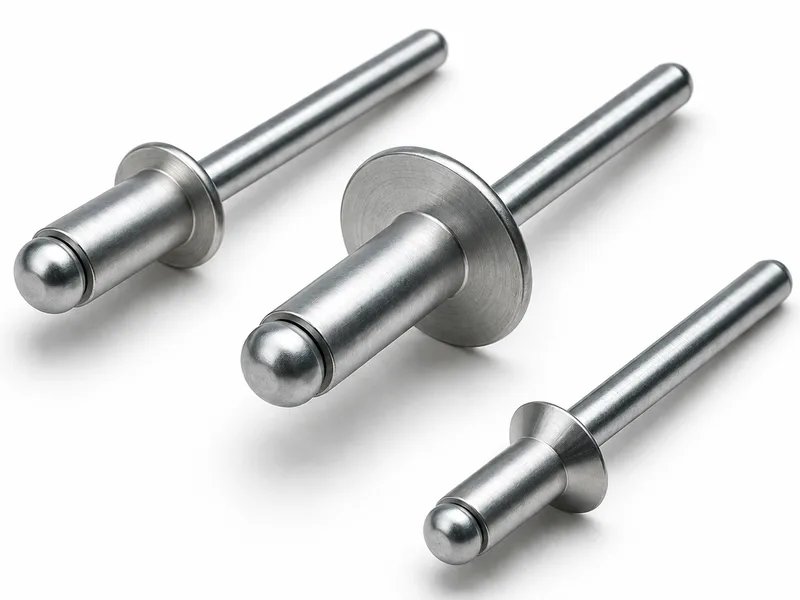
A tubular rivet is the semi-hollow middle ground of the rivet family: the shank is pierced at the plain end, leaving a thin wall (the collected table runs wall thickness s at ±10% from 0.2 mm up to 1 mm) that curls outward instead of needing a full solid head formed on the far side. That is the working advantage — setting force drops sharply compared with a solid rivet, and the thin-gauge materials DIN 7340 is listed in (steel, aluminium, copper) set cleanly in thin sheet, leather-to-metal and electrical-contact joints without the press capacity a solid shank demands. The collected standard table spans shank diameters d1 1 through 10 mm in two tolerance bands, matching head diameters d2 1.6 to 15 mm, head heights k 0.25 to 1.7 mm, and length ladders to 60 mm with per-1000-piece steel weights. The trade-off is shear capacity: the hollow end gives up cross-section, so tubular rivets are chosen where the joint load is light and the setting conditions — thin material, no heavy press — are the real constraint. Where the shank must carry structural shear, step back up to the solid DIN 660/DIN 661 line.
| Standard | DIN 7340 — tubular rivets; collected table "according to DIN 7340, dimensions in mm" |
|---|---|
| Shank diameters (d1) | 1, 1.2, 1.5, 2, 2.5, 3, 4 mm (tolerance ±0.03/±0.05/±0.07); 5, 6, 8, 10 mm (tolerance ±0.07 per collected table) |
| Wall thickness (s) | ±10% — d1 1–4: 0.2, 0.25, 0.3, 0.4, 0.5 by size step; d1 5–10: 0.3, 0.4, 0.5, 0.75, 1.0 mm |
| Head diameters (d2) | 1.6, 2, 2.5, 2.5, 3.2, 3.2, 4, 4, 4, 4.5, 4.5, 4.5, 6, 6, 6 mm (small series, tol ±0.15/±0.2/±0.25); 7.5, 9, 12, 15 mm (large series, tol ±0.25/±0.3) |
| Head height (k) | 0.25–0.8 mm (small series); 0.75–1.7 mm (large series) |
| Head fillet (r max) | 0.2–0.4 mm (small series); 0.5–1.0 mm (large series) |
| Length range (l) | 2–60 mm with per-step tolerances (±0.12 at 2 mm to ±0.35 at 55 mm); per-1000 steel weights tabulated at 7.85 kg/dm³ |
| Materials in the collected listing | Steel; non-ferrous: aluminium, copper (stainless and plastic rows not tabulated in the source) |
| MOQ / lead time | 10,000–50,000 pieces by size; 10–20 days |
Materials
- Steel
- Aluminium
- Copper
Ordering & documentation
Documents
Shipments are backed by Mill Test Certificate (MTC), Dimensional Report, Salt Spray Test Report on request, with full batch traceability from raw material to finished product. Quality management follows the owner-confirmed compliance list: ISO 9001:2015, RoHS, REACH. Exact document sets are confirmed on the order.
Quotation
- The fastener family (DIN 7340 Tubular Rivets) plus the standard designation from your drawing — DIN / ISO / JIS / ASTM / ANSI, or a drawing for custom parts.
- Size (diameter and length), thread type (metric or inch), property class or grade, and coating or finish.
- Quantity per size and your target delivery date.
- Destination country, and any required documents (for example a mill test certificate) so the quote includes them.
Sample & supply
Minimum order quantity is 10,000–50,000 pieces depending on size. Standard production run 10–20 days. Quantities or variants outside the standard range are confirmed at quotation.
Storage & shipping
Parts are packed for export and shipped factory-direct to buyers in Europe, Asia, the Americas and the Middle East. Store fasteners dry and protected until installation, and keep coated parts in their packaging until use; specific packing and preservation requirements can be stated on the order and confirmed at quotation.
Frequently asked questions
Tubular (DIN 7340) or solid (DIN 660) rivet for a thin-sheet joint?
Decide by setting force against shear load. The tubular rivet's pierced end curls with far less force, so it sets in thin sheet, soft non-ferrous stock and light-duty equipment without a heavy press — that is what the 0.2–1 mm wall is for. The solid rivet needs full-forming force but keeps its whole cross-section, so any joint rated for real shear belongs to the DIN 660/DIN 661 solid line. In practice: enclosures, electrical contacts and trim go tubular; brackets, chassis and structural metal go solid.
What is the MOQ and lead time for these rivets?
Minimum order quantity is 10,000–50,000 pieces depending on size and material. Standard production lead time is 10–20 days. Common blind rivet sizes are widely stocked — confirm the exact schedule against quantity and size mix at quotation.
What should an RFQ for these rivets state?
State the rivet subtype (open-end, closed-end, structural blind rivet or rivet nut), body diameter, grip range or total material thickness, head style (dome, countersunk or large flange), body and mandrel materials (for example aluminum body with steel mandrel, or all-stainless), finish, required certificates such as a mill test report per EN 10204 3.1, and quantity per size — plus destination country.
Request a Quote
Get factory-direct pricing from the manufacturer.
What to include in your inquiry
- ✓ Standard and property class (e.g. DIN 912, ISO 4762, class 8.8) — or a drawing for custom parts.
- ✓ Sizes, lengths and thread type (metric or inch).
- ✓ Quantity per size and your target delivery date.
- ✓ Destination country, plus any coating or finish requirement.
- ✓ Any documents you need with the shipment (e.g. mill test certificate) so the quote includes them.
- ✓ Your inquiry goes straight to the factory team by email and gets a reply within 24 hours.
- ✓ Factory-direct pricing
- ✓ Standard and custom specifications
- ✓ Factory-direct export to buyers in Europe, Asia, the Americas and the Middle East
- ✓ Full fastener family support