
DIN 1444 Clevis Pins with Head
DIN 1444 clevis pins with head, d 3 to 100: head and cotter geometry (dk, k, e, c, d1, le min) and the commercial length ladders to 200 mm with mass tables.
Last updated: 2026-11
Specifications
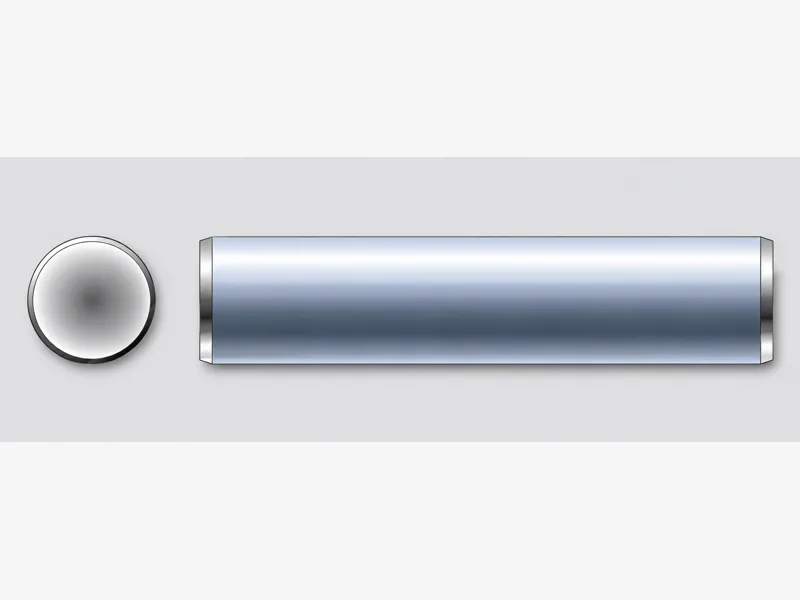
DIN 1444 is the headed clevis pin — the plain pin with a fixed head that carries fork joints, and the withdrawn source label appears right in the collected table header. The geometry table runs d 3 to 100: head diameter dk (120 at d 100), head height k (13), the cotter-side reference e (3) and c max (6), the cotter hole diameter d1 (13 at d 100) and its minimum edge distance le min (16) — the geometry that keeps the cotter from splitting the pin wall on the large sizes. Two mass ladders cover the commercial lengths: the first grid sizes d 3–20 across lengths 6 to 200, the second d 22–100 across 45 to 200 (mass ladder to 13500 kg per 1000 pcs at d 100 × 200). The cotter hole is what separates this from the plain DIN 1434/1443-class pins (registered separately): a DIN 1444 pin retains with a split cotter through d1, the cheapest field-serviceable pivot there is.
| Standard / scope | DIN 1444 clevis pins with head — d 3 to 100, withdrawn (source label) |
|---|---|
| Head geometry | dk and k per size (120 / 13 at d 100) — the fixed head that shoulders the fork |
| Cotter geometry | Cotter hole d1 (13 at d 100), edge distance le min 16, e / c max per size — cotter retention without splitting the pin |
| Commercial lengths | Two ladders: d 3–20 × l 6–200 and d 22–100 × l 45–200; approximate mass per 1000 pcs (ρ=7,85 kg/dm³) tabulated |
| Not tabulated | Material, hardness, tolerance class on d, cotter supply — per RFQ |
Materials
- Clevis pins order in free-cutting or case-hardening steel (the joint is a bearing, so hardness at the shank surface matters more than through-hardness), stainless A2/A4 for outdoor and food machinery, brass for light instrument linkages. State the fork width and the cotter size in use — the d1 cotter hole and the le min edge distance are fixed by the table, and mismatched cotters are the usual field failure on the large sizes
Ordering & documentation
Documents
Shipments are backed by Mill Test Certificate (MTC), Dimensional Report, Salt Spray Test Report on request, with full batch traceability from raw material to finished product. Quality management follows the owner-confirmed compliance list: ISO 9001:2015, RoHS, REACH. Exact document sets are confirmed on the order.
Quotation
- The fastener family (DIN 1444 Clevis Pins with Head) plus the standard designation from your drawing — DIN / ISO / JIS / ASTM / ANSI, or a drawing for custom parts.
- Size (diameter and length), thread type (metric or inch), property class or grade, and coating or finish.
- Quantity per size and your target delivery date.
- Destination country, and any required documents (for example a mill test certificate) so the quote includes them.
Sample & supply
Minimum order quantities and lead times for this family are confirmed at quotation — send your sizes, grades and quantities on the RFQ and the quote will carry a firm schedule. Sample availability is confirmed with the quotation.
Storage & shipping
Parts are packed for export and shipped factory-direct to buyers in Europe, Asia, the Americas and the Middle East. Store fasteners dry and protected until installation, and keep coated parts in their packaging until use; specific packing and preservation requirements can be stated on the order and confirmed at quotation.
Frequently asked questions
How does DIN 1444 differ from the other registered clevis pin standards?
By retention and head. The registered ISO 2341 and DIN 1443/1445 pages carry the tolerance-split series (with and without head, stud-end forms) where the pin is retained externally by washers or clips; DIN 1444 here is the headed pin with the integral cotter hole — head shoulders the fork, cotter through d1 retains, nothing else needed. That makes it the maintenance favourite: one pin, one cotter, and the joint opens with pliers. The trade is the cotter hole itself, which section-reduces the pin — for high-shear pivots the un-drilled series is stronger at the same d. Check which system your fork drawings assume: the fork slot widths and head sizes differ between the standards, and the tables here fix dk/k/d1 per size.
Why does the page split the length ladder into two tables?
The source page splits the commercial mass ladder at the size break — d 3 to 20 share one ladder (lengths 6 to 200) and d 22 to 100 another (lengths 45 to 200) — and the collected page transcribed both verbatim. Practically it reads as two markets: the small ladder is the light-machinery pin stocked in fine length steps, the large ladder is heavy-equipment pivot stock where the short lengths do not exist commercially. Order with the length under the head (the ladder dimension), the fork width, and the cotter spec; if your length sits between printed steps, custom lengths are quoted against the same head/cotter geometry from the first table.
Request a Quote
Get factory-direct pricing from the manufacturer.
What to include in your inquiry
- ✓ Standard and property class (e.g. DIN 912, ISO 4762, class 8.8) — or a drawing for custom parts.
- ✓ Sizes, lengths and thread type (metric or inch).
- ✓ Quantity per size and your target delivery date.
- ✓ Destination country, plus any coating or finish requirement.
- ✓ Any documents you need with the shipment (e.g. mill test certificate) so the quote includes them.
- ✓ Your inquiry goes straight to the factory team by email and gets a reply within 24 hours.
- ✓ Factory-direct pricing
- ✓ Standard and custom specifications
- ✓ Factory-direct export to buyers in Europe, Asia, the Americas and the Middle East
- ✓ Full fastener family support