
DIN 440 Round Washers for Wood Construction (Form V / Form R)
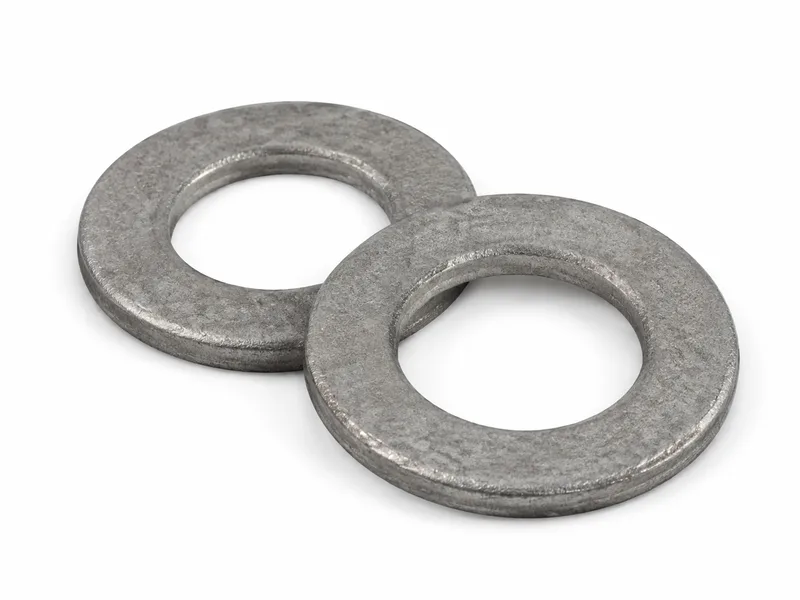
DIN 440 round washers for timber construction — form V with square hole (M5 to M22) and form R round hole (M5 to M52): hole, outer diameter, thickness bands and mass.
Last updated: 2026-11
Specifications
DIN 440 is the oversize washer for timber: the large outer diameter (form R at M52: d2 177.5/180 min/max) spreads the bolt load across wood fibres that a standard washer would crush into. The collected source carries both forms as separate tables: form V (square hole) M5 to M22 with the square hole width a min/max (24/26.84 at M22 — the square hole keys the washer against rotation under the timber-screw and coach-screw heads it serves), d2 min/max (78.1/80), thickness band h min/max (5/7) and mass; and form R (round hole) M5 to M52 with hole d1 min/max (56/57.2 at M52), the same large d2/h geometry and mass (1800 kg per 1000 pcs at M52). The form split is the ordering decision: square-hole V goes under coach bolts in laminated timber where the washer must not spin, round-hole R is the general timber/steel-plate washer across the full size range.
| Standard / scope | DIN 440 round washers for wood construction — form V square hole M5–M22; form R round hole M5–M52 (two separate source tables) |
|---|---|
| Form V square hole | a min/max per size (24/26.84 at M22); d2 min/max 78.1/80; h min/max 5/7 — hole squares off against rotation |
| Form R round hole | d1 min/max per size (56/57.2 at M52); d2 min/max 177.5/180; h min/max 8.8/11.2 — the full-range timber washer |
| Mass | Approximate kg per 1000 pcs (ρ=7,85 kg/dm³) per size in both tables (form V 210 at M22; form R 1800 at M52) |
| Not tabulated | Material, finish, edge treatment — per RFQ |
Materials
- Timber-construction washers order in mild steel, self-colour for protected structures and hot-dip galvanized for exterior timber — galvanizing adds thickness that matters in the h min/max band and the square-hole fit, so flag it. Stainless A2 for Cedar, larch and treated timbers where the preservatives attack zinc. State form (V or R), bolt size and timber species on the RFQ
Ordering & documentation
Documents
Shipments are backed by Mill Test Certificate (MTC), Dimensional Report, Salt Spray Test Report on request, with full batch traceability from raw material to finished product. Quality management follows the owner-confirmed compliance list: ISO 9001:2015, RoHS, REACH. Exact document sets are confirmed on the order.
Quotation
- The fastener family (DIN 440 Round Washers for Wood Construction (Form V / Form R)) plus the standard designation from your drawing — DIN / ISO / JIS / ASTM / ANSI, or a drawing for custom parts.
- Size (diameter and length), thread type (metric or inch), property class or grade, and coating or finish.
- Quantity per size and your target delivery date.
- Destination country, and any required documents (for example a mill test certificate) so the quote includes them.
Sample & supply
Minimum order quantity is 10,000 pieces. Stock items run 3–7 days. Quantities or variants outside the standard range are confirmed at quotation.
Storage & shipping
Parts are packed for export and shipped factory-direct to buyers in Europe, Asia, the Americas and the Middle East. Store fasteners dry and protected until installation, and keep coated parts in their packaging until use; specific packing and preservation requirements can be stated on the order and confirmed at quotation.
Frequently asked questions
Why a square hole — and when does form V actually matter?
Because in timber the washer's failure mode is rotation: as the coach screw or bolt head seats and the timber compresses unevenly, a round washer spins with the tightening and gouges the fibres, and later service torque re-gins the same scar. The form V square hole keys onto the square neck of coach bolts (the square under the head that stops spin in the timber) so washer and bolt rotate together or not at all. That coupling only exists where the bolt has the square neck — with ordinary threaded rod or hex bolts there is nothing to key to, and form R is the correct washer. So: coach bolts in exposed timber take V, everything else takes R; mixing them is the common order error this two-table standard exists to prevent.
Why is the outer diameter so much larger than a standard washer?
Wood is the weak side of the joint: its bearing strength is a fraction of steel's, so the load must be spread over enough area to stay under the crushing limit, especially across grain where timber crushes earliest. The d2 column shows the result — 80 mm at M22 form V, 180 mm at M52 form R, several times the equivalent standard washer — and the h band (5/7 to 8.8/11.2) keeps the big disc stiff enough not to dish under the head. The mass table is the cost side of that: at M52 these are kilogram-class washers. If your joint already has a steel plate distributing the load, you do not need DIN 440 — it is for washer-on-wood contact.
Request a Quote
Get factory-direct pricing from the manufacturer.
What to include in your inquiry
- ✓ Standard and property class (e.g. DIN 912, ISO 4762, class 8.8) — or a drawing for custom parts.
- ✓ Sizes, lengths and thread type (metric or inch).
- ✓ Quantity per size and your target delivery date.
- ✓ Destination country, plus any coating or finish requirement.
- ✓ Any documents you need with the shipment (e.g. mill test certificate) so the quote includes them.
- ✓ Your inquiry goes straight to the factory team by email and gets a reply within 24 hours.
- ✓ Factory-direct pricing
- ✓ Standard and custom specifications
- ✓ Factory-direct export to buyers in Europe, Asia, the Americas and the Middle East
- ✓ Full fastener family support