
Hex Thick Nuts (Inch Series)
Hex thick nuts, inch series 1/4 – 1 1/2 nominal — the taller hex pattern between the standard hex nut and the heavy hex nut, with the collected per-size table: width across flats and corners and thickness at basic/max/min.
Last updated: 2026-11
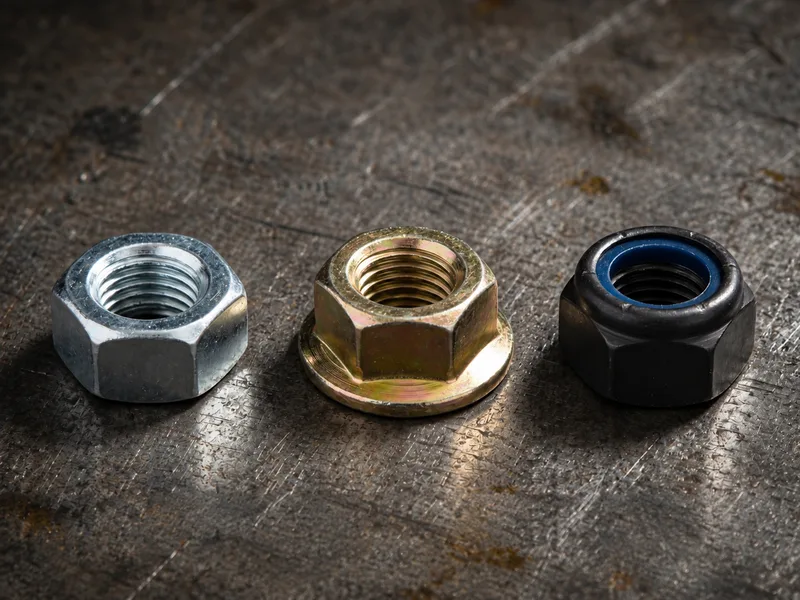
Specifications
The hex thick nut occupies the gap the inch hex system leaves between its two common patterns: same width across flats as the standard hex nut, but a thickness closer to (and above) the standard's — the tabulated data shows 9/16 basic thickness at 1/2 nominal, against 7/16 for a standard hex nut, on the same 3/4 flats. More thread engagement in the same wrench size is the whole point: where a joint needs extra length of thread in the nut — thin-walled tapped holes, studs that cannot be lengthened, threaded rod terminations — the thick nut buys engagement without changing the wrench or the envelope across the flats. The tabulated ladder runs 1/4 through 1 1/2 nominal and carries per size: width across flats F (fractional basic with max/min decimals — 3/4 basic, 0.750–0.736 at 1/2), across corners G (max/min) and thickness H (fractional basic with max/min — 9/16 basic, 0.573–0.552 at 1/2; 1 1/2 basic, 1.526–1.474 at 1 1/2). Two cautions from the tabulated data itself: 5/8 and 1.0 nominal are absent, so those sizes are not established (see the table footnote), and no governing standard is named for the pattern — quote the size and thread and the standard will be confirmed at RFQ. Threads, property classes and finishes are not tabulated — per RFQ.
| Pattern | Hex thick nut, inch series — standard-hex width across flats with elevated thickness for extra thread engagement; governing standard not named in the tabulated data |
|---|---|
| Size range | Nominal 1/4 – 1 1/2 in, ten distinct sizes in the tabulated ladder; 5/8 and 1.0 absent (not established in the tabulated data) |
| Tabulated geometry | Per size: width across flats F (basic/max/min), across corners G (max/min), thickness H (basic/max/min) — e.g. 1/2: F 3/4 basic (0.750–0.736), G 0.866–0.840, H 9/16 basic (0.573–0.552) |
| Thickness position | H basic sits between standard and heavy hex: 9/16 at 1/2 nominal (vs 7/16 standard, 9/16+ heavy envelope), rising to 1 1/2 at 1 1/2 nominal |
| Threads / classes / finishes | Not tabulated by the collected specification — per RFQ (state thread series, grade and finish at quotation) |
| Product | Nominal Dia. (d) | Width Across Flats (F) Basic | F Max | F Min | Width Across Corners (G) Max | G Min | Thickness (H) Basic | H Max | H Min |
|---|---|---|---|---|---|---|---|---|---|
| Hex Thick Nut | 0.2500 | 7/16 | 0.438 | 0.428 | 0.505 | 0.488 | 9/32 | 0.288 | 0.274 |
| Hex Thick Nut | 0.3125 | 1/2 | 0.500 | 0.489 | 0.577 | 0.557 | 21/64 | 0.336 | 0.320 |
| Hex Thick Nut | 0.3750 | 9/16 | 0.562 | 0.551 | 0.650 | 0.628 | 13/32 | 0.415 | 0.398 |
| Hex Thick Nut | 0.4375 | 11/16 | 0.688 | 0.675 | 0.794 | 0.768 | 29/64 | 0.463 | 0.444 |
| Hex Thick Nut | 0.5000 | 3/4 | 0.750 | 0.736 | 0.866 | 0.840 | 9/16 | 0.573 | 0.552 |
| Hex Thick Nut | 0.5000 | 3/4 | 0.750 | 0.736 | 0.866 | 0.840 | 9/16 | 0.573 | 0.552 |
| Hex Thick Nut | 0.5000 | 3/4 | 0.750 | 0.736 | 0.866 | 0.840 | 9/16 | 0.573 | 0.552 |
| Hex Thick Nut | 0.7500 | 1 1/8 | 1.125 | 1.088 | 1.299 | 1.240 | 13/16 | 0.827 | 0.798 |
| Hex Thick Nut | 0.7500 | 1 1/8 | 1.125 | 1.088 | 1.299 | 1.240 | 13/16 | 0.827 | 0.798 |
| Hex Thick Nut | 0.8750 | 1 5/16 | 1.312 | 1.269 | 1.516 | 1.447 | 29/32 | 0.922 | 0.890 |
| Hex Thick Nut | 1.1250 | 1 11/16 | 1.688 | 1.631 | 1.949 | 1.859 | 1 5/32 | 1.176 | 1.136 |
| Hex Thick Nut | 1.1250 | 1 11/16 | 1.688 | 1.631 | 1.949 | 1.859 | 1 5/32 | 1.176 | 1.136 |
| Hex Thick Nut | 1.3750 | 2 1/16 | 2.062 | 1.994 | 2.382 | 2.273 | 1 3/8 | 1.399 | 1.351 |
| Hex Thick Nut | 1.5000 | 2 1/4 | 2.250 | 2.175 | 2.598 | 2.480 | 1 1/2 | 1.526 | 1.474 |
- Row 6 (Hex Thick Nut): The 0.5000 row appears three times, 0.7500 and 1.1250 twice each — all reproduced verbatim.
- Row 8 (Hex Thick Nut): Sizes 5/8 and 1.0 are absent from the published ladder. Verify against the governing standard before quoting those sizes.
Materials
- Material, property class and finish specified per RFQ — thick nuts are commonly quoted for stud terminations; state the stud material and thread engagement requirement with the order
Ordering & documentation
Documents
Shipments are backed by Mill Test Certificate (MTC), Dimensional Report, Salt Spray Test Report on request, with full batch traceability from raw material to finished product. Quality management follows the owner-confirmed compliance list: ISO 9001:2015, RoHS, REACH. Exact document sets are confirmed on the order.
Quotation
- The fastener family (Hex Thick Nuts (Inch Series)) plus the standard designation from your drawing — DIN / ISO / JIS / ASTM / ANSI, or a drawing for custom parts.
- Size (diameter and length), thread type (metric or inch), property class or grade, and coating or finish.
- Quantity per size and your target delivery date.
- Destination country, and any required documents (for example a mill test certificate) so the quote includes them.
Sample & supply
Minimum order quantity is 10,000 pieces. Stock items run 3–7 days. Quantities or variants outside the standard range are confirmed at quotation.
Storage & shipping
Parts are packed for export and shipped factory-direct to buyers in Europe, Asia, the Americas and the Middle East. Store fasteners dry and protected until installation, and keep coated parts in their packaging until use; specific packing and preservation requirements can be stated on the order and confirmed at quotation.
Frequently asked questions
When do I specify a thick nut instead of a standard or heavy hex nut?
Decide on thread engagement first, wrench envelope second. The tabulated data shows the pattern's identity: at 1/2 nominal the thick nut keeps the standard hex nut's 3/4 basic flats (0.750–0.736) but carries 9/16 basic thickness (0.573–0.552) — about 29% more thread engagement than the standard's 7/16, in a nut your existing 3/4 wrench still fits. That is the case to specify one: a stud or threaded-rod termination where the nut must develop strength from engagement rather than from a longer stud, a tapped hole in thin material where every thread counts, or a re-assembly where the nut alone was the wearing part. It is not a heavy hex nut substitute: the heavy pattern grows the flats themselves (a 1/2 heavy hex nut takes a 7/8 wrench) for a larger bearing face, while the thick nut keeps the 3/4 face — so under a high-tension bolt where bearing stress on the joint face is the concern, the heavy pattern is the honest answer, and where engagement is the concern, the thick nut wins on envelope. One data caveat before quoting: 5/8 and 1.0 nominal are absent from the tabulated data, so those two sizes are not established — state them at RFQ and they will be confirmed against the governing standard rather than assumed from the table.
What is the MOQ and lead time for this nut type?
The minimum order quantity is 10,000 pieces. Stock items ship in 3–7 days; non-stock items are confirmed at quotation. Common sizes in this nut type are widely stocked; confirm the exact schedule against quantity and size mix at quotation.
Request a Quote
Get factory-direct pricing from the manufacturer.
What to include in your inquiry
- ✓ Standard and property class (e.g. DIN 912, ISO 4762, class 8.8) — or a drawing for custom parts.
- ✓ Sizes, lengths and thread type (metric or inch).
- ✓ Quantity per size and your target delivery date.
- ✓ Destination country, plus any coating or finish requirement.
- ✓ Any documents you need with the shipment (e.g. mill test certificate) so the quote includes them.
- ✓ Your inquiry goes straight to the factory team by email and gets a reply within 24 hours.
- ✓ Factory-direct pricing
- ✓ Standard and custom specifications
- ✓ Factory-direct export to buyers in Europe, Asia, the Americas and the Middle East
- ✓ Full fastener family support