
DIN 439 Thin Hex Jam Nuts
Thin hexagonal jam nuts per DIN 439 — about half the thickness of a standard hex nut (0.5 × diameter), in unchamfered Type A and chamfered Type B, right- and left-hand thread, M2 to M60 in steel, brass and stainless A2/A4. The lock nut you jam against a full nut, and the low-profile answer where a standard nut is too thick.
Last updated: 2026-11
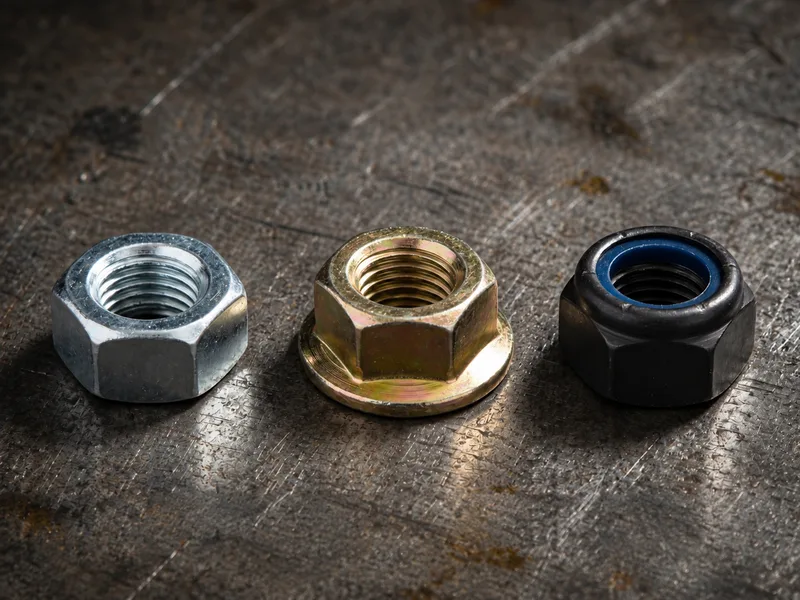
Specifications
A jam nut is a hex nut cut down to roughly half height — the collected DIN 439 spec puts it at 0.5 × diameter — and its two jobs both follow from that. Job one is locking: run the thin nut up against a standard nut and jam the pair against each other, and the assembly resists back-off without a nylon insert or deformed threads, which is why jam nuts appear on adjustment threads and turned linkages where the lock must survive re-tuning. Job two is clearance: where a full-height hex nut simply will not fit — shallow threads on a shaft end, a thin flange, a compact housing — the jam nut takes the thread with enough engagement for the application at half the stack height. DIN 439 covers both finishes, unchamfered Type A and chamfered Type B, in right- and left-hand thread, from M2 to M60 in steel, brass and stainless A2/A4. Torque the pair properly — hold the jam nut back while the full nut torques against it — or the "lock" is just two loose nuts.
| Standard | DIN 439 — thin hexagonal jam nut, thickness 0.5 × diameter |
|---|---|
| Forms | Type A unchamfered / Type B chamfered; right-hand and left-hand thread |
| Locking use | Threaded up against a standard nut, locking it in place |
| Clearance use | Low-profile alternative where a standard nut is too thick for the application |
| Size range | Stock M2 – M60; dimensions tabulated M2 – M48 |
| Dimensions at M10 | Width across flats s = 17 mm; thickness m = 5 mm |
| Series highlights (s × m, mm) | M6 10 × 3.2 · M8 13 × 4 · M12 19 × 6 · M16 24 × 8 · M20 30 × 10 · M24 36 × 12 |
| Materials | Steel, brass, stainless steel A2 and A4 |
| Typical applications | Lock-nut pairs on adjustment and linkage threads; low-clearance fastening on shaft ends and thin flanges |
Materials
- Steel
- Brass
- Stainless steel A2
- Stainless steel A4
Ordering & documentation
Documents
Shipments are backed by Mill Test Certificate (MTC), Dimensional Report, Salt Spray Test Report on request, with full batch traceability from raw material to finished product. Quality management follows the owner-confirmed compliance list: ISO 9001:2015, RoHS, REACH. Exact document sets are confirmed on the order.
Quotation
- The fastener family (DIN 439 Thin Hex Jam Nuts) plus the standard designation from your drawing — DIN / ISO / JIS / ASTM / ANSI, or a drawing for custom parts.
- Size (diameter and length), thread type (metric or inch), property class or grade, and coating or finish.
- Quantity per size and your target delivery date.
- Destination country, and any required documents (for example a mill test certificate) so the quote includes them.
Sample & supply
Minimum order quantity is 10,000 pieces. Stock items run 3–7 days. Quantities or variants outside the standard range are confirmed at quotation.
Storage & shipping
Parts are packed for export and shipped factory-direct to buyers in Europe, Asia, the Americas and the Middle East. Store fasteners dry and protected until installation, and keep coated parts in their packaging until use; specific packing and preservation requirements can be stated on the order and confirmed at quotation.
Frequently asked questions
How do I install a jam nut so it actually locks?
Order matters. Thread the jam nut on first, bottom it lightly, then run the full nut on top and torque the full nut against it while holding the jam nut back with a thin wrench — the two nuts load against each other and that axial preload is the lock. Tightening the pair "as one" leaves both loose and locks nothing. Because the thin nut carries the backlash, some practice puts the jam nut on the bottom so the full nut takes the wrench torque; either way, the lock comes from the counter-tension between the two, not from thread deformation. For re-tuned adjustment points, check the pair after each re-setting — a jam-nut lock is a service habit, not a one-time fit.
What is the MOQ and lead time for this nut type?
The minimum order quantity is 10,000 pieces. Stock items ship in 3–7 days; non-stock items are confirmed at quotation. Common diameters in this nut type are widely stocked; confirm the exact schedule against quantity and size mix at quotation.
What should an RFQ for this nut type state?
State the standard designation (for example DIN 985 or DIN 6923), nominal thread size and pitch (metric coarse unless fine pitch is required), material and strength pairing with the mating bolt, finish (plain, zinc, or hot-dip galvanized where compatible), required certificates such as a mill test report per EN 10204 3.1, and quantity per size — plus destination country.
Related knowledge
- Pairing a Nut to a Bolt: Property Class, Flange vs Hex, and What the Evidence Actually Settles
- Pairing a Nut to a Bolt: Property Class, Height, Engagement and Flange vs Hex
- Pairing a Nut to a Bolt: Property Class, Flange vs Hex, and What the Evidence Actually Settles
- Thread Locking for Vibration: Nylon Patch, Threadlocker, Safety Wire or Lock Washer — What the Evidence Can Rank
Request a Quote
Get factory-direct pricing from the manufacturer.
What to include in your inquiry
- ✓ Standard and property class (e.g. DIN 912, ISO 4762, class 8.8) — or a drawing for custom parts.
- ✓ Sizes, lengths and thread type (metric or inch).
- ✓ Quantity per size and your target delivery date.
- ✓ Destination country, plus any coating or finish requirement.
- ✓ Any documents you need with the shipment (e.g. mill test certificate) so the quote includes them.
- ✓ Your inquiry goes straight to the factory team by email and gets a reply within 24 hours.
- ✓ Factory-direct pricing
- ✓ Standard and custom specifications
- ✓ Factory-direct export to buyers in Europe, Asia, the Americas and the Middle East
- ✓ Full fastener family support