
DIN 7967 Self-Locking Counter Nuts
DIN 7967 self-locking counter nuts (sheet counter-nuts), M4 to M52 — the thin pressed lock nut that spins onto a bolt and locks by its deformed thread, with the collected per-size tables: P, d, e, m, s (h13) and t across Series 1/2/3, plus source mass rows.
Last updated: 2026-11
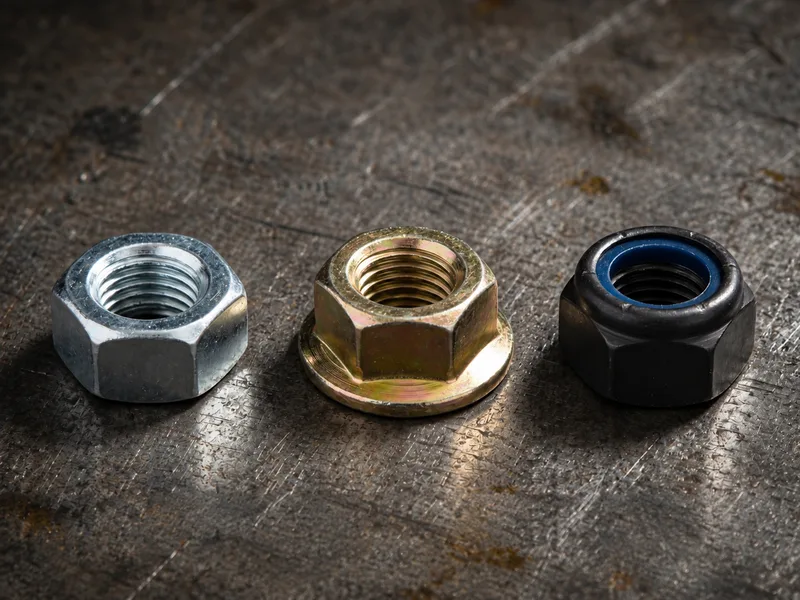
Specifications
DIN 7967 is the sheet-metal counter nut: a very thin pressed hexagonal nut — height m of just 2.5 mm at M4 rising to 16 mm at M52 — with a thread formed from folded sheet that locks by elastic deformation of its own flanks. Spun onto the bolt after the primary nut or component, it acts as the counter-nut: the deformed flanks grip the thread elastically and the pair will not walk, without nylo (so higher temperature tolerance than an insert lock nut), without a washer and at almost no added stack height. Because it is pressed from sheet, the standard is built around three pitch/diameter series — the collected tables print P, d, the sheet class t and the mass rows split into Series 1/2/3 sub-rows, with "-" where a series does not cover the size — and the width across flats carries the h13 tolerance the source prints on the s row. This is a light-duty lock: the counter nut stabilises a joint that already carries its load through the primary thread, so do not ask it to clamp on its own. Materials (typically spring or mild steel sheet) and finishes are not printed by the collected specification and stay per RFQ.
| Standard | DIN 7967 — self-locking counter nuts (thin pressed sheet counter-nuts) |
|---|---|
| Series | M4 – M52 (seven source column groups; P / d / t / mass split into Series 1/2/3 sub-rows as printed, "-" where a series does not cover the size) |
| Tabulated geometry | Per size and series: pitch P, counter-nut diameter d, e across corners (≈, 8.1–92.4 mm), height m (2.5–16 mm), s across flats (max=nominal h13 / min, 7–80 mm), sheet class t (0.3–1.7 mm), source mass per 1000 units ≈ kg |
| Locking mechanism | Elastic deformation of the pressed thread flanks — all-metal prevailing torque, no insert, reusable within its light-duty envelope |
| Duty boundary | Counter-nut: stabilises an existing joint — not a primary clamp; materials and finishes per RFQ |
| Attribute | M4 | M5 | M6 |
|---|---|---|---|
| P — Series 1 | 0.7 | 0.8 | 1 |
| Series 2 | - | - | - |
| Series 3 | - | - | - |
| d — Series 1 | 3.5 | 4.5 | 5.3 |
| Series 2 | - | - | - |
| Series 3 | - | - | - |
| e — ≈ | 8.1 | 9.2 | 11.5 |
| m | 2.5 | 2.5 | 3 |
| s — max=nominal size (h13) | 7 | 8 | 10 |
| min | 6.78 | 7.78 | 9.78 |
| t — Series 1 | 0.3 | 0.4 | 0.4 |
| Series 2 | - | - | - |
| Series 3 | - | - | - |
| per 1000 units≈kg — Series 1 | 0.17 | 0.28 | 0.4 |
| Series 2 | - | - | - |
| Series 3 | - | - | - |
| Attribute | M8 | M10 | M12 |
|---|---|---|---|
| P — Series 1 | 1.25 | 1.5 | 1.75 |
| Series 2 | 1 | 1.25 | 1.5 |
| Series 3 | - | 1 | 1.25 |
| d — Series 1 | 6.9 | 8.6 | 10.4 |
| Series 2 | 7.1 | 9 | 10.7 |
| Series 3 | - | 9.3 | 11 |
| e — ≈ | 15 | 19.6 | 21.9 |
| m | 3.5 | 4 | 4.5 |
| s — max=nominal size (h13) | 13 | 17 | 19 |
| min | 12.73 | 16.73 | 18.67 |
| t — Series 1 | 0.5 | 0.5 | 0.6 |
| Series 2 | 0.4 | 0.5 | 0.6 |
| Series 3 | - | 0.5 | 0.6 |
| per 1000 units≈kg — Series 1 | 0.9 | 1.4 | 1.9 |
| Series 2 | 0.7 | 1.4 | 1.9 |
| Series 3 | - | 1.4 | 1.9 |
| Attribute | M14 | M16 | M18 |
|---|---|---|---|
| P — Series 1 | 2 | 2 | 2.5 |
| Series 2 | 1.5 | 1.5 | 2 |
| Series 3 | - | - | 1.5 |
| d — Series 1 | 12 | 14.1 | 15.5 |
| Series 2 | 12.7 | 14.8 | 16.2 |
| Series 3 | - | - | 16.8 |
| e — ≈ | 25.4 | 27.7 | 31.2 |
| m | 5 | 5 | 5.5 |
| s — max=nominal size (h13) | 22 | 24 | 27 |
| min | 21.67 | 23.67 | 26.67 |
| t — Series 1 | 0.6 | 0.7 | 0.7 |
| Series 2 | 0.6 | 0.7 | 0.7 |
| Series 3 | - | - | 0.7 |
| per 1000 units≈kg — Series 1 | 2.5 | 3.4 | 4.1 |
| Series 2 | 2.5 | 3.4 | 4.1 |
| Series 3 | - | - | 4.1 |
| Attribute | M20 | M22 | M24 |
|---|---|---|---|
| P — Series 1 | 2.5 | 2.5 | 3 |
| Series 2 | 2 | 2 | 2 |
| Series 3 | 1.5 | 1.5 | 1.5 |
| d — Series 1 | 17.6 | 19.6 | 21 |
| Series 2 | 18.3 | 20.3 | 22.5 |
| Series 3 | 18.8 | 20.8 | 22.8 |
| e — ≈ | 34.6 | 36.9 | 41.6 |
| m | 6 | 6 | 7 |
| s — max=nominal size (h13) | 30 | 32 | 36 |
| min | 29.67 | 31.61 | 35.61 |
| t — Series 1 | 0.8 | 0.8 | 0.9 |
| Series 2 | 0.8 | 0.8 | 0.9 |
| Series 3 | 0.7 | 0.7 | 0.7 |
| per 1000 units≈kg — Series 1 | 5.8 | 6.4 | 9.5 |
| Series 2 | 5.8 | 6.4 | 9.5 |
| Series 3 | 5.1 | 5.6 | 7.4 |
| Attribute | M27 | M30 | M33 |
|---|---|---|---|
| P — Series 1 | 3 | 3.5 | 3.5 |
| Series 2 | 2 | 2 | 2 |
| Series 3 | - | - | - |
| d — Series 1 | 24.2 | 26.6 | 29.8 |
| Series 2 | 25.5 | 28.5 | 31.5 |
| Series 3 | - | - | - |
| e — ≈ | 47.3 | 53.1 | 57.7 |
| m | 7 | 8 | 8 |
| s — max=nominal size (h13) | 41 | 46 | 50 |
| min | 40.61 | 45.61 | 49.61 |
| t — Series 1 | 1 | 1.1 | 1.2 |
| Series 2 | 1 | 1 | 1 |
| Series 3 | - | - | - |
| per 1000 units≈kg — Series 1 | 13 | 17.5 | 22 |
| Series 2 | 13 | 16 | 18.5 |
| Series 3 | - | - | - |
| Attribute | M36 | M39 | M42 |
|---|---|---|---|
| P — Series 1 | 4 | 4 | 4.5 |
| Series 2 | 3 | 3 | 3 |
| Series 3 | - | - | - |
| d — Series 1 | 32.2 | 35.2 | 37.6 |
| Series 2 | 33.6 | 36.6 | 39.8 |
| Series 3 | - | - | - |
| e — ≈ | 63.5 | 69.3 | 75 |
| m | 9 | 9 | 11 |
| s — max=nominal size (h13) | 55 | 60 | 65 |
| min | 54.54 | 59.54 | 64.54 |
| t — Series 1 | 1.3 | 1.3 | 1.4 |
| Series 2 | 1.3 | 1.3 | 1.4 |
| Series 3 | - | - | - |
| per 1000 units≈kg — Series 1 | 29 | 32 | 45 |
| Series 2 | 29 | 32 | 45 |
| Series 3 | - | - | - |
| Attribute | M45 | M48 | M52 |
|---|---|---|---|
| P — Series 1 | 4.5 | 5 | 5 |
| Series 2 | 3 | 3 | 3 |
| Series 3 | - | - | - |
| d — Series 1 | 40.9 | 43.9 | 48.2 |
| Series 2 | 42.8 | 45.8 | 49.8 |
| Series 3 | - | - | - |
| e — ≈ | 80.8 | 86.5 | 92.4 |
| m | 12 | 14 | 16 |
| s — max=nominal size (h13) | 70 | 75 | 80 |
| min | 69.54 | 74.54 | 79.54 |
| t — Series 1 | 1.5 | 1.6 | 1.7 |
| Series 2 | 1.5 | 1.5 | 1.5 |
| Series 3 | - | - | - |
| per 1000 units≈kg — Series 1 | 64 | 80 | 95 |
| Series 2 | 64 | 75 | 80 |
| Series 3 | - | - | - |
Materials
- Sheet material and finish specified per RFQ — confirm the host thread and duty temperature at quotation
Ordering & documentation
Documents
Shipments are backed by Mill Test Certificate (MTC), Dimensional Report, Salt Spray Test Report on request, with full batch traceability from raw material to finished product. Quality management follows the owner-confirmed compliance list: ISO 9001:2015, RoHS, REACH. Exact document sets are confirmed on the order.
Quotation
- The fastener family (DIN 7967 Self-Locking Counter Nuts) plus the standard designation from your drawing — DIN / ISO / JIS / ASTM / ANSI, or a drawing for custom parts.
- Size (diameter and length), thread type (metric or inch), property class or grade, and coating or finish.
- Quantity per size and your target delivery date.
- Destination country, and any required documents (for example a mill test certificate) so the quote includes them.
Sample & supply
Minimum order quantity is 10,000 pieces. Stock items run 3–7 days. Quantities or variants outside the standard range are confirmed at quotation.
Storage & shipping
Parts are packed for export and shipped factory-direct to buyers in Europe, Asia, the Americas and the Middle East. Store fasteners dry and protected until installation, and keep coated parts in their packaging until use; specific packing and preservation requirements can be stated on the order and confirmed at quotation.
Frequently asked questions
Can a DIN 7967 counter nut replace a nylon-insert lock nut?
Only inside its light-duty envelope — and it earns its place on two counts. Count one: temperature. The lock is elastic deformation of the pressed sheet thread, not a nylon collar, so where a nyloc loses grip near the insert's ceiling the DIN 7967 keeps locking; the collected tables carry no temperature limit, so confirm the sheet grade at RFQ for hot duty. Count two: stack. At 2.5 mm height (M4) to 16 mm (M52) it adds almost nothing to the thread run, which matters on long adjustment threads and fine-pitch rods. But the load path is the limit: the counter nut's clamp contribution is small — it is there to stop relative rotation, not to carry preload — so on a primary structural joint use a proper lock nut (DIN 982/980) and keep the DIN 7967 for counter-nut duty on rods, adjusters and light assemblies. Read the Series 1/2/3 rows in the collected table against the pitch you need: the series, not just the size, defines the part.
What is the MOQ and lead time for this nut type?
The minimum order quantity is 10,000 pieces. Stock items ship in 3–7 days; non-stock items are confirmed at quotation. Common sizes in this nut type are widely stocked; confirm the exact schedule against quantity and size mix at quotation.
Request a Quote
Get factory-direct pricing from the manufacturer.
What to include in your inquiry
- ✓ Standard and property class (e.g. DIN 912, ISO 4762, class 8.8) — or a drawing for custom parts.
- ✓ Sizes, lengths and thread type (metric or inch).
- ✓ Quantity per size and your target delivery date.
- ✓ Destination country, plus any coating or finish requirement.
- ✓ Any documents you need with the shipment (e.g. mill test certificate) so the quote includes them.
- ✓ Your inquiry goes straight to the factory team by email and gets a reply within 24 hours.
- ✓ Factory-direct pricing
- ✓ Standard and custom specifications
- ✓ Factory-direct export to buyers in Europe, Asia, the Americas and the Middle East
- ✓ Full fastener family support