
DIN 977 Hexagon Weld Nuts with Flange
DIN 977 hexagon weld nuts with flange, M5–M16 — the flanged hex nut resistance-welded onto sheet or bracket faces, with the collected flange/weld-face geometry ladder.
Last updated: 2026-11
Specifications
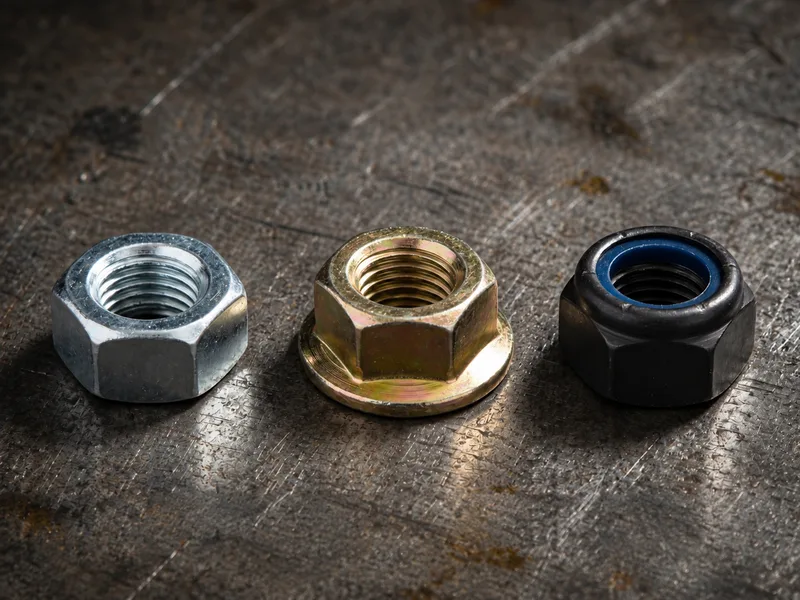
A DIN 977 weld nut puts a reusable machine thread onto a sheet-metal face where a tapped hole would be too thin to hold: the flange ring under the hex is the weld face, and resistance (projection) welding collapses it into the sheet in a fraction of a second, leaving a flush, permanent nut the paint line can run over. The collected ladder runs M5 to M16 and carries per size the flange diameter dc (15,5 → 36,5 mm), the nut height h (1,7 → 4 mm — these nuts sit low because the sheet, not the nut body, carries the joint), the weld-projection n (4 → 8), the hex width k across flats in its max./min. pair (5/4,7 at M5 up to 19,5/18,66 at M16), and the pitch columns — the source serves a small/large pitch pair, with the coarse series alone below M12. S and N are printed letter-only by the source; reproduce them with care (see the table note). Welding side matters: the flange goes against the electrode side with the projection ring set to collapse first, and the sheet must be bare at the weld spot — paint, scale and galvanising are removed or pierced before the weld. Where the joint is a stud-side rather than a nut-side thread, the weld stud pages in bolts are the counterpart; where the sheet is too thin for projection welding, a rivet nut (this catalog's rivets family) sets mechanically instead. Materials and plating are not tabulated by the collected specification — per RFQ.
| Standard | DIN 977 — hexagon weld nuts with flange (projection-weld flange ring under the hex) |
|---|---|
| Size range | M5 – M16, seven sizes in the collected ladder |
| Flange | dc: 15,5 → 36,5 mm across the ladder |
| Height / projection | h: 1,7 → 4 mm; weld-projection n: 4 → 8 |
| Hex width (k, max./min.) | 5 / 4,7 (M5) → 19,5 / 18,66 (M16) |
| Pitch | Coarse series only below M12 ("-" in the small-pitch column); from M12 the source lists small (1,5) and large (1,75 → 2) pitches |
| Materials / finishes | Not tabulated by the collected specification — per RFQ (state sheet thickness, material and weld schedule at quotation) |
| Thread (d) | P (small) | P (large) | Flange Dia. (dc) | h | n | k (max.) | k (min.) | S | N |
|---|---|---|---|---|---|---|---|---|---|
| M5 | - | 0,8 | 15,5 | 1,7 | 4 | 5 | 4,7 | 8 | 2,9 |
| M6 | - | 1 | 18,5 | 2 | 5 | 7 | 6,64 | 10 | 5,7 |
| M8 | - | 1,25 | 22,5 | 2,5 | 6 | 10 | 9,64 | 13 | 12,2 |
| M10 | - | 1,5 | 26,5 | 3 | 7 | 13 | 12,57 | 16 | 21,8 |
| M12 | 1,5 | 1,75 | 30,5 | 3 | 8 | 15 | 14,57 | 18 | 29,4 |
| M14 | 1,5 | 2 | 33,5 | 4 | 8 | 17 | 16,16 | 21 | 45,8 |
| M16 | 1,5 | 2 | 36,5 | 4 | 8 | 19,5 | 18,66 | 24 | 63,1 |
- Row 1 (M5): The S and N columns carry no legend in the collected capture (letter-only headers over a two-row flattened header); all figures are reproduced as printed. Verify against DIN 977 before quoting S/N-dependent process data (weld tip sizing).
Materials
- Material specified per RFQ — weldability drives the choice (low-carbon steel welds clean; check the weld schedule for coated or higher-alloy bodies); state the host sheet and electrode access with the order
Ordering & documentation
Documents
Shipments are backed by Mill Test Certificate (MTC), Dimensional Report, Salt Spray Test Report on request, with full batch traceability from raw material to finished product. Quality management follows the owner-confirmed compliance list: ISO 9001:2015, RoHS, REACH. Exact document sets are confirmed on the order.
Quotation
- The fastener family (DIN 977 Hexagon Weld Nuts with Flange) plus the standard designation from your drawing — DIN / ISO / JIS / ASTM / ANSI, or a drawing for custom parts.
- Size (diameter and length), thread type (metric or inch), property class or grade, and coating or finish.
- Quantity per size and your target delivery date.
- Destination country, and any required documents (for example a mill test certificate) so the quote includes them.
Sample & supply
Minimum order quantity is 10,000 pieces. Stock items run 3–7 days. Quantities or variants outside the standard range are confirmed at quotation.
Storage & shipping
Parts are packed for export and shipped factory-direct to buyers in Europe, Asia, the Americas and the Middle East. Store fasteners dry and protected until installation, and keep coated parts in their packaging until use; specific packing and preservation requirements can be stated on the order and confirmed at quotation.
Frequently asked questions
DIN 977 or DIN 929 — which weld nut does my sheet want?
Both are projection weld nuts; they differ in what sits against the sheet. DIN 929 (covered in this catalog) is the hex with weld projections on the nut face and no flange — it sits proud and takes up less boss space. DIN 977 adds the flange ring under the hex: a larger, more forgiving weld face (dc 15,5 → 36,5 mm across M5–M16 in the collected table) that spreads the weld current and gives the painted assembly a broader bearing surface, at the cost of a bigger flat spot on the sheet. Practical read from the collected ladder: use the flanged DIN 977 when the sheet is thin enough that a six-projection hex face over-concentrates heat, or when the finished face wants the load spread; use DIN 929 on thicker sheet where the smaller print is an advantage. One caution from the capture: the source prints the S and N columns with letter-only headers — verify those figures against DIN 977 before they drive weld-tip sizing. Sheet thickness range, electrode schedule and plating are RFQ lines.
Request a Quote
Get factory-direct pricing from the manufacturer.
What to include in your inquiry
- ✓ Standard and property class (e.g. DIN 912, ISO 4762, class 8.8) — or a drawing for custom parts.
- ✓ Sizes, lengths and thread type (metric or inch).
- ✓ Quantity per size and your target delivery date.
- ✓ Destination country, plus any coating or finish requirement.
- ✓ Any documents you need with the shipment (e.g. mill test certificate) so the quote includes them.
- ✓ Your inquiry goes straight to the factory team by email and gets a reply within 24 hours.
- ✓ Factory-direct pricing
- ✓ Standard and custom specifications
- ✓ Factory-direct export to buyers in Europe, Asia, the Americas and the Middle East
- ✓ Full fastener family support