
DIN 985 Nylon-Insert Lock Nuts
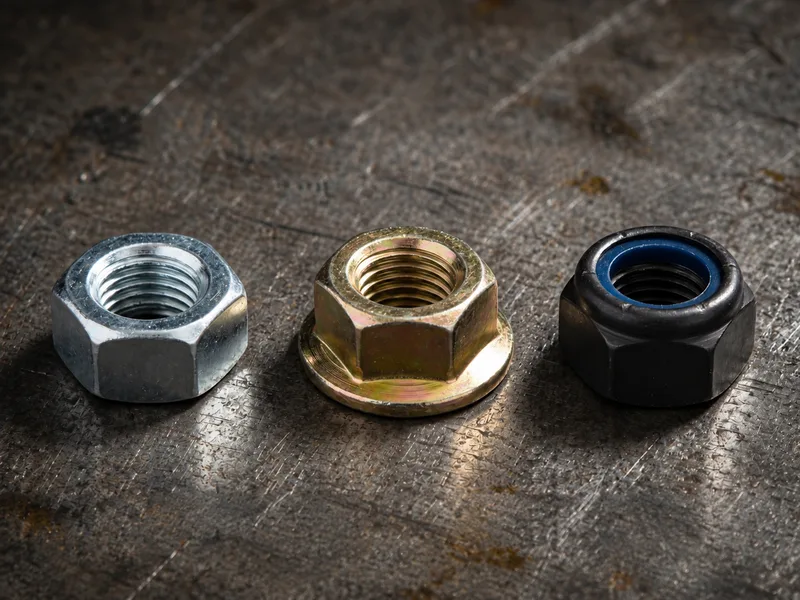
Nylon-insert prevailing-torque lock nuts per DIN 985 — a nylon collar grips the bolt threads and resists back-off, good to roughly 250°F (≈120°C), reusable a few times. The everyday lock nut for general assembly and moderate vibration.
Last updated: 2026-11
Specifications
The nyloc is the everyday lock nut: a nylon collar molded into the top of the nut deforms around the bolt threads, creating friction that resists back-off without galling the thread or marring the bearing surface. It is inexpensive, effective against moderate vibration, and needs no special installation practice — torque it like a standard hex nut. Its limit is temperature: above roughly 250°F (≈120°C) the nylon softens and the locking action degrades, so it does not belong on engines, exhaust systems or other hot spots — those call for an all-metal prevailing-torque nut such as DIN 980.
| Standard | DIN 985 — hex lock nut, nylon insert (non-metallic prevailing torque) |
|---|---|
| Locking mechanism | Nylon collar deforms around the bolt threads and grips by friction |
| Temperature limit | About 250°F (≈120°C) — above it the nylon softens and the lock degrades |
| Reuse | Reusable a few times before the nylon insert wears out |
| Typical applications | General assembly and moderate-vibration joints; not for engines, exhaust or other hot spots |
| Thread (d) | P | da min | da max | dw min | e min | h nominal = max | h min | m min | m' min | s nominal = max | s min | Also threaded (per source) |
|---|---|---|---|---|---|---|---|---|---|---|---|---|
| M3 | 0,5 | 3 | 3,45 | 4,6 | 6,01 | 4 | 3,7 | 2,4 | 1,65 | 5,5 | 5,32 | - |
| M4 | 0,7 | 4 | 4,6 | 5,9 | 7,66 | 5 | 4,7 | 2,9 | 2,2 | 7 | 6,78 | - |
| M5 | 0,8 | 5 | 5,75 | 6,9 | 8,79 | 5 | 4,7 | 3,2 | 2,75 | 8 | 7,78 | - |
| M6 | 1 | 6 | 6,75 | 8,9 | 11,05 | 6 | 5,7 | 4 | 3,3 | 10 | 9,78 | - |
| M7 | 1 | 7 | 7,75 | 9,6 | 12,12 | 7,5 | 7,14 | 4,7 | 3,85 | 11 | 10,73 | - |
| M8 | 1,25 | 8 | 8,75 | 11,6 | 14,38 | 8 | 7,64 | 5,5 | 4,4 | 13 | 12,73 | M8x1 |
| M10 | 1,5 | 10 | 10,8 | 15,6 | 18,9 | 10 | 9,64 | 6,5 | 5,5 | 17 | 16,73 | M10x1 / M10x1,25 |
| M12 | 1,75 | 12 | 13 | 17,4 | 21,1 | 12 | 11,57 | 8 | 6,6 | 19 | 18,67 | M12x1,5 / M12x1,25 |
| M14 | 2 | 14 | 15,1 | 20,5 | 24,49 | 14 | 13,3 | 9,5 | 7,7 | 22 | 21,67 | M14x1,5 |
| M16 | 2 | 16 | 17,3 | 22,5 | 26,75 | 16 | 15,3 | 10,5 | 8,8 | 24 | 23,67 | M16x1,5 |
| M18 | 2,5 | 18 | 19,5 | 24,9 | 29,56 | 18,5 | 17,66 | 13 | 9,9 | 27 | 26,16 | M18x2 / M18x1,5 |
| M20 | 2,5 | 20 | 21,6 | 27,7 | 32,95 | 20 | 18,7 | 14 | 11 | 30 | 29,16 | M20x2 / M20x1,5 |
| M22 | 2,5 | 22 | 23,7 | 29,5 | 35,03 | 22 | 20,7 | 15 | 12,2 | 32 | 31 | M22x2 / M22x1,5 |
| M24 | 3 | 24 | 25,9 | 33,2 | 39,55 | 24 | 22,7 | 15 | 13,2 | 36 | 35 | M24x2 |
| M27 | 3 | 27 | 29,1 | 38 | 45,2 | 27 | 25,7 | 17 | 14,8 | 41 | 40 | M27x2 |
| M30 | 3,5 | 30 | 32,4 | 42,7 | 50,85 | 30 | 28,7 | 19 | 16,5 | 46 | 45 | M30x2 |
| M33 | 3,5 | 33 | 35,6 | 46,6 | 55,37 | 33 | 31,4 | 22 | 18,2 | 50 | 46 | M33x2 |
| M36 | 4 | 36 | 38,9 | 51,1 | 60,79 | 36 | 34,4 | 25 | 19,8 | 55 | 53,8 | M36x3 |
| M39 | 4 | 39 | 42,1 | 55,9 | 66,44 | 39 | 37,4 | 27 | 21,5 | 60 | 58,8 | M39x3 |
| M42 | 4,5 | 42 | 45,4 | 60,6 | 72,09 | 42 | 40,4 | 29 | 23,1 | 65 | 63,8 | M42x3 |
| M45 | 4,5 | 45 | 48,6 | 64,7 | 76,95 | 45 | 43,4 | 32 | 24,8 | 70 | 68,1 | M45x3 |
| M48 | 5 | 48 | 51,8 | 69,4 | 82,6 | 48 | 46,4 | 36 | 26,5 | 75 | 73,1 | M48x3 |
- Row 12 (M20): The source splits the ladder at M20 into a second table — merged here with no value changes. The site-added weight row (kg/1000 pcs at 7.85 kg/dm³) is a calculated site column, not part of the standard, and is excluded from this table.
- Row 16 (M30): The source prints the M33 s min as 46 — against the max of 50 and the neighbouring ladder (M30: 45/46, M36: 53,8) — reproduced verbatim; treat with care (a 50-max nut with a 46-min flat envelope leaves no manufacturing band). Verify against ISO 10511 before quoting M33.
- Row 1 (M3): Prevailing-torque performance, property classes and finishes are not tabulated by the source — per RFQ. M24 and M27 fill the gap registered when the earlier amesweb capture stopped short of them.
Materials
- Steel
- Stainless steel
- Brass
Ordering & documentation
Documents
Shipments are backed by Mill Test Certificate (MTC), Dimensional Report, Salt Spray Test Report on request, with full batch traceability from raw material to finished product. Quality management follows the owner-confirmed compliance list: ISO 9001:2015, RoHS, REACH. Exact document sets are confirmed on the order.
Quotation
- The fastener family (DIN 985 Nylon-Insert Lock Nuts) plus the standard designation from your drawing — DIN / ISO / JIS / ASTM / ANSI, or a drawing for custom parts.
- Size (diameter and length), thread type (metric or inch), property class or grade, and coating or finish.
- Quantity per size and your target delivery date.
- Destination country, and any required documents (for example a mill test certificate) so the quote includes them.
Sample & supply
Minimum order quantity is 10,000 pieces. Stock items run 3–7 days. Quantities or variants outside the standard range are confirmed at quotation.
Storage & shipping
Parts are packed for export and shipped factory-direct to buyers in Europe, Asia, the Americas and the Middle East. Store fasteners dry and protected until installation, and keep coated parts in their packaging until use; specific packing and preservation requirements can be stated on the order and confirmed at quotation.
Frequently asked questions
How many times can a nylon-insert lock nut be reused?
A few times. Each installation compresses the nylon collar further, and the grip fades as the insert wears — a nyloc that has been on and off several times no longer delivers its original prevailing torque. For joints that are serviced frequently, or for any high-temperature location, an all-metal lock nut (DIN 980) is the specification that keeps its lock over more cycles.
What is the MOQ and lead time for this nut type?
The minimum order quantity is 10,000 pieces. Stock items ship in 3–7 days; non-stock items are confirmed at quotation. Common diameters in this nut type are widely stocked; confirm the exact schedule against quantity and size mix at quotation.
What should an RFQ for this nut type state?
State the standard designation (for example DIN 985 or DIN 6923), nominal thread size and pitch (metric coarse unless fine pitch is required), material and strength pairing with the mating bolt, finish (plain, zinc, or hot-dip galvanized where compatible), required certificates such as a mill test report per EN 10204 3.1, and quantity per size — plus destination country.
Related knowledge
Request a Quote
Get factory-direct pricing from the manufacturer.
What to include in your inquiry
- ✓ Standard and property class (e.g. DIN 912, ISO 4762, class 8.8) — or a drawing for custom parts.
- ✓ Sizes, lengths and thread type (metric or inch).
- ✓ Quantity per size and your target delivery date.
- ✓ Destination country, plus any coating or finish requirement.
- ✓ Any documents you need with the shipment (e.g. mill test certificate) so the quote includes them.
- ✓ Your inquiry goes straight to the factory team by email and gets a reply within 24 hours.
- ✓ Factory-direct pricing
- ✓ Standard and custom specifications
- ✓ Factory-direct export to buyers in Europe, Asia, the Americas and the Middle East
- ✓ Full fastener family support