
DIN 6923 Serrated Flange Nuts
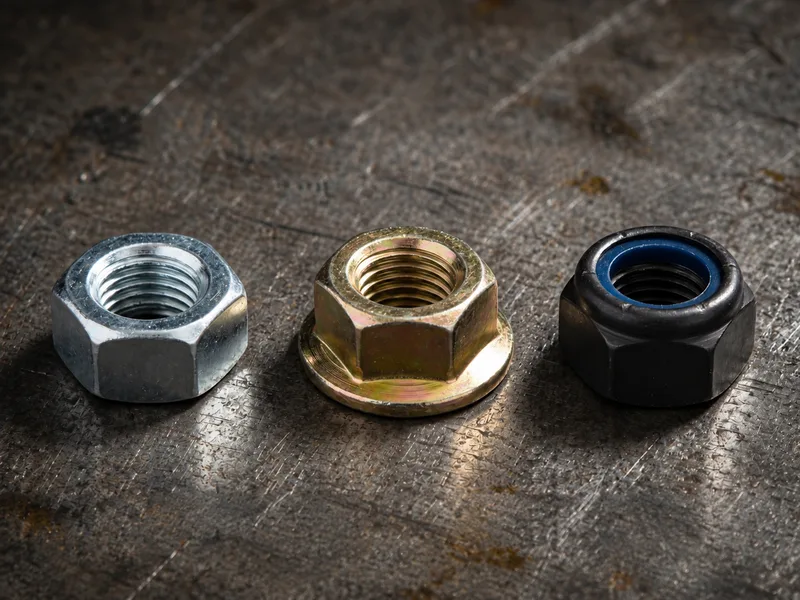
Serrated hex flange nuts per DIN 6923 — a built-in flange spreads the load like an integrated washer while conical teeth bite the bearing surface and resist back-off. All-steel, high temperature capable, the lock nut for soft or thin materials.
Last updated: 2026-11
Specifications
The serrated flange nut combines three parts in one: a hex nut, a washer, and a lock. The flange spreads the clamp load over a larger bearing area — the reason it earns its place on soft or thin materials that a plain hex nut would dig into — while the conical teeth on the flange face bite the mating surface and resist back-off by bite rather than by thread friction. It is all steel, so it carries the high temperatures that exclude nylon-insert nuts. The bite has a cost: the teeth mark the mating surface, so it is not the choice for finished or repeatedly refit faces.
| Standard | DIN 6923 — serrated hex flange nut (inch-series counterparts IFI 100/107) |
|---|---|
| Locking mechanism | Teeth on the flange bite into the bearing surface and resist back-off |
| Bearing face | Built-in flange spreads the load like an integrated washer |
| Temperature limit | High — all-steel construction |
| Surface note | Flange teeth mar the mating surface |
| Typical applications | Soft or thin materials and joints that need a built-in washer plus bite |
| Supply condition | Commonly supplied case hardened |
| Thread (d) | P | c min | da min | da max | dc max | dw min | e min | m max | m min | m' min | s nominal = max | s min | r max | Also threaded (per source) |
|---|---|---|---|---|---|---|---|---|---|---|---|---|---|---|
| M5 | 0,8 | 1 | 5 | 5,75 | 11,8 | 9,8 | 8,79 | 5 | 4,7 | 2,2 | 8 | 7,78 | 0,3 | - |
| M6 | 1 | 1,1 | 6 | 6,75 | 14,2 | 12,2 | 11,05 | 6 | 5,7 | 3,1 | 10 | 9,78 | 0,36 | - |
| M8 | 1,25 | 1,2 | 8 | 8,75 | 17,9 | 15,8 | 14,38 | 8 | 7,6 | 4,5 | 13 | 12,73 | 0,48 | M8x1 |
| M10 | 1,5 | 1,5 | 10 | 10,8 | 21,8 | 19,6 | 16,64 | 10 | 9,6 | 5,5 | 15 | 14,73 | 0,6 | M10x1,25 / (M10x1) |
| M12 | 1,75 | 1,8 | 12 | 13 | 26 | 23,8 | 20,03 | 12 | 11,6 | 6,7 | 18 | 17,73 | 0,72 | (M12x1,5) |
| M14 | 2 | 2,1 | 14 | 15,1 | 29,9 | 27,6 | 23,36 | 14 | 13,3 | 7,8 | 21 | 20,67 | 0,88 | M14x1,5 |
| M16 | 2 | 2,4 | 16 | 17,3 | 34,5 | 31,9 | 26,75 | 16 | 15,3 | 9 | 24 | 23,67 | 0,96 | M16x1,5 |
| M20 | 2,5 | 3 | 20 | 21,6 | 42,8 | 39,9 | 32,95 | 20 | 18,9 | 11,1 | 30 | 29,67 | 1,2 | M20x1,5 |
| Thread (d x pitch) | Width Across Flats (s) | Flange Dia. (dc min) | Height (m) |
|---|---|---|---|
| M8x1 | 13 | 17.9 | 8.0 |
| M10x1 | 15 | 21.8 | 9.6 |
| M12x1.5 | 18 | 26.0 | 11.6 |
| M14x1.5 | 21 | 29.9 | 13.4 |
| M16x1.5 | 24 | 34.5 | 15.9 |
| M18x1.5 | 27 | 39.9 | 17.9 |
| M20x1.5 | 30 | 42.8 | 19.2 |
| Thread (d) | Width Across Flats (s) | Flange Dia. (dc) | Height (m) |
|---|---|---|---|
| M5 | 8 | 11.8 | 6.9 |
| M6 | 10 | 14.2 | 8.0 |
| M8 | 13 | 17.9 | 9.5 |
| M10 | 15 | 21.8 | 12.4 |
| M12 | 18 | 26.0 | 14.9 |
| M16 | 24 | 34.5 | 19.0 |
| M20 | 30 | 42.8 | 23.0 |
- Row 5 (M12): The source ladder jumps M12 → M16; M14 is not tabulated. Verify against ISO 7043 before quoting M14.
| Thread (d x pitch) | Width Across Flats (s) | Flange Dia. (dc) | Height (m max) |
|---|---|---|---|
| M8x1 | 13 | 15.8 | 9.5 |
| M10x1 | 15 | 19.6 | 11.9 |
| M12x1.5 | 18 | 23.8 | 14.9 |
| M14x1.5 | 21 | 27.6 | 16.9 |
| M16x1.5 | 24 | 31.9 | 18.9 |
| M20x1.5 | 30 | 39.9 | 22.9 |
- Row 5 (M16x1.5): The fine ladder jumps M16x1.5 → M20x1.5 (no M18x1.5 row) in the source — reproduced verbatim. ISO 12125 M6 (coarse counterpart) remains uncollected — registered gap.
Materials
- Case hardened steel
Ordering & documentation
Documents
Shipments are backed by Mill Test Certificate (MTC), Dimensional Report, Salt Spray Test Report on request, with full batch traceability from raw material to finished product. Quality management follows the owner-confirmed compliance list: ISO 9001:2015, RoHS, REACH. Exact document sets are confirmed on the order.
Quotation
- The fastener family (DIN 6923 Serrated Flange Nuts) plus the standard designation from your drawing — DIN / ISO / JIS / ASTM / ANSI, or a drawing for custom parts.
- Size (diameter and length), thread type (metric or inch), property class or grade, and coating or finish.
- Quantity per size and your target delivery date.
- Destination country, and any required documents (for example a mill test certificate) so the quote includes them.
Sample & supply
Minimum order quantity is 10,000 pieces. Stock items run 3–7 days. Quantities or variants outside the standard range are confirmed at quotation.
Storage & shipping
Parts are packed for export and shipped factory-direct to buyers in Europe, Asia, the Americas and the Middle East. Store fasteners dry and protected until installation, and keep coated parts in their packaging until use; specific packing and preservation requirements can be stated on the order and confirmed at quotation.
Frequently asked questions
Do serrated flange nuts work on soft or thin materials?
That is exactly their use case. The flange spreads the clamp load over a wider bearing area than a plain hex nut, so soft or thin substrates are less likely to deform or pull through, and the serrations bite the surface to hold the joint against vibration. The same bite marks the surface — acceptable on structural brackets and sheet-metal assemblies, not on finished or sealing faces. Where the surface must stay unmarked but the material is still thin, use a plain flange nut with a separate locking method instead.
What is the MOQ and lead time for this nut type?
The minimum order quantity is 10,000 pieces. Stock items ship in 3–7 days; non-stock items are confirmed at quotation. Common diameters in this nut type are widely stocked; confirm the exact schedule against quantity and size mix at quotation.
What should an RFQ for this nut type state?
State the standard designation (for example DIN 985 or DIN 6923), nominal thread size and pitch (metric coarse unless fine pitch is required), material and strength pairing with the mating bolt, finish (plain, zinc, or hot-dip galvanized where compatible), required certificates such as a mill test report per EN 10204 3.1, and quantity per size — plus destination country.
Related knowledge
- Pairing a Nut to a Bolt: Property Class, Flange vs Hex, and What the Evidence Actually Settles
- Pairing a Nut to a Bolt: Property Class, Height, Engagement and Flange vs Hex
- Pairing a Nut to a Bolt: Property Class, Flange vs Hex, and What the Evidence Actually Settles
- Thread Locking for Vibration: Nylon Patch, Threadlocker, Safety Wire or Lock Washer — What the Evidence Can Rank
Request a Quote
Get factory-direct pricing from the manufacturer.
What to include in your inquiry
- ✓ Standard and property class (e.g. DIN 912, ISO 4762, class 8.8) — or a drawing for custom parts.
- ✓ Sizes, lengths and thread type (metric or inch).
- ✓ Quantity per size and your target delivery date.
- ✓ Destination country, plus any coating or finish requirement.
- ✓ Any documents you need with the shipment (e.g. mill test certificate) so the quote includes them.
- ✓ Your inquiry goes straight to the factory team by email and gets a reply within 24 hours.
- ✓ Factory-direct pricing
- ✓ Standard and custom specifications
- ✓ Factory-direct export to buyers in Europe, Asia, the Americas and the Middle East
- ✓ Full fastener family support