
DIN 6925 Self-Locking Nuts, All-Metal (Reduced Width Across Flats)
DIN 6925 all-metal self-locking nuts with reduced width across flats, M3 to M36: coarse and fine pitch, reduced s, e min and the prevailing-torque height band h min/max.
Last updated: 2026-11
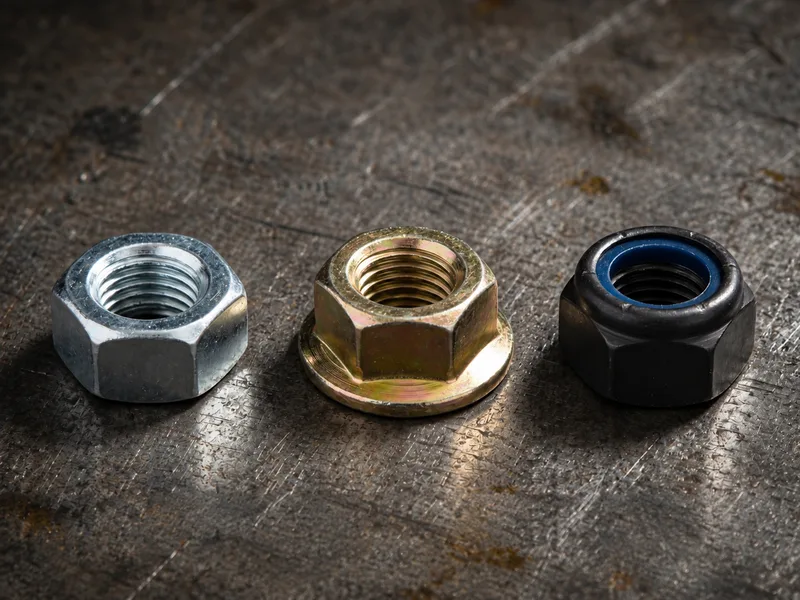
Specifications
DIN 6925 is the withdrawn all-metal self-locking nut that the source titles "width across flat reduced" — the insert-free prevailing-torque nut whose locking collar (the distorted thread section) keeps preload under vibration without nylon, so it survives heat and chemicals the polymer versions cannot. The collected 07/1987-edition table runs M3 to M36 with both pitch columns printed side by side (P coarse and P fine per size, fine-pitch cells as printed, e.g. 1/1.25 and 1.25/1.5 at M10/M12), the s nom=max column (17 at M10, 30 at M20, 55 at M36), e min and the locking height band h min/max (34/36 at M36 — the extra height that houses the distorted collar). Withdrawn is the source's own label: the geometry remains what legacy heat-exposed and chemical-exposed assemblies order against, while new drawings typically move to the current all-metal flange standard ISO 7044 (registered separately) where the flange version suits.
| Standard / scope | DIN 6925 self-locking nuts, all-metal, width across flats reduced — M3 to M36, withdrawn (source label; edition 07/1987) |
|---|---|
| Pitch columns | P coarse and P fine printed per size (e.g. M36: 4 coarse / 3 fine) — order states which pitch |
| Width across flats s | Source-titled "reduced": s nom=max 5.5 (M3) to 55 (M36) with e min per size (6.01 at M3, 60.79 at M36) — check s against your wrench stock, locknut WAF ladders differ between series |
| Locking height h | min/max band per size (34/36 at M36) — the all-metal collar geometry |
| Not tabulated | Property class, prevailing torque values, finish, temperature rating — per RFQ |
Materials
- All-metal locknuts order in steel property classes 8/10/12 with the collar distortion done after finish where plating would fill the locking threads — flag any coating requirement, because some platings change prevailing torque. Stainless A2/A4 versions for corrosive/heat service; the all-metal collar is exactly the choice where nylon inserts melt (>120 °C-class service) or soften in solvents
Ordering & documentation
Documents
Shipments are backed by Mill Test Certificate (MTC), Dimensional Report, Salt Spray Test Report on request, with full batch traceability from raw material to finished product. Quality management follows the owner-confirmed compliance list: ISO 9001:2015, RoHS, REACH. Exact document sets are confirmed on the order.
Quotation
- The fastener family (DIN 6925 Self-Locking Nuts, All-Metal (Reduced Width Across Flats)) plus the standard designation from your drawing — DIN / ISO / JIS / ASTM / ANSI, or a drawing for custom parts.
- Size (diameter and length), thread type (metric or inch), property class or grade, and coating or finish.
- Quantity per size and your target delivery date.
- Destination country, and any required documents (for example a mill test certificate) so the quote includes them.
Sample & supply
Minimum order quantity is 10,000 pieces. Stock items run 3–7 days. Quantities or variants outside the standard range are confirmed at quotation.
Storage & shipping
Parts are packed for export and shipped factory-direct to buyers in Europe, Asia, the Americas and the Middle East. Store fasteners dry and protected until installation, and keep coated parts in their packaging until use; specific packing and preservation requirements can be stated on the order and confirmed at quotation.
Frequently asked questions
What does the "reduced width across flats" in the title mean for my assembly?
It is the source standard's own designation, and its practical effect is on the wrench, not the joint: read the s column per size (17 at M10, 19 at M12, 24 at M16, 55 at M36) and check it against your socket stock, because locknut and flange-series WAF ladders do not follow one rule across sizes — some match the hex series, some sit a step off, which is exactly why the title flags the reduction. Everything the joint cares about — prevailing torque, pitch (including the double fine-pitch cells like 1/1.25 at M10), height band h, thread — is the all-metal locknut system. Two cautions when substituting a standard all-metal nut: the wrench size can change, and the h height differs — anything with a thread-protrusion or stack-up check needs re-verifying against the columns here.
The standard is withdrawn — is the all-metal locknut itself obsolete?
No — the concept is current practice; the DIN document was superseded in the standards system, not the part. New drawings should call the current ISO all-metal nut (ISO 7044 for the flange version, registered separately, or the ISO prevailing-torque hex series), and we map DIN 6925 call-outs to the current equivalent size by size because the reduced-WAF detail means a blind substitution can change the wrench and the h stack. For replacement work the parts are supplied exactly against the DIN 6925 number. If your application is the classic all-metal territory — exhaust-adjacent, oven, chemical bath — say the temperature and medium on the RFQ and we confirm the material class of the collar, which the standard tables do not carry.
Request a Quote
Get factory-direct pricing from the manufacturer.
What to include in your inquiry
- ✓ Standard and property class (e.g. DIN 912, ISO 4762, class 8.8) — or a drawing for custom parts.
- ✓ Sizes, lengths and thread type (metric or inch).
- ✓ Quantity per size and your target delivery date.
- ✓ Destination country, plus any coating or finish requirement.
- ✓ Any documents you need with the shipment (e.g. mill test certificate) so the quote includes them.
- ✓ Your inquiry goes straight to the factory team by email and gets a reply within 24 hours.
- ✓ Factory-direct pricing
- ✓ Standard and custom specifications
- ✓ Factory-direct export to buyers in Europe, Asia, the Americas and the Middle East
- ✓ Full fastener family support