
DIN 936 Hex Thin Nuts (Chamfered)
DIN 936 chamfered thin hex nuts, M8 to M52 — the low-height jam and locknut of the hex series — with the full collected 18-size table across coarse and three fine-pitch series: heights, bearing faces, effective bearing height and the source's reference mass per 1000 units.
Last updated: 2026-11
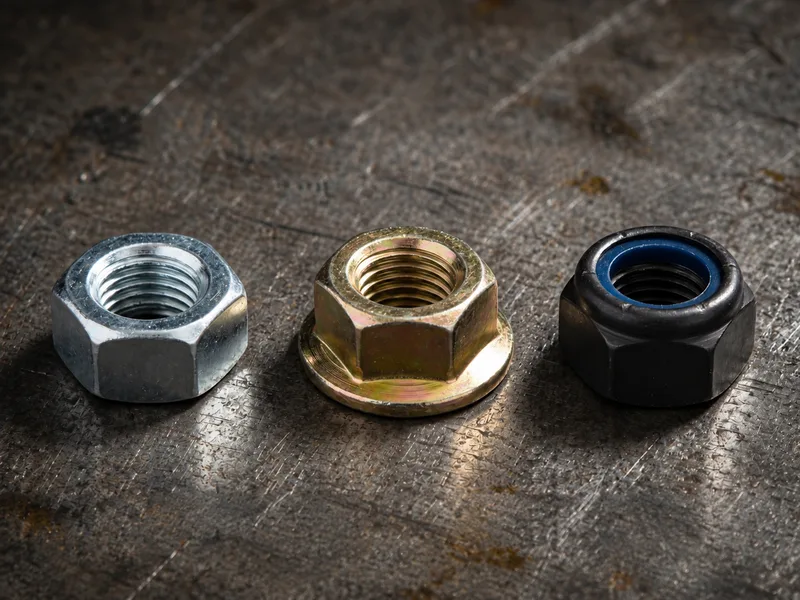
Specifications
DIN 936 is the chamfered thin hex nut — about half the height of a DIN 934 standard nut, used wherever thread engagement is already guaranteed by another element: as a jam nut locked against a full nut, as a locknut on a stud or adjusting screw where fine position must be held, or where overall height is constrained and a full nut would not fit. The chamfered bearing face distinguishes it from the un-chamfered DIN 439 flat form. The collected table runs M8 to M52 and, unusually, tabulates the pitch columns the jam-nut applications actually need: one coarse column plus three fine-pitch series per size, with "/" printed where a series does not apply — reproduced verbatim. Geometry per size covers the d a countersink and d w bearing-face diameters, e across-corners minimum, the m nut height pair (nominal and minimum), the m w effective bearing height that a locknut calculation uses, the s across-flats limits, and the source's reference mass per 1000 units. For a jam nut, the classic pairing on this site is DIN 936 against DIN 934; for the slotted thin form see DIN 937. Materials, property classes and finishes are not printed by the collected specification and stay per RFQ.
| Standard | DIN 936 — hex thin nuts, chamfered |
|---|---|
| Series | M8 – M52 (18 sizes tabulated) |
| Tabulated geometry | Per size: pitch P in four columns (coarse + three fine-pitch series, "/" where a series does not apply), countersink d a min/max, bearing face d w min, across-corners e min, nut height m (max=nominal size / min), effective bearing height m w min, across-flats s (max=nominal size / min), reference mass per 1000 units ≈ kg |
| Head form | Hex nut, approx. half DIN 934 height, chamfered bearing face — jam / locknut duty |
| Family note | Jam pairing with DIN 934; un-chamfered thin form DIN 439; slotted thin form DIN 937 |
| Materials / strength | Not tabulated by the collected specification — per RFQ (property class and finish per drawing callout) |
| Nominal thread | P — Pitch — Coarse thread | P — Pitch — Fine thread 1 | P — Pitch — Fine thread 2 | P — Pitch — Fine thread 3 | d a — min | d a — max | d w — min | e — min | m — max=nominal size | m — min | m w — min | s — max=nominal size | s — min | per 1000 units ≈ kg |
|---|---|---|---|---|---|---|---|---|---|---|---|---|---|---|
| M8 | 1.25 | 1 | / | / | 8 | 8.75 | 11.3 | 14.38 | 5 | 4.7 | 3.8 | 13 | 12.73 | 4 |
| M10 | 1.5 | 1 | 1.25 | / | 10 | 10.8 | 15.3 | 18.9 | 6 | 5.7 | 4.6 | 17 | 16.73 | 8.6 |
| M12 | 1.75 | 1.25 | 1.5 | / | 12 | 13 | 17.2 | 21.1 | 7 | 6.64 | 5.3 | 19 | 18.67 | 12.1 |
| M14 | 2 | 1.5 | / | / | 14 | 15.1 | 20.2 | 24.49 | 8 | 7.42 | 5.9 | 22 | 21.67 | 18.2 |
| M16 | 2 | 1.5 | / | / | 16 | 17.3 | 22.2 | 26.75 | 8 | 7.42 | 5.9 | 24 | 23.67 | 20.1 |
| M18 | 2.5 | 1.5 | 2 | / | 18 | 19.5 | 25.3 | 29.56 | 9 | 8.42 | 6.7 | 27 | 26.16 | 29.6 |
| M20 | 2.5 | 1.5 | 2 | / | 20 | 21.6 | 28.2 | 32.95 | 9 | 8.1 | 6.5 | 30 | 29.16 | 36.3 |
| M22 | 2.5 | 1.5 | 2 | / | 22 | 23.7 | 29.5 | 35.03 | 10 | 9.1 | 7.3 | 32 | 31 | 43.8 |
| M24 | 3 | 1.5 | 2 | / | 24 | 25.9 | 33.2 | 39.55 | 10 | 9.1 | 7.3 | 36 | 35 | 58 |
| M27 | 3 | 1.5 | 2 | / | 27 | 29.1 | 38 | 45.2 | 12 | 10.9 | 8.7 | 41 | 40 | 90 |
| M30 | 3.5 | 1.5 | 2 | / | 30 | 32.4 | 42.7 | 50.85 | 12 | 10.9 | 8.7 | 46 | 45 | 110 |
| M33 | 3.5 | 1.5 | 2 | / | 33 | 35.6 | 46.6 | 55.37 | 14 | 12.9 | 10.3 | 50 | 49 | 155 |
| M36 | 4 | 1.5 | 2 | 3 | 36 | 38.9 | 51.1 | 60.79 | 14 | 12.9 | 10.3 | 55 | 53.8 | 190 |
| M39 | 4 | 1.5 | 2 | 3 | 39 | 42.1 | 55.9 | 66.44 | 16 | 14.9 | 11.9 | 60 | 58.8 | 260 |
| M42 | 4.5 | 1.5 | 2 | 3 | 42 | 45.4 | 60.6 | 71.3 | 16 | 14.9 | 11.9 | 65 | 63.1 | 307 |
| (M45) | 4.5 | 1.5 | 2 | 3 | 45 | 48.6 | 64.7 | 76.95 | 18 | 16.9 | 13.5 | 70 | 68.1 | 400 |
| M48 | 5 | 1.5 | 2 | 3 | 48 | 51.8 | 69.4 | 82.6 | 18 | 16.9 | 13.5 | 75 | 73.1 | 460 |
| M52 | 5 | 1.5 | 2 | 3 | 52 | 56.2 | 74.2 | 88.25 | 20 | 18.7 | 15 | 80 | 78.1 | 580 |
Materials
- Material, property class and finish specified per RFQ — the collected specification table covers geometry and reference mass only
Ordering & documentation
Documents
Shipments are backed by Mill Test Certificate (MTC), Dimensional Report, Salt Spray Test Report on request, with full batch traceability from raw material to finished product. Quality management follows the owner-confirmed compliance list: ISO 9001:2015, RoHS, REACH. Exact document sets are confirmed on the order.
Quotation
- The fastener family (DIN 936 Hex Thin Nuts (Chamfered)) plus the standard designation from your drawing — DIN / ISO / JIS / ASTM / ANSI, or a drawing for custom parts.
- Size (diameter and length), thread type (metric or inch), property class or grade, and coating or finish.
- Quantity per size and your target delivery date.
- Destination country, and any required documents (for example a mill test certificate) so the quote includes them.
Sample & supply
Minimum order quantity is 10,000 pieces. Stock items run 3–7 days. Quantities or variants outside the standard range are confirmed at quotation.
Storage & shipping
Parts are packed for export and shipped factory-direct to buyers in Europe, Asia, the Americas and the Middle East. Store fasteners dry and protected until installation, and keep coated parts in their packaging until use; specific packing and preservation requirements can be stated on the order and confirmed at quotation.
Frequently asked questions
Jam nut or locknut — how is a thin nut used correctly?
As a jam nut: two nuts on the same thread, the thin one tightened against the full nut so the opposing flanks clamp and the joint cannot back off — the thin nut's lower height keeps the stack compact. As a locknut on a stud or adjusting screw, it fixes a setting without the clamping duty of a full nut. In both roles thread engagement of the load-carrying element must come from the other component — that is exactly why the thin form is only about half a DIN 934 in height. Where vibration is the enemy rather than setting drift, a prevailing-torque locknut (DIN 985/DIN 980 on this site) does the job in one part.
Why does the table have four pitch columns?
Thin nuts are heavily used on fine-pitch threads — adjusting and positioning duty — so the collected specification tabulates coarse pitch plus three fine-pitch series per size. Pick the column that matches your mating thread; the "/" cells mean that series does not exist for that size. Note the m w effective bearing height in the chosen column is the figure that governs how much thread the nut can carry in a locknut calculation.
What is the MOQ and lead time for this nut type?
The minimum order quantity is 10,000 pieces. Stock items ship in 3–7 days; non-stock items are confirmed at quotation. Common diameters in this nut type are widely stocked; confirm the exact schedule against quantity and size mix at quotation.
Request a Quote
Get factory-direct pricing from the manufacturer.
What to include in your inquiry
- ✓ Standard and property class (e.g. DIN 912, ISO 4762, class 8.8) — or a drawing for custom parts.
- ✓ Sizes, lengths and thread type (metric or inch).
- ✓ Quantity per size and your target delivery date.
- ✓ Destination country, plus any coating or finish requirement.
- ✓ Any documents you need with the shipment (e.g. mill test certificate) so the quote includes them.
- ✓ Your inquiry goes straight to the factory team by email and gets a reply within 24 hours.
- ✓ Factory-direct pricing
- ✓ Standard and custom specifications
- ✓ Factory-direct export to buyers in Europe, Asia, the Americas and the Middle East
- ✓ Full fastener family support