
ISO 8675 Hex Nuts Low Form, Fine Pitch
ISO 8675 hex nuts low form with metric fine pitch thread M8 to M52 — the thin plain nut with the collected da/dw/e/m/m'/s rows, per-nominal fine-pitch alternates and the 7,85 kg/dm3 mass row.
Last updated: 2026-11
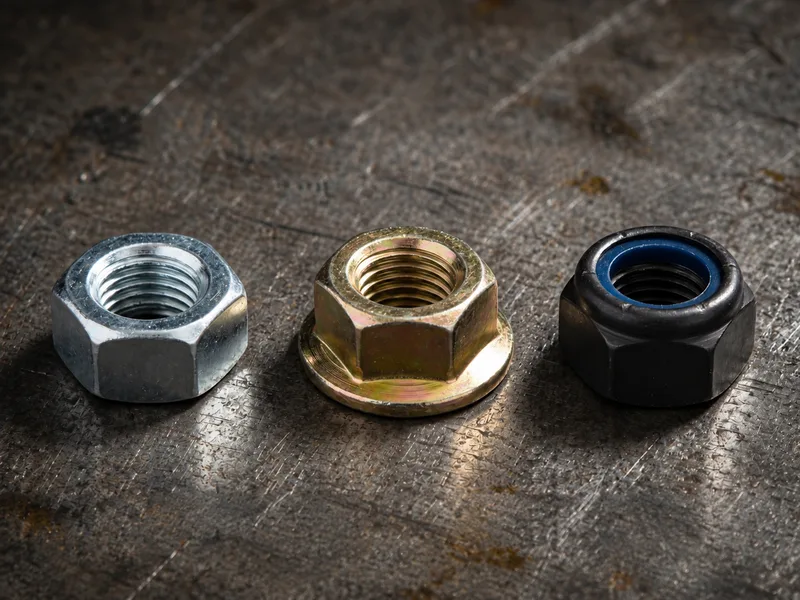
Specifications
The low-form fine-pitch nut is the thin jam-style plain nut: roughly half the height of a standard hex (m nominal 5 at M8 up to 20 at M52), threaded to the fine pitches that give preload control on adjusted and vibration-exposed joints. It works both ways the thin-nut family always has — as a lock partner stacked behind a working nut (jam-nut service, where the two nuts pinch the bolt thread between them) and as the primary nut where joint length is tight but the bolt is fine-pitch. The collected ladder runs M8 to M52 with the source's stacked pitch header rows carried per nominal (M8x1 / M10x1,25 / M12x1,5 ... x1,5/x2/x3 alternates), rows da min./max. (8 → 56,2), dw min. (11,3 → 74,2), e min. (14,38 → 88,25), m nominal=max./min., wrench height m' min. and width across flats s (13 → 80), plus the source's own mass row ("Weight (7,85 kg/dm3) kg/1000pcs": 4 → 580). Verbatim quirks are flagged: the P row prints 1,25 under the M8x1 column and 1 under M10x1, and m min. dips to 8,1 at M20 — both carried, not corrected; confirm the exact pitch per RFQ. Property class and finish are not tabulated — per RFQ.
| Standard | ISO 8675 — hex nuts low form with metric fine pitch thread (thin plain nut, jam-nut service) |
|---|---|
| Size range | M8 – M52; per-nominal fine-pitch alternates (x1 / x1,25 / x1,5 / x2 / x3) per the source's stacked headers |
| Height | m nominal=max. 5 (M8) → 20 (M52) — low form, roughly half a standard hex |
| Hex | s nominal=max. 13 → 80 (min. 12,73 → 78,1); e min. 14,38 → 88,25 |
| Mass | kg/1000 pcs at 7,85 kg/dm3: 4 (M8) → 580 (M52), the source's own row |
| Flagged verbatim | P row prints 1,25 under M8x1 and 1 under M10x1; m min. 8,1 at M20 non-monotone — carried, confirm pitch per RFQ |
| Material / class / finish | Not tabulated by the collected specification — per RFQ |
| Thread d | M8 | M10 | M12 | M14 | M16 | M18 | M20 | M22 | M24 | |
|---|---|---|---|---|---|---|---|---|---|---|
| M8x1 | M10x1 | M12x1,25 | M14x1,5 | M16x1,5 | M18x1,5 | M20x1,5 | M22x1,5 | M24x1,5 | ||
| - | M10x1,25 | M12x1,5 | - | - | M18x2 | M20x2 | M22x2 | M24x2 | ||
| P | 1,25 | 1 | 1,75 | 2 | 2 | 2,5 | 2,5 | 2,5 | 3 | |
| da | min. | 8 | 10 | 12 | 14 | 16 | 18 | 20 | 22 | 24 |
| max | 8,75 | 10,8 | 13 | 15,1 | 17,3 | 19,5 | 21,6 | 23,7 | 25,9 | |
| dw | min. | 11,3 | 15,3 | 17,2 | 20,2 | 22,2 | 25,3 | 28,2 | 29,5 | 33,2 |
| e | min. | 14,38 | 18,9 | 21,1 | 24,49 | 26,75 | 29,56 | 32,95 | 35,03 | 39,55 |
| m | nominal=max. | 5 | 6 | 7 | 8 | 8 | 9 | 9 | 10 | 10 |
| min. | 4,7 | 5,7 | 6,64 | 7,42 | 7,42 | 8,42 | 8,1 | 9,1 | 9,1 | |
| m´ | min. | 3,8 | 4,6 | 5,3 | 5,9 | 5,9 | 6,7 | 6,5 | 7,3 | 7,3 |
| s | nominal=max. | 13 | 17 | 19 | 22 | 24 | 27 | 30 | 32 | 36 |
| min. | 12,73 | 16,73 | 18,67 | 21,67 | 23,67 | 26,16 | 29,16 | 31 | 35 | |
| Weight (7,85 kg/dm3) kg/1000pcs | 4 | 8,6 | 12,1 | 18,2 | 20,1 | 29,6 | 36,3 | 43,8 | 58 |
- Row 3 (P): the P row prints 1,25 under the M8x1 column and 1 under M10x1 - in tension with the fine-pitch size labels above; carried verbatim, confirm pitch per RFQ
- Row 8 (m): m min. prints 8,1 at M20 between M18's 8,42 and M22's 9,1 - a non-monotone dip against the ladder; carried verbatim
| Thread d | M27 | M30 | M33 | M36 | M39 | M42 | (M45) | M48 | M52 | |
|---|---|---|---|---|---|---|---|---|---|---|
| M27x1,5 | M30x1,5 | M33x1,5 | M36x1,5 | M39x1,5 | M42x1,5 | M45x1,5 | M48x1,5 | M52x1,5 | ||
| M27x2 | M30x2 | M33x2 | M36x2 | M39x2 | M42x2 | M45x2 | M48x2 | M52x2 | ||
| - | - | - | M36x3 | M39x3 | M42x3 | M45x3 | M48x3 | M52x3 | ||
| P | 3 | 3,5 | 3,5 | 4 | 4 | 4,5 | 4,5 | 5 | 5 | |
| da | min. | 27 | 30 | 33 | 36 | 39 | 42 | 45 | 48 | 52 |
| max | 29,1 | 32,4 | 35,6 | 38,9 | 42,1 | 45,4 | 48,6 | 51,8 | 56,2 | |
| dw | min. | 38 | 42,7 | 46,6 | 51,1 | 55,9 | 60,6 | 64,7 | 69,4 | 74,2 |
| e | min. | 45,2 | 50,85 | 55,37 | 60,79 | 66,44 | 71,3 | 76,95 | 82,6 | 88,25 |
| m | nominal=max. | 12 | 12 | 14 | 14 | 16 | 16 | 18 | 18 | 20 |
| min. | 10,9 | 10,9 | 12,9 | 12,9 | 14,9 | 14,9 | 16,9 | 16,9 | 18,7 | |
| m´ | min. | 8,7 | 8,7 | 10,3 | 10,3 | 11,9 | 11,9 | 13,5 | 13,5 | 15 |
| s | nominal=max. | 41 | 46 | 50 | 55 | 60 | 65 | 70 | 75 | 80 |
| min. | 40 | 45 | 49 | 53,8 | 58,8 | 63,1 | 68,1 | 73,1 | 78,1 | |
| Weight (7,85 kg/dm3) kg/1000pcs | 90 | 110 | 155 | 190 | 260 | 307 | 400 | 460 | 580 |
Materials
- Property class and finish specified per RFQ — thin nuts commonly run class 04/05 (jam service) or matched to the bolt for primary duty; state the pitch you are threading onto (the ladder stacks alternates per nominal) and the jam-nut or primary-nut role at quotation
Ordering & documentation
Documents
Shipments are backed by Mill Test Certificate (MTC), Dimensional Report, Salt Spray Test Report on request, with full batch traceability from raw material to finished product. Quality management follows the owner-confirmed compliance list: ISO 9001:2015, RoHS, REACH. Exact document sets are confirmed on the order.
Quotation
- The fastener family (ISO 8675 Hex Nuts Low Form, Fine Pitch) plus the standard designation from your drawing — DIN / ISO / JIS / ASTM / ANSI, or a drawing for custom parts.
- Size (diameter and length), thread type (metric or inch), property class or grade, and coating or finish.
- Quantity per size and your target delivery date.
- Destination country, and any required documents (for example a mill test certificate) so the quote includes them.
Sample & supply
Minimum order quantity is 10,000 pieces. Stock items run 3–7 days. Quantities or variants outside the standard range are confirmed at quotation.
Storage & shipping
Parts are packed for export and shipped factory-direct to buyers in Europe, Asia, the Americas and the Middle East. Store fasteners dry and protected until installation, and keep coated parts in their packaging until use; specific packing and preservation requirements can be stated on the order and confirmed at quotation.
Frequently asked questions
This low-form nut, or the all-metal prevailing-torque nut — how do I choose for a fine-pitch joint?
Two different jobs. As a jam pair (two nuts locked against each other), the low-form nut is the classic: the collected height row shows m at roughly half a standard hex, so stacked they add little length while the pinch between them holds. As a single lock, the prevailing-torque type (ISO 7042, in this catalog) does the job alone with no second nut and no thread damage — but its clamp section needs bolt protrusion. The collected ISO 8675 ladder covers M8 – M52 with fine-pitch alternates per nominal, which is exactly the pitch range where fine-thread preload control earns its keep. Two capture quirks are flagged and not normalized: the P row prints 1,25 under M8x1 and 1 under M10x1 (in tension with the pitch labels), and m min. dips at M20 — confirm the pitch you order per RFQ. The mass row (7,85 kg/dm3 basis, 4 → 580 kg/1000) is the source's own carbon-steel figure. Class and finish per RFQ.
Request a Quote
Get factory-direct pricing from the manufacturer.
What to include in your inquiry
- ✓ Standard and property class (e.g. DIN 912, ISO 4762, class 8.8) — or a drawing for custom parts.
- ✓ Sizes, lengths and thread type (metric or inch).
- ✓ Quantity per size and your target delivery date.
- ✓ Destination country, plus any coating or finish requirement.
- ✓ Any documents you need with the shipment (e.g. mill test certificate) so the quote includes them.
- ✓ Your inquiry goes straight to the factory team by email and gets a reply within 24 hours.
- ✓ Factory-direct pricing
- ✓ Standard and custom specifications
- ✓ Factory-direct export to buyers in Europe, Asia, the Americas and the Middle East
- ✓ Full fastener family support