
ISO 7042 Prevailing Torque All-Metal Hex Nuts
ISO 7042 hexagon nuts with clamping part, all-metal — M3 to M39 with fine-pitch alternates — the reusable vibration-lock nut, with the collected da/dv/e/h/m/s geometry ladder including the clamping length m row.
Last updated: 2026-11
Specifications
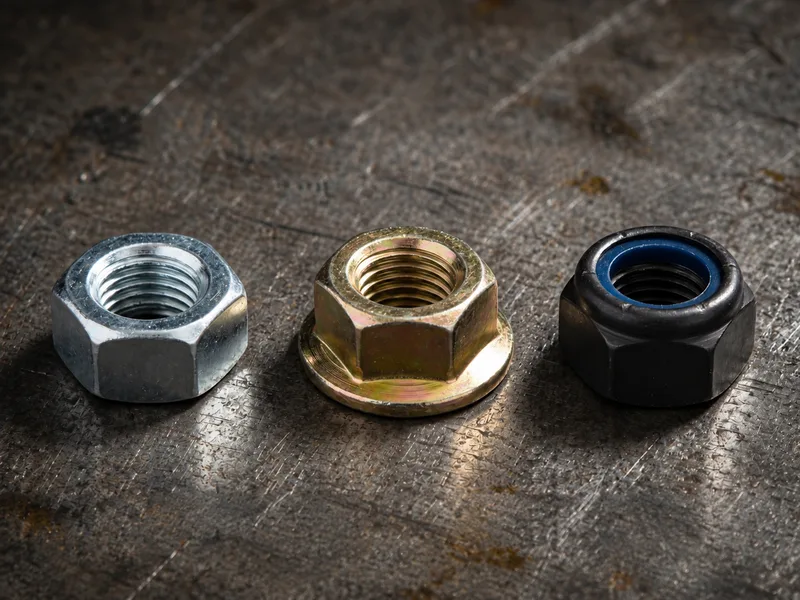
ISO 7042 is the all-metal prevailing-torque nut: a hex nut whose top portion is conically compressed (the "clamping part") so that threads pinch the bolt elastically, holding preload under vibration with no nylon insert to melt, age or shed — the lock you choose for engine bays, exhaust-adjacent brackets, and anywhere temperature or reusability rules out the nylon member. The collected ladder is the widest in this batch: M3 to M39, and at M8 and up the source lists the fine-pitch alternates (M8x1; M10x1 / M10x1,25; M12x1,5 / M12x1,25; … M36x3 / M39x3) in stacked header rows merged into the size labels — one geometry set per nominal, either pitch. The distinguishing row is m min. (1,65 → 21,5): the effective clamping-thread length that makes the prevailing torque, the number to check against bolt protrusion so the pinching section actually engages. Around it: da min./max., clamping-bearing diameter dv min. (4,6 → 55,9), across-corners e min. (6,01 → 66,44), height h max./min. (3,7/3,4 → 39/37), and the hex width s max./min. pair (5,5/5,32 → 60/58,8). Two verbatim print defects are flagged and not normalized: da max. at M30 prints 324 (a lost decimal comma suspected, ladder expects ~32,4) and e min. at M22 prints 350,3 (ladder expects ~35,03). Height discipline: an all-metal lock nut needs more bolt protrusion than a plain nut — size h is why. Material, property class (these are commonly class 8/10/12 steels) and finish are not tabulated — per RFQ.
| Standard | ISO 7042 — hexagon nuts with clamping part, all-metal (prevailing torque type) |
|---|---|
| Size range | M3 – M39 coarse; fine-pitch alternates from M8 (M8x1 → M39x3) listed by the source per nominal |
| Clamping geometry | m min.: 1,65 → 21,5 mm (effective clamping-thread length); dv min. 4,6 → 55,9 |
| Height | h max. 3,7 → 39 / min. 3,4 → 37 per size (both pitches share the geometry) |
| Hex | s max. 5,5 → 60 (min. 5,32 → 58,8); e min. 6,01 → 66,44 |
| Print defects | da max. M30 prints 324 and e min. M22 prints 350,3 — carried verbatim, flagged, not normalized |
| Material / class / finish | Not tabulated by the collected specification — per RFQ |
| d | P | da min. | da max. | dv min. | e min. | h max. | h min. | m min. | s max. | s min. |
|---|---|---|---|---|---|---|---|---|---|---|
| M3 | 0,5 | 3 | 3,45 | 4,6 | 6,01 | 3,7 | 3,4 | 1,65 | 5,5 | 5,32 |
| M4 | 0,7 | 4 | 4,6 | 5,9 | 7,66 | 4,2 | 3,9 | 2,2 | 7 | 6,78 |
| M5 | 0,8 | 5 | 5,75 | 6,9 | 8,79 | 5,1 | 4,8 | 2,75 | 8 | 7,78 |
| M6 | 1 | 6 | 6,75 | 8,9 | 11,05 | 6 | 5,7 | 3,3 | 10 | 9,78 |
| M7 | 1 | 7 | 7,75 | 9,6 | 12,12 | 7 | 6,5 | 3,85 | 11 | 10,73 |
| M8 / M8x1 | 1 / 1,25 | 8 | 8,75 | 11,6 | 14,38 | 8 | 7,5 | 4,4 | 13 | 12,73 |
| M10 / M10x1 / M10x1,25 | 1,5 | 10 | 10,8 | 15,6 | 18,9 | 10 | 9 | 5,5 | 17 | 16,73 |
| M12 / M12x1,5 / M12x1,25 | 1,75 | 12 | 13 | 17,4 | 21,1 | 12 | 11 | 6,6 | 19 | 18,67 |
| M14 / M14x1,5 | 2 | 14 | 15,1 | 20,5 | 24,49 | 14 | 12 | 7,7 | 22 | 21,67 |
| M16 / M16x1,5 | 2 | 16 | 17,3 | 22,5 | 26,75 | 16 | 14 | 8,8 | 24 | 23,67 |
| M18 / M18x2 / M18x1,5 | 2,5 | 18 | 19,5 | 24,9 | 29,56 | 18 | 16 | 9,9 | 27 | 26,16 |
| M20 / M20x2 / M20x1,5 | 2,5 | 20 | 21,6 | 27,7 | 32,95 | 20 | 18 | 11 | 30 | 29,16 |
| M22 / M22x2 / M22x1,5 | 2,5 | 22 | 23,7 | 29,5 | 350,3 | 22 | 20 | 12,2 | 32 | 31 |
| M24 / M24x2 | 3 | 24 | 25,9 | 33,2 | 39,55 | 24 | 22 | 13,2 | 36 | 35 |
| M27 / M27x2 | 3 | 27 | 29,1 | 38 | 45,2 | 27 | 25 | 14,8 | 41 | 40 |
| M30 / M30x2 | 3,5 | 30 | 324 | 42,7 | 50,85 | 30 | 28 | 16,5 | 46 | 45 |
| M33 / M33x2 | 3,5 | 33 | 35,6 | 46,6 | 55,37 | 33 | 31 | 18,2 | 50 | 49 |
| M36 / M36x3 | 4 | 36 | 38,9 | 51,1 | 60,79 | 36 | 34 | 19,8 | 55 | 53,8 |
| M39 / M39x3 | 4 | 39 | 42,1 | 55,9 | 66,44 | 39 | 37 | 21,5 | 60 | 58,8 |
- Row 16 (M30 / M30x2): M30: da max. prints 324 against the ladder's thread-plus-1,1 progression (M27 29,1 → M33 35,6) — a lost decimal comma (32,4) suspected. Carried verbatim, not normalized.
- Row 13 (M22 / M22x2 / M22x1,5): M22: e min. prints 350,3 against the ladder (M20 32,95 → M24 39,55; sibling ~35,03) — a stray zero digit suspected. Carried verbatim, not normalized.
Materials
- Material, property class and finish specified per RFQ — all-metal prevailing-torque nuts are commonly class 8/10/12 steel (class matched to the bolt, never lower); stainless variants trade lock performance at temperature; state the bolt class and service temperature at quotation, since the clamping geometry behaves differently per substrate
Ordering & documentation
Documents
Shipments are backed by Mill Test Certificate (MTC), Dimensional Report, Salt Spray Test Report on request, with full batch traceability from raw material to finished product. Quality management follows the owner-confirmed compliance list: ISO 9001:2015, RoHS, REACH. Exact document sets are confirmed on the order.
Quotation
- The fastener family (ISO 7042 Prevailing Torque All-Metal Hex Nuts) plus the standard designation from your drawing — DIN / ISO / JIS / ASTM / ANSI, or a drawing for custom parts.
- Size (diameter and length), thread type (metric or inch), property class or grade, and coating or finish.
- Quantity per size and your target delivery date.
- Destination country, and any required documents (for example a mill test certificate) so the quote includes them.
Sample & supply
Minimum order quantity is 10,000 pieces. Stock items run 3–7 days. Quantities or variants outside the standard range are confirmed at quotation.
Storage & shipping
Parts are packed for export and shipped factory-direct to buyers in Europe, Asia, the Americas and the Middle East. Store fasteners dry and protected until installation, and keep coated parts in their packaging until use; specific packing and preservation requirements can be stated on the order and confirmed at quotation.
Frequently asked questions
All-metal (ISO 7042) or nylon-insert lock nut — which does my joint want?
Temperature and reuse. The nylon insert loses its grip as temperature climbs (roughly past 120 °C service it is the wrong tool, and it degrades with each reuse) — the all-metal clamping part of ISO 7042 is bare steel, so it holds near the fastener material's own limits and survives repeated assembly: the threads stay pinched because the deflection is in the metal, not a polymer. What you pay is seating care and protrusion: the collected m min. row (1,65 mm at M3 up to 21,5 at M39) is the clamping-thread length — the bolt must protrude past it fully, or the pinch never engages and the nut is just an expensive plain nut; and the h row shows these sit taller than a plain hex. Also, the friction means torque wrenches read high — torque-to-yield practice on critical joints should account for it. The flagged cells (M30 da, M22 e min.) are the capture's print defects — confirm per RFQ if those sizes matter. For cold, single-use, non-critical panels a nylon insert is cheaper; for hot, reusable or safety joints the all-metal earns it. Class, material and finish per RFQ.
Request a Quote
Get factory-direct pricing from the manufacturer.
What to include in your inquiry
- ✓ Standard and property class (e.g. DIN 912, ISO 4762, class 8.8) — or a drawing for custom parts.
- ✓ Sizes, lengths and thread type (metric or inch).
- ✓ Quantity per size and your target delivery date.
- ✓ Destination country, plus any coating or finish requirement.
- ✓ Any documents you need with the shipment (e.g. mill test certificate) so the quote includes them.
- ✓ Your inquiry goes straight to the factory team by email and gets a reply within 24 hours.
- ✓ Factory-direct pricing
- ✓ Standard and custom specifications
- ✓ Factory-direct export to buyers in Europe, Asia, the Americas and the Middle East
- ✓ Full fastener family support