
DIN 134 Plain Washers — Large OD (M3 – M20)
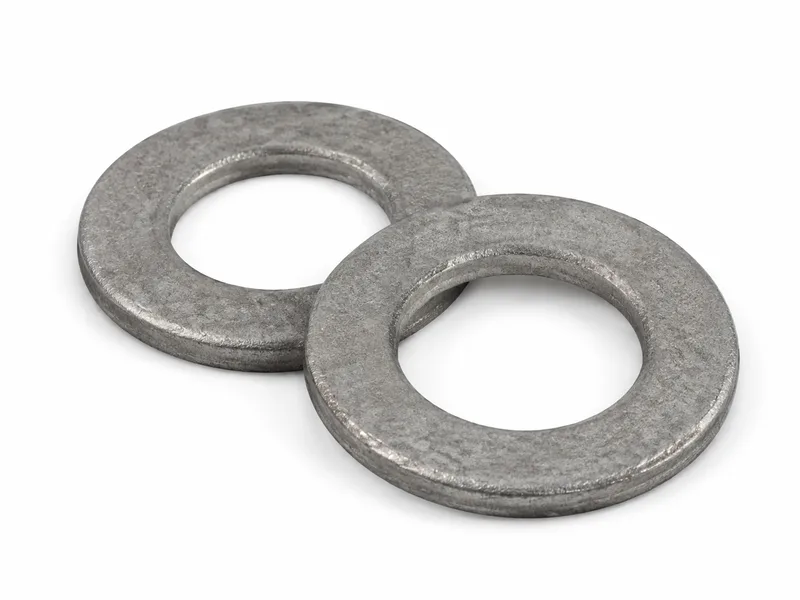
DIN 134 plain washers, large outside diameter (US series) — nominal 3,2 to 21 for M3 to M20 with d1/d2/h tolerance bands, the wide-bearing flat washer for soft substrates, oversized or slotted holes and load spreading where the DIN 125A OD is too small.
Last updated: 2026-11
Specifications
DIN 134 is the wide-body member of the plain-washer family: same flat annulus as DIN 125A, but a noticeably larger outside diameter, so the bolt load spreads over more surface. That extra bearing width is what you buy it for — soft substrates (aluminium, plastics, timber, composites) that would creep or pull a small washer in, oversize or slotted mounting holes where the wider OD keeps the washer on the hole, and thin sheet that tears around a narrow bearing face. The collected ladder runs nominal 3,2 to 21 (M3 to M20): d1 3,2/3,38 to 21/21,33 in min./max. bands, d2 up to 40/39,38, thickness h 0,5/0,45/0,55 to 4/3,7/4,3. Reading notes before engineering use: the source prints the d2 max. value before its min. at every row (M8: 18 then 17,57) — order carried verbatim, not swapped; the sub-header labels under d1/d2/h are garbled against the data semantics and are documented in the table notes rather than trusted; and the M8 row's h pair prints min. 1,8 / max. 0,2 — a flagged source inconsistency (every other row prints max. = nominal + 0,05..0,1). Materials and finishes are not printed on the source page and are not claimed — per RFQ.
| Standard / scope | DIN 134 plain washers, large outside diameter (source title "DIN 134 - Plain Washers - Large"); nominal sizes 3,2 to 21 for threads M3 to M20, 11 sizes |
|---|---|
| Bore (d1) | min./max. 3,2/3,38 (M3) to 21/21,33 (M20) |
| Outside diameter (d2) | up to 40/39,38 (M18/M20); the pair prints the max. value before the min. at every row (M3: 8 then 7,64) — order verbatim, flagged |
| Thickness (h) | Nominal/max./min. 0,5/0,55/0,45 (M3) to 4/4,3/3,7 (M18/M20); the M8 row prints max. 0,2 against min. 1,8 — flagged source inconsistency, verbatim |
| Shared rows | M12/M14 share d2 28 and the h band; M18/M20 share d2 40 and the h band — as printed |
| Not tabulated | No materials, finishes, hardness or equivalents printed on the source page — per RFQ against the standard document |
| Nominal size | For thread | d1 (Min.) | d1 (Max.) | d2 (printed 1st) | d2 (printed 2nd) | h Nominal | h Min. | h Max. |
|---|---|---|---|---|---|---|---|---|
| 3,2 | M3 | 3,2 | 3,38 | 8 | 7,64 | 0,5 | 0,45 | 0,55 |
| 4,3 | M4 | 4,3 | 4,48 | 10 | 9,64 | 0,8 | 0,7 | 0,9 |
| 5,3 | M5 | 5,3 | 5,48 | 12 | 11,57 | 1 | 0,9 | 1,1 |
| 6,4 | M6 | 6,4 | 6,62 | 14 | 13,57 | 1,5 | 1,4 | 1,8 |
| 8,4 | M8 | 8,4 | 8,62 | 18 | 17,57 | 2 | 1,8 | 0,2 |
| 10,5 | M10 | 10,5 | 10,77 | 22 | 21,48 | 2,5 | 2,3 | 2,7 |
| 13 | M12 | 13 | 13,27 | 28 | 27,48 | 3 | 2,7 | 3,3 |
| 15 | M14 | 15 | 15,27 | 28 | 27,48 | 3 | 2,7 | 3,3 |
| 17 | M16 | 17 | 17,27 | 34 | 33,38 | 3 | 2,7 | 3,3 |
| 19 | M18 | 19 | 19,33 | 40 | 39,38 | 4 | 3,7 | 4,3 |
| 21 | M20 | 21 | 21,33 | 40 | 39,38 | 4 | 3,7 | 4,3 |
- Row 5 (8,4): the M8 h row prints min. 1,8 / max. 0,2 — a max. below its own min. and off every other row's pattern (max. = nominal + 0,05..0,1) — verbatim, flagged; confirm the M8 h band against the standard document for tolerance-critical use.
- the d2 pair prints the max. value before the min. at every row (M3: 8 then 7,64; M8: 18 then 17,57) — column order carried verbatim as "printed 1st / printed 2nd", not re-labelled or swapped.
- the source's sub-header labels ('min. Nominal size', 'max. Nominal size', an unlabelled trailing column) do not align with the data semantics — the labels live in the verbatim snapshot; the rendered column names follow the captured DOM column occupancy.
- the source page prints no materials, finishes, hardness or equivalents — only this grid; everything outside it is per RFQ.
Materials
- The source page prints no materials or finish line, so this page makes no material claim: for a load-spreading washer the material decision usually follows the substrate — a hardened grade where the bolt is tightened hard into steel, a soft or non-metallic washer where the point is to protect aluminium or plastic. Both belong on the RFQ as explicit requirements matched to a certificate. State size (M3-M20 per the ladder), material grade, finish and quantity; requirements outside the tabulated grid — sizes past M20, hardened-and-certified batches, special finishes — are confirmed at quotation.
Ordering & documentation
Documents
Shipments of DIN 134 Plain Washers — Large OD (M3 – M20) are backed by Mill Test Certificate (MTC), Dimensional Report, Salt Spray Test Report on request, with full batch traceability from raw material to finished product. Quality management for DIN 134 Plain Washers — Large OD (M3 – M20) orders follows the owner-confirmed compliance list: ISO 9001:2015, RoHS, REACH. Exact document sets are confirmed on the order.
Quotation
- The product family (DIN 134 Plain Washers — Large OD (M3 – M20)), product standard/designation and drawing or part number.
- The dimensions that apply to this part — such as size, pitch, length, thickness, fit, grip or groove geometry.
- Material/grade, heat-treatment condition and surface finish, together with the service environment.
- Quantity per size, delivery destination and required test or traceability documents.
Sample & supply
Supply source for DIN 134 Plain Washers — Large OD (M3 – M20): own manufacturing plus qualified outsourcing (per the owner-confirmed scope of supply (own production plus outsourcing)).
Minimum order quantity for din 134 plain washers — large od (m3 – m20) is 10,000 pieces (applies to the standard sizes and finishes for din 134 plain washers — large od (m3 – m20); mixed, special or custom variants are quoted — final commercial terms per quotation) Stock items for din 134 plain washers — large od (m3 – m20) run 3–7 days. Quantities or variants of din 134 plain washers — large od (m3 – m20) outside the standard range are confirmed at quotation.
Storage & shipping
DIN 134 Plain Washers — Large OD (M3 – M20) are packed for export and shipped factory-direct to buyers in Europe, Asia, the Americas and the Middle East. Store din 134 plain washers — large od (m3 – m20) dry and protected until installation, and keep coated parts in their packaging until use; specific packing and preservation requirements can be stated on the order and confirmed at quotation.
Frequently asked questions
DIN 134 or DIN 125A / DIN 9021 — which wide washer is right for my hole?
Compare outside diameters, not names. DIN 125A is the plain standard-series washer — the narrowest bearing face; DIN 134 (this page) sits above it with a larger OD per nominal size (M8: d2 up to 18 vs the 125A's 16); DIN 9021 is the extra-large series beyond that (M8 up to 24). The choice is mechanical: use 125A on steel with a standard hole, step up to DIN 134 for soft substrates, oversize or slotted holes and thin sheet where 125A's bearing face is too narrow, and go to DIN 9021 when the load spread or hole damage risk demands the widest practical face. The d1 bands here match the same nominal thread as the other two series, so the washer always fits the bolt — what changes is how much substrate it protects. For an existing hole, check the d2 min. against the hole diameter and the d1 max. against the bolt before ordering.
The d2 columns print the larger number first (M8: 18 then 17,57) and the M8 thickness row prints max. 0,2 against min. 1,8 — are these errors?
Both prints are carried verbatim from the source, and the page flags rather than corrects them. The d2 order (max. printed before min. at every row) reads as presentation order, not wrong values — the two numbers bracket the diameter band normally (M8 d2: 17,57 to 18). The M8 h row is different: max. 0,2 sits below its own min. 1,8 and breaks the pattern every other row follows (max. = nominal + 0,05..0,1), so it is almost certainly a source misprint — but this page does not guess the intended value; use the M8 h nominal (2) and confirm the band against the standard document if your drawing tolerances need it. That honesty rule is deliberate: a silently "fixed" table can't be told apart from a verified one downstream.
What should an RFQ for DIN 134 washers state?
Thread size (M3-M20 per the ladder), material grade and hardness class matched to your substrate and clamp load (the source tabulates none, so both are quotation items), finish if not plain, quantity per size — and if your drawing carries a tolerance that leans on a flagged print (the M8 h band, or the d2 order), state that the value should be quoted from the standard document, not the reference grid. Anything outside the table — sizes past M20, certified batches, special finishes — is confirmed at quotation.
Request a Quote
Get factory-direct pricing from the manufacturer.
What to include in your DIN 134 Plain Washers — Large OD (M3 – M20) inquiry
- ✓ Identify the washer form and dimensional standard (for example flat, fender, spring-lock or hardened structural washer).
- ✓ Give the mating bolt size plus inside diameter, outside diameter and thickness; include the applicable dimensional series.
- ✓ State washer material and any specified hardness class or coating. Washer hardness is not a bolt property class.
- ✓ Describe the bearing surface or locking function, quantity per size and destination.
- ✓ Factory-direct pricing for your DIN 134 Plain Washers — Large OD (M3 – M20)
- ✓ Standard and custom specifications
- ✓ Factory-direct export to buyers in Europe, Asia, the Americas and the Middle East
- ✓ Full fastener family support