
DIN 6921 Hex Flange Bolts
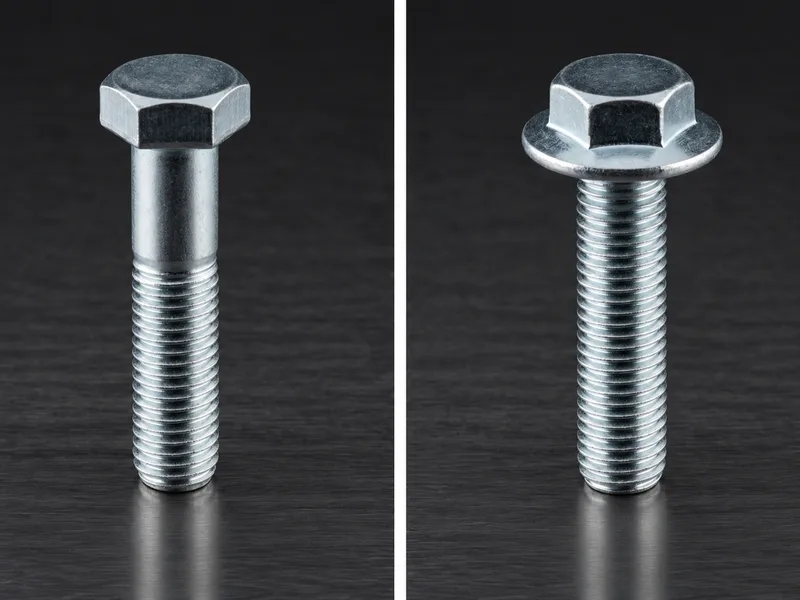
Hexagon head bolts with flange per DIN 6921 — an integrated washer-face flange under the head, smooth or serrated, M5–M20 in the standard table, steel classes 8.8/10.9 and A2 stainless, 6g thread. One part replaces bolt plus flat washer in high-volume assembly.
Last updated: 2026-11
Specifications
DIN 6921 is the metric hexagon flange bolt: a hex head with an integrated circular flange that does the job of a separate flat washer — always concentric, never omitted, never misaligned. The serrated variant adds teeth under the flange that bite into the joint surface and resist vibration loosening, which is why flange bolts dominate automotive, machinery and appliance assembly. Strength comes from the property class, not the flange: a class 8.8 flange bolt has the same tensile as a class 8.8 hex bolt, and torque tables carry over unchanged — with one note, since a serrated flange slightly raises the friction under the head. The limits are equally clear: flange bolts are not typically certified for structural connections, and hot-dip galvanizing can fill the serrations, so HDG work uses the smooth flange.
| Standard | DIN 6921 — hexagon head bolts with flange, metric; smooth flange or serrated flange |
|---|---|
| Size range | M5–M20 in the standard table (coarse and listed fine pitches); commonly stocked M6–M24 |
| Dimensions at M10 | Width across flats 15 nominal (14.73 min); flange diameter max 21.8; bearing-side e min 16.64; body dia 10.00 max / 9.78 min (mm) |
| Property classes | Steel 8.8 (min 800 MPa, 22–32 HRC) and 10.9 (min 1040 MPa, 32–39 HRC); 12.9 listed (min 1220 MPa, 39–44 HRC); stainless A2; thread 6g |
| Class 8.8 make | Carbon steel 10B21 / AISI 1035; 10.9/12.9 alloy steel AISI 4135 (collected chart) |
| Vibration | Serrated flange teeth bite into the joint surface; Junker testing shows clamp force retained 3–5× longer than bolt + flat washer |
| Torque | Same table as the equivalent-grade hex bolt; serrated flange raises the K factor slightly — verify or add 5–10% where clamp force is critical |
| Hot-dip galvanizing | Zinc fills the serrations and reduces locking — prefer smooth flange under HDG, or electroplated serrated where teeth must survive |
| Joint type | Not typically certified for structural connections — structural work uses hex bolts with hardened washers |
Materials
- Carbon steel 10B21 / AISI 1035 (class 8.8)
- Alloy steel AISI 4135 (classes 10.9 / 12.9)
- A2 stainless steel
Ordering & documentation
Documents
Shipments are backed by Mill Test Certificate (MTC), Dimensional Report, Salt Spray Test Report on request, with full batch traceability from raw material to finished product. Quality management follows the owner-confirmed compliance list: ISO 9001:2015, RoHS, REACH. Exact document sets are confirmed on the order.
Quotation
- The fastener family (DIN 6921 Hex Flange Bolts) plus the standard designation from your drawing — DIN / ISO / JIS / ASTM / ANSI, or a drawing for custom parts.
- Size (diameter and length), thread type (metric or inch), property class or grade, and coating or finish.
- Quantity per size and your target delivery date.
- Destination country, and any required documents (for example a mill test certificate) so the quote includes them.
Sample & supply
Minimum order quantity is 1,000–10,000 pieces depending on size. Stock items run 3–7 days. High-strength and custom parts run 15–25 days. Quantities or variants outside the standard range are confirmed at quotation.
Storage & shipping
Parts are packed for export and shipped factory-direct to buyers in Europe, Asia, the Americas and the Middle East. Store fasteners dry and protected until installation, and keep coated parts in their packaging until use; specific packing and preservation requirements can be stated on the order and confirmed at quotation.
Frequently asked questions
Serrated or smooth flange — which do I need?
Serrated for vibrating assemblies: the teeth under the flange bite into the joint surface and mechanically resist rotation, which makes them the default in engines, machinery mounts and bracket work. Smooth wherever the mating surface cannot take bite marks — painted, coated or polished faces — and under hot-dip galvanizing, because the thick zinc fills the serrations and quiets their locking action. If you need vibration locking on a finished surface, the usual combination is a smooth flange bolt with a separate locking nut rather than serrations.
Does the flange make a flange bolt stronger than a hex bolt?
No — tensile strength is set by the property class and the shank diameter, and a class 8.8 flange bolt meets the same 800 MPa minimum as a class 8.8 hex bolt. What the flange changes is bearing: clamp load spreads over the integrated washer face, which is always concentric and seated flat — a separate washer can be tilted or off-center, and its omission is a classic assembly-line defect. The trade-offs are dimensional and surface: the flange enlarges the head profile (it may not fit a recess), and serrated flanges leave bite marks on the joint.
What is the MOQ and lead time for this bolt type?
The minimum order quantity is 1,000–10,000 pieces depending on size. Stock items ship in 3–7 days; high-strength and custom parts in 15–25 days. Common diameters in this bolt type are widely stocked; confirm the exact schedule against quantity and size mix at quotation.
What should an RFQ for DIN 6921 flange bolts state?
State the standard and property class (for example DIN 6921 M10 × 30, class 10.9, serrated or smooth flange), diameter and length, thread (metric coarse 6g or a named fine pitch), finish (plain, zinc-plated, zinc flake, or hot-dip galvanized where the serration note applies), required certificates such as a mill test report per EN 10204 3.1, and quantity per size — plus destination country.
Related knowledge
- What Bolt Property Classes 8.8, 10.9 and 12.9 Encode — and When High Strength Stops Being the Right Choice
- Bolt Grade Selection: ISO 898-1 8.8/10.9/12.9 vs ASTM A307 and A325
- 8.8 vs 10.9 vs 12.9 Bolts: Strength, Hardness and Cost — What the Evidence Settles
- Calculating Bolt Preload and Clamp Force: Torque, Friction and Tightening Method
- How to Determine Tightening Torque and Choose a Tightening Method for a Bolted Joint
- Fastener Failure Modes: Which Fatigue, Creep and SCC Controls the Evidence Supports
- Hydrogen Embrittlement in High-Strength Bolts: Which Grades Need Controls, Which Coatings and Baking Schedules Are Acceptable, and What to Require Before the RFQ
- Thread Locking for Vibration: Nylon Patch, Threadlocker, Safety Wire or Lock Washer — What the Evidence Can Rank
Request a Quote
Get factory-direct pricing from the manufacturer.
What to include in your inquiry
- ✓ Standard and property class (e.g. DIN 912, ISO 4762, class 8.8) — or a drawing for custom parts.
- ✓ Sizes, lengths and thread type (metric or inch).
- ✓ Quantity per size and your target delivery date.
- ✓ Destination country, plus any coating or finish requirement.
- ✓ Any documents you need with the shipment (e.g. mill test certificate) so the quote includes them.
- ✓ Your inquiry goes straight to the factory team by email and gets a reply within 24 hours.
- ✓ Factory-direct pricing
- ✓ Standard and custom specifications
- ✓ Factory-direct export to buyers in Europe, Asia, the Americas and the Middle East
- ✓ Full fastener family support