
ISO 4014 vs ISO 4017 — Choosing Partial or Full Thread
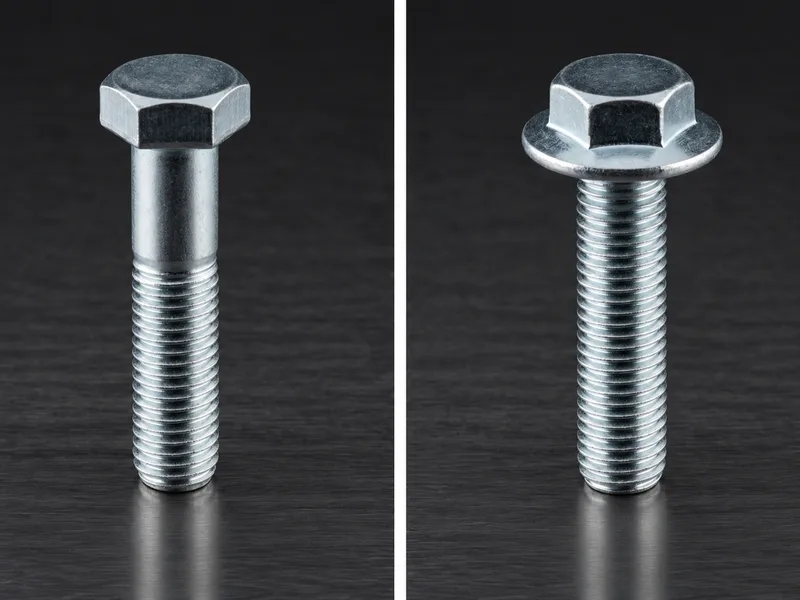
Side-by-side selection comparison of the metric hex-head pair — ISO 4014 hexagon head bolts (partially threaded, defined unthreaded shank) versus ISO 4017 hexagon head screws (fully threaded) — covering grip length, shear-plane location, interchangeability discipline and the fine-pitch counterparts.
Last updated: 2026-11
Specifications
Most hex-bolt selection questions in metric work reduce to one choice: does the thread run the whole length, or is there a smooth shank under the head? Both standards in the pair are current as 2022 editions, both cover M1.6–M64 in product grades A and B, both take metric coarse pitch, and neither defines a strength level — yet the two parts behave differently in the assembled joint because of where the thread sits. The decision is a grip-length decision first: define the clamped stack, decide whether threads are acceptable inside it, and only then pick the configuration. The comparison sources add two disciplines buyers skip at their cost — verify that a supposed 4014/4017 substitution actually places the shank and runout where the joint needs them rather than trusting matching head dimensions, and never bolt a fine pitch onto either callout, because the fine-pitch series lives in its own standards (ISO 8765 for bolts, ISO 8676 for screws).
| Selection factor — thread configuration | ISO 4014: normally partially threaded, with a standard-defined unthreaded shank depending on nominal length · ISO 4017: fully threaded along the applicable usable length beneath the head |
|---|---|
| Selection factor — ISO terminology | ISO 4014: hexagon head bolt · ISO 4017: hexagon head screw (purchasing language often says "fully threaded hex bolt" for 4017) |
| Selection factor — typical reason to choose | 4014: unthreaded shank through part of the joint, or control of thread location · 4017: thread through most of the length, especially for variable or short grip conditions |
| Shared properties | M1.6–M64, metric coarse pitch, product grades A and B, 2022 editions — both standards are dimensional only; strength comes separately from ISO 898-1 (steel class) or ISO 3506 (stainless) |
| Grip length rule | Grip is the clamped stack between head and nut. For 4014, check the standard-defined thread length places runout outside the grip — a short selection bottoms the nut on the shank, and more torque does not fix it; for 4017, confirm threads throughout the stack are acceptable to the design |
| Shear-plane consideration | A 4014 shank can keep threads out of a transverse shear plane — but the sources caution it does not automatically raise joint shear capacity; actual performance depends on shear planes, preload, friction, hole clearance, thread location and design method |
| Interchangeability rule | Do not treat the pair as automatically interchangeable: verify grip, thread engagement, shear-plane location, dimensions, property class, coating and drawing requirements — matching head dimensions alone establish nothing |
| Fine-pitch counterparts | ISO 8765:2022 (hexagon head bolts) and ISO 8676:2022 (hexagon head screws) — do not add a fine pitch to a 4014/4017 callout; an incompatible standard-pitch combination creates ambiguity between drawing, quotation and inspection |
| Length calculation discipline | Include washers, locking devices, brackets, coatings and tolerance stack in the bolt-length calculation — a nominal CAD dimension is not the worst-case production grip |
Materials
- Either configuration takes any property class — ISO 898-1 steel classes or ISO 3506 stainless grades, specified separately
Ordering & documentation
Documents
Shipments are backed by Mill Test Certificate (MTC), Dimensional Report, Salt Spray Test Report on request, with full batch traceability from raw material to finished product. Quality management follows the owner-confirmed compliance list: ISO 9001:2015, RoHS, REACH. Exact document sets are confirmed on the order.
Quotation
- The fastener family (ISO 4014 vs ISO 4017 — Choosing Partial or Full Thread) plus the standard designation from your drawing — DIN / ISO / JIS / ASTM / ANSI, or a drawing for custom parts.
- Size (diameter and length), thread type (metric or inch), property class or grade, and coating or finish.
- Quantity per size and your target delivery date.
- Destination country, and any required documents (for example a mill test certificate) so the quote includes them.
Sample & supply
Minimum order quantity is 1,000–10,000 pieces depending on size. Stock items run 3–7 days. High-strength and custom parts run 15–25 days. Quantities or variants outside the standard range are confirmed at quotation.
Storage & shipping
Parts are packed for export and shipped factory-direct to buyers in Europe, Asia, the Americas and the Middle East. Store fasteners dry and protected until installation, and keep coated parts in their packaging until use; specific packing and preservation requirements can be stated on the order and confirmed at quotation.
Frequently asked questions
Which of the two should my RFQ name?
The one the joint design assumed. Start from ISO 4014 when engineering wants the shank in a specific place — threads kept off a shear plane, a smooth bearing body through clearance holes, or a drawing that controls grip geometry. Start from ISO 4017 when full thread coverage is the useful property — thin stacks, variable grip, adjustment along the body, short bolts needing extended thread, or an approved maintenance length spanning several joint thicknesses. Then name the standard, the diameter and length, the coarse-thread designation, the property class or stainless grade, and the finish. If you are substituting a fully threaded screw into a joint drawn around a shank, the sources require checking shear, bearing, fatigue and alignment first — send that question with the RFQ rather than deciding it at the counter.
What are the classic mistakes this comparison exists to prevent?
Three, per the comparison sources. First, under-threading a partial-thread selection: the nut runs out of thread before the joint is clamped, and applying more torque cannot fix a geometry error. Second, treating the dimensional standard as the strength grade: ISO 4014 vs 4017 changes where the thread sits; changing 8.8 to 10.9 changes the mechanical properties — separate decisions, both required on the purchase line. Third, writing a fine pitch against either standard: 4014/4017 are coarse-pitch documents, and the fine-pitch equivalents are ISO 8765 and ISO 8676 — an incompatible pairing shows up later as ambiguity between the drawing, the quotation, the production traveler and the inspection report.
What is the MOQ and lead time for this bolt grade?
The minimum order quantity is 1,000–10,000 pieces depending on size. Stock items ship in 3–7 days; high-strength and custom parts in 15–25 days. Common diameters in this grade are widely stocked; confirm the exact schedule against quantity and size mix at quotation.
What should an RFQ for this bolt grade state?
State the standard and grade (for example ISO 4017 Class 8.8 or ASTM F3125 Grade A325 Type 1), diameter and length, thread type (metric coarse or UNC/UNF), finish (plain, zinc, or hot-dip galvanized where the grade permits), required certificates such as a mill test report per EN 10204 3.1, and quantity per size — plus destination country.
Related knowledge
- What Bolt Property Classes 8.8, 10.9 and 12.9 Encode — and When High Strength Stops Being the Right Choice
- Bolt Grade Selection: ISO 898-1 8.8/10.9/12.9 vs ASTM A307 and A325
- 8.8 vs 10.9 vs 12.9 Bolts: Strength, Hardness and Cost — What the Evidence Settles
- Calculating Bolt Preload and Clamp Force: Torque, Friction and Tightening Method
- How to Determine Tightening Torque and Choose a Tightening Method for a Bolted Joint
- Fastener Failure Modes: Which Fatigue, Creep and SCC Controls the Evidence Supports
- Hydrogen Embrittlement in High-Strength Bolts: Which Grades Need Controls, Which Coatings and Baking Schedules Are Acceptable, and What to Require Before the RFQ
Request a Quote
Get factory-direct pricing from the manufacturer.
What to include in your inquiry
- ✓ Standard and property class (e.g. DIN 912, ISO 4762, class 8.8) — or a drawing for custom parts.
- ✓ Sizes, lengths and thread type (metric or inch).
- ✓ Quantity per size and your target delivery date.
- ✓ Destination country, plus any coating or finish requirement.
- ✓ Any documents you need with the shipment (e.g. mill test certificate) so the quote includes them.
- ✓ Your inquiry goes straight to the factory team by email and gets a reply within 24 hours.
- ✓ Factory-direct pricing
- ✓ Standard and custom specifications
- ✓ Factory-direct export to buyers in Europe, Asia, the Americas and the Middle East
- ✓ Full fastener family support