
GB/T 5786-2016 Hexagon Head Bolts with Fine Pitch Thread, Full Thread
GB/T 5786-2016 fully threaded hexagon head bolts with metric fine pitch thread: per-size fine pitches, thread runout, bearing face, across-flats and corners, head height and fillet ladders across the fine-thread size range.
Last updated: 2026-11
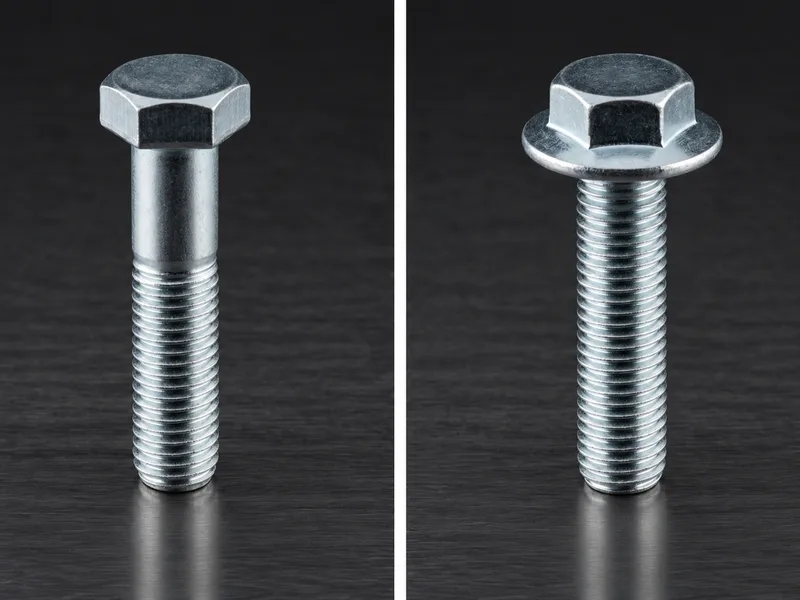
Specifications
Fine-pitch full-thread hex bolts are the adjustable-position variant of the hex bolt: same head architecture as GB/T 5783, but with the finer thread pitches that give finer axial setting and better vibration behaviour at high preload. The collected GB/T 5786-2016 table carries the fine-pitch assignment per size — 24 size columns from the small end to (M64), each with its fine pitch (the P row prints 1.0 at M8 x1 through 4.0 at M64 x4) — plus the runout a, bearing dw/da, across-corners e max/min (grade-split rows where printed), head height k max/min, fillet r and across-flats s with its tolerance ladder. The two salvaged 12-column header segments (small and large size ranges) are stitched into one 24-size row set exactly as the collected page segments them. Where a coarse-thread identity covers the same nominal size, this fine-pitch ladder is the one a "×1.5"-style callout orders against.
| Standard / scope | GB/T 5786-2016 hexagon head bolts with fine pitch thread, full thread — 24 sizes M8 x1 to M64 x4 in two segments, non-preferred sizes parenthesized as printed |
|---|---|
| Fine pitch P | M8 x1, M10 x1, (M10) x1.25, M12 x1.5, (M12) x1.25, (M14) x1.5, M16 x1.5 ... M36 x3 ... M56 x4, M64 x4 — the size x pitch header cells are the fine-pitch assignment itself |
| Width across flats s | 13 (M8 x1) to 95 (M64 x4) nominal; min ladder 12.57 to 92.8 — max/min rows carried as printed |
| Width across corners e | Grade A min 14.38 (M8 x1) to 104.86 (M64 x4); Grade B from M10 (17.59) — grade-split rows as printed |
| Head height k / k1 / fillet r | k max 5.3 (M8) to 40 (M64) with max/min grade rows; k1 grade A 3.61 (M8) to 27.65 (M64); r 0.4 to 2 |
| Not tabulated | Lengths, property classes, finishes — per RFQ against the fine-pitch property-class standards |
Materials
- Fine-pitch hex bolts are usually the fastener of choice where preload accuracy and vibration resistance matter — clamping fixtures, pressed housings, hydraulic ends. Supply is commonly 8.8/10.9 alloy with zinc or black finish; fine pitch reduces the thread's self-loosening tendency but raises the consequences of cross-threading at assembly, so specify thread pitch explicitly (M12×1.5, not "M12 fine") on the RFQ and gauge-check mating parts
Ordering & documentation
Documents
Shipments are backed by Mill Test Certificate (MTC), Dimensional Report, Salt Spray Test Report on request, with full batch traceability from raw material to finished product. Quality management follows the owner-confirmed compliance list: ISO 9001:2015, RoHS, REACH. Exact document sets are confirmed on the order.
Quotation
- The fastener family (GB/T 5786-2016 Hexagon Head Bolts with Fine Pitch Thread, Full Thread) plus the standard designation from your drawing — DIN / ISO / JIS / ASTM / ANSI, or a drawing for custom parts.
- Size (diameter and length), thread type (metric or inch), property class or grade, and coating or finish.
- Quantity per size and your target delivery date.
- Destination country, and any required documents (for example a mill test certificate) so the quote includes them.
Sample & supply
Minimum order quantity is 1,000–10,000 pieces depending on size. Stock items run 3–7 days. High-strength and custom parts run 15–25 days. Quantities or variants outside the standard range are confirmed at quotation.
Storage & shipping
Parts are packed for export and shipped factory-direct to buyers in Europe, Asia, the Americas and the Middle East. Store fasteners dry and protected until installation, and keep coated parts in their packaging until use; specific packing and preservation requirements can be stated on the order and confirmed at quotation.
Frequently asked questions
When should a fine-pitch full-thread bolt be chosen over the coarse-thread equivalent?
Three practical triggers: fine axial adjustment (a 1.5 mm pitch moves the nut a third of what a coarse M12 thread does per turn), higher preload per torque unit (the smaller thread helix angle converts torque to tension more efficiently), and vibration service, where the shallow helix resists back-off. The costs are assembly care and damage sensitivity — fine threads gall and cross-thread more easily, and the bolt's ductile margin at the root is lower. If the application ticks one of the three triggers, the GB/T 5786 identity is the right ladder; otherwise the coarse GB 5783 / ISO 4017 family is cheaper to assemble and more forgiving.
How do I read the two size segments in the table?
The collected page prints its size ladder in two salvaged header segments — the small range and the large range (with the non-preferred sizes parenthesized) — because of how the source lays out its grids; the generator stitches them column-wise into one row set without touching values. Read any size column straight down for that bolt's pitch, runout, bearing face, corners, head height and flats. If a size you need prints parenthesized, it is a non-preferred step: manufacturable but usually slower and pricier — quote it explicitly and expect the schedule to reflect it.
Related knowledge
- What Bolt Property Classes 8.8, 10.9 and 12.9 Encode — and When High Strength Stops Being the Right Choice
- Bolt Grade Selection: ISO 898-1 8.8/10.9/12.9 vs ASTM A307 and A325
- 8.8 vs 10.9 vs 12.9 Bolts: Strength, Hardness and Cost — What the Evidence Settles
- Calculating Bolt Preload and Clamp Force: Torque, Friction and Tightening Method
- How to Determine Tightening Torque and Choose a Tightening Method for a Bolted Joint
- Fastener Failure Modes: Which Fatigue, Creep and SCC Controls the Evidence Supports
- Hydrogen Embrittlement in High-Strength Bolts: Which Grades Need Controls, Which Coatings and Baking Schedules Are Acceptable, and What to Require Before the RFQ
Request a Quote
Get factory-direct pricing from the manufacturer.
What to include in your inquiry
- ✓ Standard and property class (e.g. DIN 912, ISO 4762, class 8.8) — or a drawing for custom parts.
- ✓ Sizes, lengths and thread type (metric or inch).
- ✓ Quantity per size and your target delivery date.
- ✓ Destination country, plus any coating or finish requirement.
- ✓ Any documents you need with the shipment (e.g. mill test certificate) so the quote includes them.
- ✓ Your inquiry goes straight to the factory team by email and gets a reply within 24 hours.
- ✓ Factory-direct pricing
- ✓ Standard and custom specifications
- ✓ Factory-direct export to buyers in Europe, Asia, the Americas and the Middle East
- ✓ Full fastener family support