
SAE J429 Grade 2 Bolts
SAE J429 Grade 2 — the general-purpose low-carbon inch-series bolt grade: 74 ksi minimum tensile and 55 ksi proof load from 1/4″ through 3/4″, dropping to 60/33 ksi over 3/4″ through 1-1/2″, Rockwell B70–B100. No radial head lines.
Last updated: 2026-11
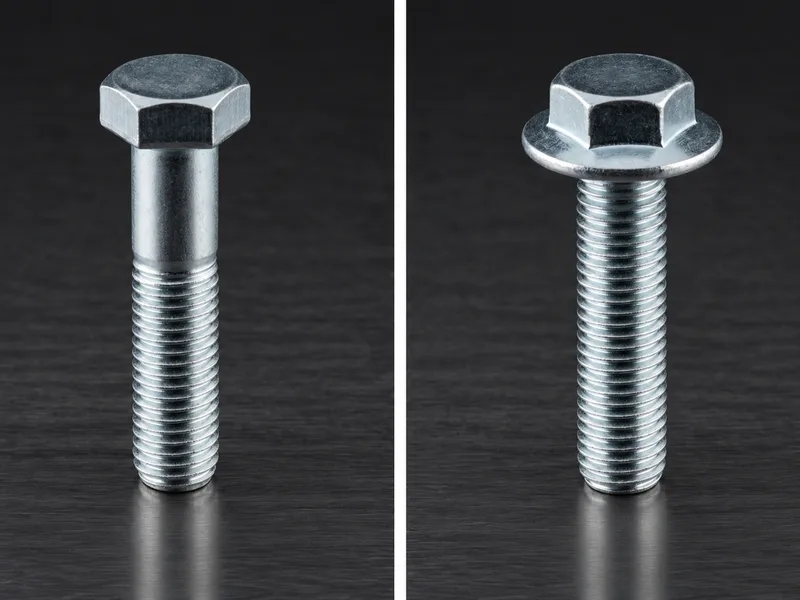
Specifications
Grade 2 is where the SAE grade system starts: a low- or medium-carbon steel bolt with no radial lines on the head, sized for general automotive and industrial work that does not justify a quenched-and-tempered grade. The figure to watch is the step at 3/4″ — above that diameter the minimum tensile drops from 74 ksi to 60 ksi and the proof load from 55 ksi to 33 ksi, because the grade gets its properties from carbon content and workmanship rather than heat treatment, and thicker sections do not through-harden. In practice that means a large "Grade 2" bolt is materially weaker than the small hardware store version of the same designation, which is why drawings that leave the diameter to the fabricator should also state the strength expectation. Where the load needs more, the same head geometry exists in Grade 5 (3 radial lines, 120 ksi class); where the drawing calls out an ASTM spec instead, Grade 2 is the functional counterpart of ASTM A307 Grade A.
| Standard | SAE J429 Grade 2 — mechanical and material requirements for externally threaded inch-series fasteners |
|---|---|
| Head marking | No radial lines (manufacturer symbol only) |
| Material | Low or medium carbon steel, no alloy content required, no hardening requirement |
| Min. tensile | 74 ksi (1/4″ through 3/4″); 60 ksi (over 3/4″ through 1-1/2″) |
| Min. yield | 57 ksi (1/4″ through 3/4″); 36 ksi (over 3/4″ through 1-1/2″) |
| Min. proof load | 55 ksi (1/4″ through 3/4″); 33 ksi (over 3/4″ through 1-1/2″) |
| Hardness | Rockwell B70–B100 (HRB) across both size bands |
| Size range | 1/4″ through 1-1/2″ — the strength step at 3/4″ is part of the grade, not a supplier variation |
| Typical pairing | SAE J995 Grade 2 nut, F844 plain washer |
| ASTM counterpart | Functionally equivalent to ASTM A307 Grade A (low carbon, general purpose) |
Materials
- Low or medium carbon steel, no alloy content required
Ordering & documentation
Documents
Shipments are backed by Mill Test Certificate (MTC), Dimensional Report, Salt Spray Test Report on request, with full batch traceability from raw material to finished product. Quality management follows the owner-confirmed compliance list: ISO 9001:2015, RoHS, REACH. Exact document sets are confirmed on the order.
Quotation
- The fastener family (SAE J429 Grade 2 Bolts) plus the standard designation from your drawing — DIN / ISO / JIS / ASTM / ANSI, or a drawing for custom parts.
- Size (diameter and length), thread type (metric or inch), property class or grade, and coating or finish.
- Quantity per size and your target delivery date.
- Destination country, and any required documents (for example a mill test certificate) so the quote includes them.
Sample & supply
Minimum order quantity is 1,000–10,000 pieces depending on size. Stock items run 3–7 days. High-strength and custom parts run 15–25 days. Quantities or variants outside the standard range are confirmed at quotation.
Storage & shipping
Parts are packed for export and shipped factory-direct to buyers in Europe, Asia, the Americas and the Middle East. Store fasteners dry and protected until installation, and keep coated parts in their packaging until use; specific packing and preservation requirements can be stated on the order and confirmed at quotation.
Frequently asked questions
Why does Grade 2 get weaker above 3/4″?
Because the grade is not quenched and tempered: its strength comes from the carbon content of the bar, and the mechanical table reflects what unhardened low-carbon steel delivers as sections get thicker. The collected specification prints the drop explicitly — 74 ksi tensile and 55 ksi proof at 1/4″–3/4″, 60 ksi and 33 ksi over 3/4″ through 1-1/2″ — and the effect is more pronounced than in the quenched-and-tempered ASTM A449, which shows the same size-dependent behavior in milder form. If your joint needs full strength in large diameters, that is what Grade 5 or a specified ASTM grade is for; do not scale Grade 2 proof loads from the small-size table.
Can I substitute ASTM A307 when the drawing says SAE Grade 2?
The collected specification describes the SAE and ASTM families as functionally overlapping — Grade 2 ≈ A307 Grade A for general-purpose low-carbon work — and notes ASTM equivalents are generally acceptable substitutions when no specific SAE callout is mandated. The discipline is the reverse: a drawing that names A307, A449, or A354 has already made a testing and certification choice, so substitute back to SAE grades only with the engineer's concurrence. Either way, the matched nut is SAE J995 Grade 2 and the washer an F844 plain — the pair is part of how the grade keeps the joint failing in the bolt, not the nut.
What is the MOQ and lead time for this bolt grade?
The minimum order quantity is 1,000–10,000 pieces depending on size. Stock items ship in 3–7 days; high-strength and custom parts in 15–25 days. Common diameters in this grade are widely stocked; confirm the exact schedule against quantity and size mix at quotation.
What should an RFQ for this bolt grade state?
State the standard and grade (for example ISO 4017 Class 8.8 or ASTM F3125 Grade A325 Type 1), diameter and length, thread type (metric coarse or UNC/UNF), finish (plain, zinc, or hot-dip galvanized where the grade permits), required certificates such as a mill test report per EN 10204 3.1, and quantity per size — plus destination country.
Related knowledge
- What Bolt Property Classes 8.8, 10.9 and 12.9 Encode — and When High Strength Stops Being the Right Choice
- Bolt Grade Selection: ISO 898-1 8.8/10.9/12.9 vs ASTM A307 and A325
- 8.8 vs 10.9 vs 12.9 Bolts: Strength, Hardness and Cost — What the Evidence Settles
- Calculating Bolt Preload and Clamp Force: Torque, Friction and Tightening Method
- How to Determine Tightening Torque and Choose a Tightening Method for a Bolted Joint
- Fastener Failure Modes: Which Fatigue, Creep and SCC Controls the Evidence Supports
- Hydrogen Embrittlement in High-Strength Bolts: Which Grades Need Controls, Which Coatings and Baking Schedules Are Acceptable, and What to Require Before the RFQ
Request a Quote
Get factory-direct pricing from the manufacturer.
What to include in your inquiry
- ✓ Standard and property class (e.g. DIN 912, ISO 4762, class 8.8) — or a drawing for custom parts.
- ✓ Sizes, lengths and thread type (metric or inch).
- ✓ Quantity per size and your target delivery date.
- ✓ Destination country, plus any coating or finish requirement.
- ✓ Any documents you need with the shipment (e.g. mill test certificate) so the quote includes them.
- ✓ Your inquiry goes straight to the factory team by email and gets a reply within 24 hours.
- ✓ Factory-direct pricing
- ✓ Standard and custom specifications
- ✓ Factory-direct export to buyers in Europe, Asia, the Americas and the Middle East
- ✓ Full fastener family support