
Steel Bolt Strength Designation System
Minimum tensile strength, yield stress and stress at permanent set limit per steel bolt strength grade 4.6 through 14.9, tabulated in the collected source's kgf/mm 2 units — the strength-designation ladder behind grade-marked bolts.
Last updated: 2026-11
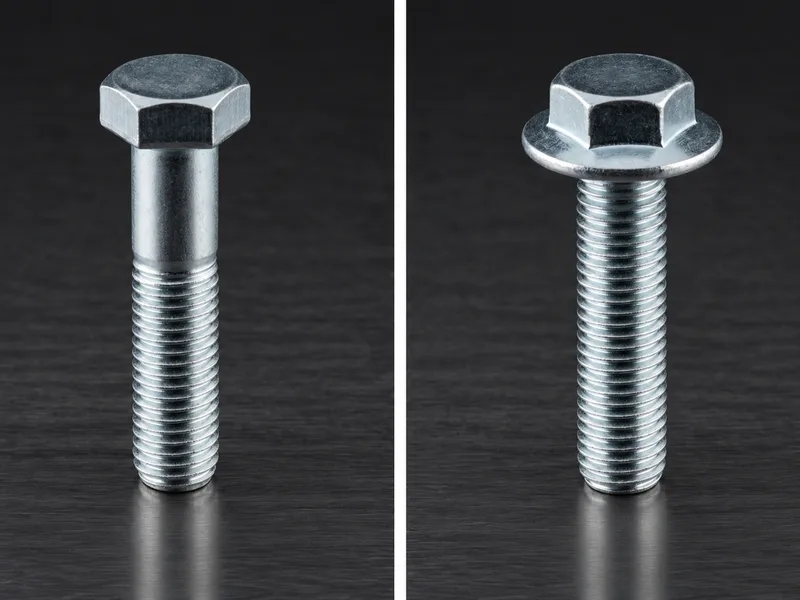
Specifications
A steel bolt grade such as 4.6 or 10.9 is a compact strength statement: the first digit carries the nominal tensile strength, the second the ratio of yield (or permanent-set-limit stress) to it. This reference tabulates the collected source's strength-designation table across grades 4.6, 4.8, 5.6, 5.8, 6.6, 6.8, 8.8, 10.9, 12.9 and 14.9, in its own units — all stress and strength values are in kgf/mm 2, as the table's own footer states. The split you see across the rows is the hardening route: the ductile low grades print a minimum yield stress (grade 4.6: 24; 4.8: 32; 5.6: 30; 5.8: 40; 6.6: 36; 6.8: 48), while from 8.8 upward the table prints a minimum stress at permanent set limit R 0.2 instead (grade 8.8: 64; 10.9: 90; 12.9: 108; 14.9: 126) — quenched-and-tempered steels have no flat yield plateau, so a proof-type value takes its place. Minimum tensile strength climbs from 40 at the 4.x grades to 140 at 14.9. Two cautions when you use this table: it is a legacy-units tabulation carried verbatim (its 6.6 and 14.9 columns and the absence of 9.8 are the source's own grade ladder — flagged, not normalized), and the current ISO 898-1 property-class values in N/mm 2 are tabulated on our screw-strength page in the screws family. Head dimensions, proof loads and certificates are per RFQ.
| Grades covered | 4.6, 4.8, 5.6, 5.8, 6.6, 6.8, 8.8, 10.9, 12.9, 14.9 — as the collected table prints them |
|---|---|
| Minimum tensile strength | 40 / 40 / 50 / 50 / 60 / 60 / 80 / 100 / 120 / 140 across the grade ladder |
| Yield stress (R e), min. | Printed for the ductile grades only: 24 (4.6), 32 (4.8), 30 (5.6), 40 (5.8), 36 (6.6), 48 (6.8); ellipsis cells above |
| Stress at permanent set limit (R 0.2), min. | Printed from 8.8 up: 64 (8.8), 90 (10.9), 108 (12.9), 126 (14.9); ellipsis cells below |
| Units | kgf/mm 2 for all stress and strength values (the table's own footer note, carried verbatim) |
| Not tabulated | N/mm 2 conversions, hardness, proof loads, marking rules — the ISO 898 ladder in N/mm 2 is on the screw-strength page; the rest per RFQ |
| Strength Grade Designation | 4.6 | 4.8 | 5.6 | 5.8 | 6.6 | 6.8 | 8.8 | 10.9 | 12.9 | 14.9 |
|---|---|---|---|---|---|---|---|---|---|---|
| Tensile Strength ( R m), Min. | 40 | 40 | 50 | 50 | 60 | 60 | 80 | 100 | 120 | 140 |
| Yield Stress (R e ), Min. | 24 | 32 | 30 | 40 | 36 | 48 | … | … | … | … |
| Stress at Permanent Set Limit (R 0.2 ), Min. | … | … | … | … | … | … | 64 | 90 | 108 | 126 |
| All stress and strength values are in kgf/mm 2 units. |
- Row 1 (Tensile Strength ( R m), Min.): grade ladder includes "6.6" and "14.9" and omits 9.8 (the ISO 898-1 standard ladder is 4.6/4.8/5.6/5.8/6.8/8.8/9.8/10.9/12.9) — the source's own grade set, carried verbatim, not normalized
- Row 2 (Yield Stress (R e ), Min.): Yield Stress printed for the ductile grades only; Stress at Permanent Set Limit (R 0.2) printed from 8.8 up — the two ellipsis-split rows are the source's hardening-route split, as printed
- Row 4 (All stress and strength values are in kgf/mm 2 units.): footer unit note is a full-width spanning row in the source table; carried as the last row with empty trailing cells
Materials
- The grades on this table span the carbon and alloy-steel bolt supply: low-carbon steels at the 4.x/5.x grades, medium-carbon quenched and tempered from 8.8, alloy steel at 10.9 and above. Order by the grade marking your drawing calls out and state the certificate requirement — delivered strength is certified against the standard per order, not from this table
Ordering & documentation
Documents
Shipments are backed by Mill Test Certificate (MTC), Dimensional Report, Salt Spray Test Report on request, with full batch traceability from raw material to finished product. Quality management follows the owner-confirmed compliance list: ISO 9001:2015, RoHS, REACH. Exact document sets are confirmed on the order.
Quotation
- The fastener family (Steel Bolt Strength Designation System) plus the standard designation from your drawing — DIN / ISO / JIS / ASTM / ANSI, or a drawing for custom parts.
- Size (diameter and length), thread type (metric or inch), property class or grade, and coating or finish.
- Quantity per size and your target delivery date.
- Destination country, and any required documents (for example a mill test certificate) so the quote includes them.
Sample & supply
Minimum order quantity is 1,000–10,000 pieces depending on size. Stock items run 3–7 days. High-strength and custom parts run 15–25 days. Quantities or variants outside the standard range are confirmed at quotation.
Storage & shipping
Parts are packed for export and shipped factory-direct to buyers in Europe, Asia, the Americas and the Middle East. Store fasteners dry and protected until installation, and keep coated parts in their packaging until use; specific packing and preservation requirements can be stated on the order and confirmed at quotation.
Frequently asked questions
How do I convert this table's kgf/mm 2 values to the N/mm 2 numbers I see on modern datasheets?
Treat this table as the legacy-units view of the same grade ladder: 1 kgf/mm 2 is 9.81 N/mm 2, so grade 4.6's 40 here corresponds to the familiar ~400 N/mm 2 nominal tensile on an ISO 898 datasheet, and grade 8.8's 64 R 0.2 to the ~640 proof value. For quoting, specifying or certificate checks, use the N/mm 2 standard table — it is tabulated on our screw-strength page in the screws family — and keep this page as the designation-system overview in the source's own units. Do not mix the two unit systems inside one calculation without converting every value.
The table shows yield stress for some grades and permanent-set-limit stress for others — why?
Because the two grade families behave differently under load. The low grades (4.6 - 6.8) are made of steels with a distinct yield point, so the table can print a minimum yield stress directly — grade 4.6 yields at 24, roughly 0.6 of its 40 tensile. From grade 8.8 up the bolts are quenched and tempered: the stress-strain curve no longer has a flat yield plateau, so the strength is specified at a small permanent set (R 0.2, the stress leaving 0.2% permanent deformation) — 64 for 8.8, 126 for 14.9. Functionally both numbers play the same role: the stress the bolt can carry while staying essentially elastic. When you RFQ, name the grade, not the property — the marking governs what the certificate must show.
Related knowledge
- What Bolt Property Classes 8.8, 10.9 and 12.9 Encode — and When High Strength Stops Being the Right Choice
- Bolt Grade Selection: ISO 898-1 8.8/10.9/12.9 vs ASTM A307 and A325
- 8.8 vs 10.9 vs 12.9 Bolts: Strength, Hardness and Cost — What the Evidence Settles
- Calculating Bolt Preload and Clamp Force: Torque, Friction and Tightening Method
- How to Determine Tightening Torque and Choose a Tightening Method for a Bolted Joint
- Fastener Failure Modes: Which Fatigue, Creep and SCC Controls the Evidence Supports
- Hydrogen Embrittlement in High-Strength Bolts: Which Grades Need Controls, Which Coatings and Baking Schedules Are Acceptable, and What to Require Before the RFQ
Request a Quote
Get factory-direct pricing from the manufacturer.
What to include in your inquiry
- ✓ Standard and property class (e.g. DIN 912, ISO 4762, class 8.8) — or a drawing for custom parts.
- ✓ Sizes, lengths and thread type (metric or inch).
- ✓ Quantity per size and your target delivery date.
- ✓ Destination country, plus any coating or finish requirement.
- ✓ Any documents you need with the shipment (e.g. mill test certificate) so the quote includes them.
- ✓ Your inquiry goes straight to the factory team by email and gets a reply within 24 hours.
- ✓ Factory-direct pricing
- ✓ Standard and custom specifications
- ✓ Factory-direct export to buyers in Europe, Asia, the Americas and the Middle East
- ✓ Full fastener family support