
DIN 7968 Hexagon Fit Bolts with Hexagon Nut for Steel Structures (M12 – M30)
DIN 7968 hexagon fit bolts with hexagon nut for steel structures, M12 to M30 — the turned-shank h11 fit bolt that fills a reamed hole and takes shear on the shank itself, with the full geometry ladder (P, b, ds, dw, e, k, k´, s, r) and a 35-row length matrix giving grip length ls and thread projection lg per bolt length from 30 to 200 mm.
Last updated: 2026-11
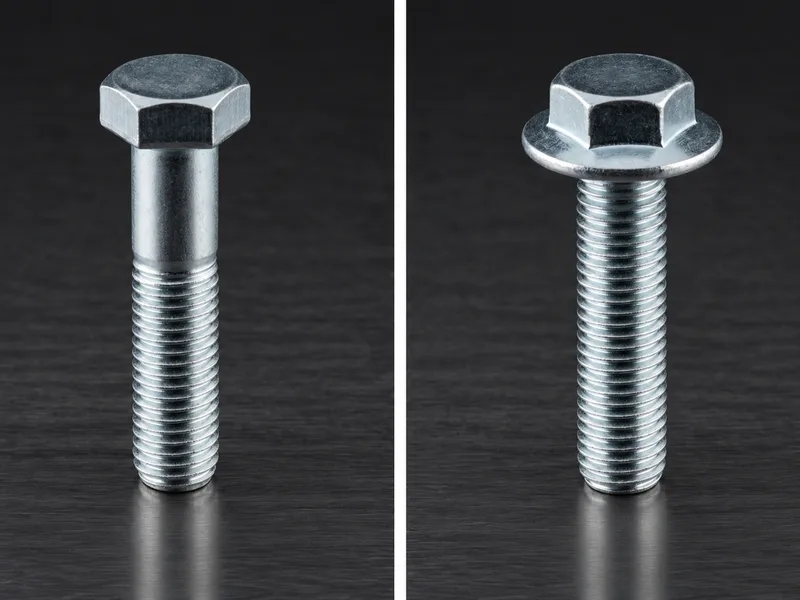
Specifications
DIN 7968 is the fit bolt of the steel-structure pair — and the h11 in its shank row is the whole point. Where an ordinary hex bolt (its sibling DIN 7990) sits in a standard clearance hole and holds through thread grip, a DIN 7968 fit bolt has a machined shank in the h11 tolerance band, sized to fill a reamed hole so the joint takes shear directly on the shank bearing instead of slipping into bolt-bearing. That is why it shows up where displacement cannot be tolerated: brackets, shear connections, jig and fixture frames on heavy fabrication. The collected ladder runs M12 to M30 (pitch 1,75 at M12 stepping to 3,5 at M30), head height k nominal 8 to 19, width across flats s 18 to 46, and the partial-thread build shows in the b row — "length of the thread (at least)" 17,12 at M12 rising to 31,25 at M30 — so the unthreaded fitted portion does the locating while the thread does the clamping. The 35-row length matrix is what a fabricator orders from: bolt length l 30 to 200 in 5 mm steps, with grip length ls min. and thread projection lg max. per thread, going ragged where a thread's ladder runs out — M12 stops at l=120, M16 at 160, M20 at 180, and the 185-200 band belongs to the big threads M22 up. Materials per the source's Makings panel: steel 5.6 and 8.8, thread tolerance 8g. One reading note applies: the source prints two unlabeled value columns per thread size, and at M12 and M22 several rows (dw, e, s) print different values in the two columns — this page carries both verbatim rather than picking one; see the anomaly FAQ before leaning on those cells for a hole or head detail.
| Standard / scope | DIN 7968 hexagon fit bolts with hexagon nut for steel structures (source title "DIN 7968 - Hexagon fit bolts with hexagon nut for steel structures"; "Current norm: DIN 7968"), M12 to M30 |
|---|---|
| Thread ladder | M12 (P 1,75), M16 (2), M20 (2,5), M22 (2,5), M24 (3), M27 (3), M30 (3,5); thread tolerance 8g per the Makings panel |
| Fitted shank | ds prints the h11 tolerance — the fit-bolt discriminator: a machined shank for reamed holes, shear taken on the shank itself; ds 13 (M12) to 31 (M30); waisted shank diameter da max. 14,7 to 35,4 |
| Head geometry | Head height k nominal 8 (M12) to 19 (M30), min. 7,55 to 17,95; width across flats s 18 to 46 nominal=max. (with the source's doubled-column divergence at M12/M22 — carried verbatim); head diameter e min. 19,85 to 50,85; bearing dw min. 16,4 to 42,7 |
| Thread length b (at least) | 17,12 (M12) to 31,25 (M30) — printed by the source as "b (auxility dimension)"; the unthreaded fitted portion at each bolt length is read from the length matrix (ls min. / lg max. per thread) |
| Length matrix | Bolt length l 30 to 200 in 5 mm steps (35 rows), with ls min. and lg max. per thread; ragged ladder: M12 runs 30-120, M16 35-160, M20 40-180, M22 45-200, M24 50-200, M27 60-200, M30 70-200 |
| Materials | Steel 5.6, 8.8 per the source Makings panel (stainless, plastic, non-ferrous print "-" — not claimed) |
| Not tabulated | No finishes or coatings, no hole/reaming tolerance spec beyond the h11 shank print, no proof-load ratings (see the DIN 7990 page for the clearance-hole sibling) — confirmed at quotation |
| Attribute | Limit | M12 (col. 1) | M12 (col. 2) | M16 (col. 1) | M16 (col. 2) | M20 (col. 1) | M20 (col. 2) | M22 (col. 1) | M22 (col. 2) | M24 (col. 1) | M24 (col. 2) | M27 (col. 1) | M27 (col. 2) | M30 (col. 1) | M30 (col. 2) |
|---|---|---|---|---|---|---|---|---|---|---|---|---|---|---|---|
| Attribute | Limit | M12 (col. 1) | M12 (col. 2) | M16 (col. 1) | M16 (col. 2) | M20 (col. 1) | M20 (col. 2) | M22 (col. 1) | M22 (col. 2) | M24 (col. 1) | M24 (col. 2) | M27 (col. 1) | M27 (col. 2) | M30 (col. 1) | M30 (col. 2) |
| P | 1,75 | 1,75 | 2 | 2 | 2,5 | 2,5 | 2,5 | 2,5 | 3 | 3 | 3 | 3 | 3,5 | 3,5 | |
| b (auxility dimension) | 17,12 | 17,12 | 20,5 | 20,5 | 23,75 | 23,75 | 25,75 | 25,75 | 26,5 | 26,5 | 29,5 | 29,5 | 31,25 | 31,25 | |
| c | max. | 0,6 | 0,6 | 0,8 | 0,8 | 0,8 | 0,8 | 0,8 | 0,8 | 0,8 | 0,8 | 0,8 | 0,8 | 0,8 | 0,8 |
| da | max. | 14,7 | 14,7 | 18,7 | 18,7 | 24,4 | 24,4 | 26,4 | 26,4 | 28,4 | 28,4 | 32,4 | 32,4 | 35,4 | 35,4 |
| ds | h11 | 13 | 13 | 17 | 17 | 21 | 21 | 23 | 23 | 25 | 25 | 28 | 28 | 31 | 31 |
| dw | min. | 16,4 | 17,2 | 22 | 22 | 27,7 | 27,7 | 31,4 | 29,5 | 33,2 | 33,2 | 38 | 38 | 42,7 | 42,7 |
| e | min. | 19,85 | 20,88 | 26,17 | 26,17 | 32,95 | 32,95 | 37,29 | 35,03 | 39,55 | 39,55 | 45,2 | 45,2 | 50,85 | 50,85 |
| k | Nominal size | 8 | 8 | 10 | 10 | 13 | 13 | 14 | 14 | 15 | 15 | 17 | 17 | 19 | 19 |
| k | min. | 7,55 | 7,55 | 9,25 | 9,25 | 12,1 | 12,1 | 13,1 | 13,1 | 14,1 | 14,1 | 16,1 | 16,1 | 17,95 | 17,95 |
| k | max. | 8,45 | 8,45 | 10,75 | 10,75 | 13,9 | 13,9 | 14,9 | 14,9 | 15,9 | 15,9 | 17,9 | 17,9 | 20,05 | 20,05 |
| k´ | min. | 5,28 | 5,28 | 6,47 | 6,47 | 8,47 | 8,47 | 9,17 | 9,17 | 9,87 | 9,87 | 11,27 | 11,27 | 12,56 | 12,56 |
| r | min. | 0,6 | 0,6 | 0,6 | 0,6 | 0,8 | 0,8 | 0,8 | 0,8 | 0,8 | 0,8 | 1 | 1 | 1 | 1 |
| s | max.=nominal size | 18 | 19 | 24 | 24 | 30 | 30 | 34 | 32 | 36 | 36 | 41 | 41 | 46 | 46 |
| s | min. | 17,57 | 18,48 | 23,16 | 23,16 | 29,16 | 29,16 | 33 | 31 | 35 | 35 | 40 | 40 | 45 | 45 |
- Row 6 (ds): dw min. prints two different values at M12 (16,4 / 17,2) and M22 (31,4 / 29,5) across the source's two unlabeled columns; all other threads print one value spanning both. Verbatim, not adjudicated.
- Row 7 (dw): e min. prints two different values at M12 (19,85 / 20,88) and M22 (37,29 / 35,03) across the two columns. Verbatim, not adjudicated.
- Row 13 (r): s (max.=nominal size) prints 18 / 19 at M12 and 34 / 32 at M22 across the two columns — the source's own doubled-column divergence, carried side by side.
- Row 14 (s): s min. prints 17,57 / 18,48 at M12 and 33 / 31 at M22 across the two columns. Verbatim.
- Row 1 (Attribute): The source's own header row ("Thread size (d)", M12-M30) is carried as this table's header; the doubled column presentation "(col. 1)/(col. 2)" is a transcription label for the source's two unlabeled value columns, not a source designation.
- The legend covers b/l/d/k/r/ds only; P, c, da, dw, e, k´ and s have no legend entries on the source page (conventional metric-bolt symbols; "k´ min." carries the source's own prime notation).
| l nominal | min. | max. | M12 ls min. | M12 lg max. | M16 ls min. | M16 lg max. | M20 ls min. | M20 lg max. | M22 ls min. | M22 lg max. | M24 ls min. | M24 lg max. | M27 ls min. | M27 lg max. | M30 ls min. | M30 lg max. |
|---|---|---|---|---|---|---|---|---|---|---|---|---|---|---|---|---|
| 30 | 28,95 | 31,05 | 8,5 | 12,88 | ||||||||||||
| 35 | 33,75 | 36,25 | 13,5 | 17,88 | 9,5 | 14,5 | ||||||||||
| 40 | 38,75 | 41,25 | 18,5 | 22,88 | 14,5 | 19,5 | 10 | 16,25 | ||||||||
| 45 | 43,75 | 46,25 | 23,5 | 27,88 | 19,5 | 24,5 | 15 | 21,25 | 13 | 19,25 | ||||||
| 50 | 48,75 | 51,25 | 28,5 | 32,88 | 24,5 | 29,5 | 20 | 26,25 | 18 | 24,25 | 16 | 23,5 | ||||
| 55 | 53,5 | 56,5 | 33,5 | 37,88 | 29,5 | 34,5 | 25 | 31,25 | 23 | 29,25 | 21 | 28,5 | ||||
| 60 | 58,5 | 61,5 | 38,5 | 42,88 | 34,5 | 39,5 | 30 | 36,25 | 28 | 34,25 | 26 | 33,5 | 23 | 30,5 | ||
| 65 | 63,5 | 66,5 | 43,5 | 47,88 | 39,5 | 44,5 | 35 | 41,25 | 33 | 39,25 | 31 | 38,5 | 28 | 35,5 | ||
| 70 | 68,5 | 71,5 | 48,5 | 52,88 | 44,5 | 49,5 | 40 | 46,25 | 38 | 44,25 | 36 | 43,5 | 33 | 40,5 | 30 | 38,75 |
| 75 | 73,5 | 76,5 | 53,5 | 57,88 | 49,5 | 54,5 | 45 | 51,25 | 43 | 49,25 | 41 | 48,5 | 38 | 45,5 | 35 | 43,75 |
| 80 | 78,5 | 81,5 | 58,5 | 62,88 | 54,5 | 59,5 | 50 | 56,25 | 48 | 54,25 | 46 | 53,5 | 43 | 50,5 | 40 | 48,75 |
| 85 | 83,25 | 86,75 | 63,5 | 67,88 | 59,5 | 64,5 | 55 | 61,25 | 53 | 59,25 | 51 | 58,5 | 48 | 55,5 | 45 | 53,75 |
| 90 | 88,25 | 91,75 | 68,5 | 72,88 | 64,5 | 69,5 | 60 | 66,25 | 58 | 64,25 | 56 | 63,5 | 53 | 60,5 | 50 | 58,75 |
| 95 | 93,25 | 96,75 | 73,5 | 77,88 | 69,5 | 74,5 | 65 | 71,25 | 63 | 69,25 | 61 | 68,5 | 58 | 65,5 | 55 | 63,75 |
| 100 | 98,25 | 101,75 | 78,5 | 82,88 | 74,5 | 79,5 | 70 | 76,25 | 68 | 74,25 | 66 | 73,5 | 63 | 70,5 | 60 | 68,75 |
| 105 | 103,25 | 106,75 | 83,5 | 87,88 | 79,5 | 84,5 | 75 | 81,25 | 73 | 79,25 | 71 | 78,5 | 68 | 75,5 | 65 | 73,75 |
| 110 | 108,25 | 11,75 | 88,5 | 92,88 | 84,5 | 89,5 | 80 | 86,25 | 78 | 84,25 | 76 | 83,5 | 73 | 80,5 | 70 | 78,75 |
| 115 | 113,25 | 116,75 | 93,5 | 97,88 | 89,5 | 94,5 | 85 | 91,25 | 83 | 89,25 | 81 | 88,5 | 78 | 85,5 | 75 | 83,75 |
| 120 | 118,25 | 121,75 | 98,5 | 102,88 | 94,5 | 99,5 | 90 | 96,25 | 88 | 94,25 | 86 | 93,5 | 83 | 90,5 | 80 | 88,75 |
| 125 | 123 | 127 | 99,5 | 104,5 | 95 | 101,25 | 93 | 99,25 | 91 | 98,5 | 88 | 95,5 | 85 | 93,75 | ||
| 130 | 128 | 132 | 104,5 | 109,5 | 100 | 106,25 | 98 | 104,25 | 96 | 103,5 | 93 | 100,5 | 90 | 98,75 | ||
| 135 | 133 | 137 | 109,5 | 114,5 | 105 | 11,25 | 103 | 109,25 | 101 | 108,5 | 98 | 105,5 | 95 | 103,75 | ||
| 140 | 138 | 142 | 114,5 | 119,5 | 110 | 116,25 | 108 | 114,25 | 106 | 113,5 | 103 | 110,5 | 100 | 108,75 | ||
| 145 | 143 | 147 | 119,5 | 124,5 | 115 | 121,25 | 113 | 119,25 | 111 | 118,5 | 108 | 115,5 | 105 | 113,75 | ||
| 150 | 152 | 152 | 124,5 | 129,5 | 120 | 126,25 | 118 | 124,25 | 116 | 123,5 | 113 | 120,5 | 110 | 118,75 | ||
| 155 | 148 | 159 | 129,5 | 134,5 | 125 | 131,25 | 123 | 129,25 | 121 | 128,5 | 118 | 125,5 | 115 | 123,75 | ||
| 160 | 156 | 164 | 134,5 | 139,5 | 130 | 136,25 | 128 | 134,25 | 126 | 133,5 | 123 | 130,5 | 120 | 128,75 | ||
| 165 | 161 | 169 | 135 | 141,25 | 133 | 139,25 | 131 | 138,5 | 128 | 135,5 | 125 | 133,75 | ||||
| 170 | 166 | 174 | 140 | 146,25 | 138 | 144,25 | 136 | 143,5 | 133 | 140,5 | 130 | 138,75 | ||||
| 175 | 171 | 179 | 145 | 151,25 | 143 | 149,25 | 141 | 148,5 | 138 | 145,5 | 135 | 143,75 | ||||
| 180 | 176 | 184 | 150 | 156,25 | 148 | 154,25 | 146 | 153,5 | 143 | 150,5 | 140 | 148,75 | ||||
| 185 | 180,4 | 189,6 | 153 | 159,25 | 151 | 158,5 | 148 | 155,5 | 145 | 153,75 | ||||||
| 190 | 185,4 | 194,6 | 158 | 164,25 | 156 | 163,5 | 153 | 160,5 | 150 | 158,75 | ||||||
| 195 | 190,4 | 199,6 | 163 | 169,25 | 161 | 168,5 | 158 | 165,5 | 155 | 163,75 | ||||||
| 200 | 195,4 | 204,6 | 168 | 174,25 | 166 | 173,5 | 163 | 170,5 | 160 | 168,75 |
- Row 17 (110): l=110 prints max. 11,75 against min. 108,25 (every neighbour's band steps around nominal ± 1-4); the leading digit appears truncated. Verbatim, flagged, not normalized.
- Row 22 (135): l=135 prints M20 lg max. 11,25 against ls min. 105 (neighbours 106,25 / 116,25); same truncated-leading-digit character as the l=110 cell. Verbatim, flagged.
- Row 33 (190): l=150 prints min. 152 / max. 152 — an identical pair, against the band pattern elsewhere (min. below nominal, max. above). Verbatim, flagged.
- Row 34 (195): l=155 prints min. 148 / max. 159 against nominal 155, breaking the non-monotonic pattern of the surrounding ladder (150: 152/152; 160: 156/164). Verbatim, flagged.
- The ragged ladder itself is structural, not anomalous: M12 runs 30-120, M16 35-160, M20 40-180, M22 45-200, M24 50-200, M27 60-200, M30 70-200 — a thread's ladder runs out where the shank can no longer hold the required thread length b (see the geometry table).
Materials
- Steel grades 5.6 and 8.8 per the collected Makings panel. 5.6 is the machined-shank grade that suits the classic fitted-joint work — the shank is turned to h11 either way, and the grade choice follows the connection design; 8.8 covers the higher-strength assemblies where the fitted bolt also carries meaningful tension. Both grades print on the source page, so both are quoted as tabulated; stainless, plastic and non-ferrous print "-" and are quoted per RFQ, as are hot-dip galvanized variants (galvanizing shifts thread tolerance and the reamed-hole pairing — state it on the RFQ so the fit survives the coating).
Ordering & documentation
Documents
Shipments of DIN 7968 Hexagon Fit Bolts with Hexagon Nut for Steel Structures (M12 – M30) are backed by Mill Test Certificate (MTC), Dimensional Report, Salt Spray Test Report on request, with full batch traceability from raw material to finished product. Quality management for DIN 7968 Hexagon Fit Bolts with Hexagon Nut for Steel Structures (M12 – M30) orders follows the owner-confirmed compliance list: ISO 9001:2015, RoHS, REACH. Exact document sets are confirmed on the order.
Quotation
- The product family (DIN 7968 Hexagon Fit Bolts with Hexagon Nut for Steel Structures (M12 – M30)), product standard/designation and drawing or part number.
- The dimensions that apply to this part — such as size, pitch, length, thickness, fit, grip or groove geometry.
- Material/grade, heat-treatment condition and surface finish, together with the service environment.
- Quantity per size, delivery destination and required test or traceability documents.
Sample & supply
Supply source for DIN 7968 Hexagon Fit Bolts with Hexagon Nut for Steel Structures (M12 – M30): own manufacturing plus qualified outsourcing (per the owner-confirmed scope of supply (own production plus outsourcing)).
Minimum order quantity for din 7968 hexagon fit bolts with hexagon nut for steel structures (m12 – m30) is 1,000–10,000 pieces depending on size (applies to the standard sizes and finishes for din 7968 hexagon fit bolts with hexagon nut for steel structures (m12 – m30); mixed, special or custom variants are quoted — final commercial terms per quotation) Stock items for din 7968 hexagon fit bolts with hexagon nut for steel structures (m12 – m30) run 3–7 days. High-strength and custom parts for din 7968 hexagon fit bolts with hexagon nut for steel structures (m12 – m30) run 15–25 days. Quantities or variants of din 7968 hexagon fit bolts with hexagon nut for steel structures (m12 – m30) outside the standard range are confirmed at quotation.
Storage & shipping
DIN 7968 Hexagon Fit Bolts with Hexagon Nut for Steel Structures (M12 – M30) are packed for export and shipped factory-direct to buyers in Europe, Asia, the Americas and the Middle East. Store din 7968 hexagon fit bolts with hexagon nut for steel structures (m12 – m30) dry and protected until installation, and keep coated parts in their packaging until use; specific packing and preservation requirements can be stated on the order and confirmed at quotation.
Frequently asked questions
DIN 7968 or DIN 7990 — which structural bolt does my drawing mean?
The hole decides. If the drawing calls a reamed or fitted hole ("passung", "reamed to size"), it means DIN 7968: the h11 machined shank fills the hole and shear passes through the shank bearing — no slip allowed. If the hole is a standard clearance hole, it means DIN 7990, the ordinary structural hex bolt held by thread grip and friction. Both share the M12-M30 ladder, so the designation on the order must name the standard, not just "M20 structural bolt". Pairing the two defeats the design: a 7990 bolt rattling in a reamed hole carries nothing by fit, and forcing a 7968 shank into a clearance hole loses the registered bearing. Where the drawing is silent, the clearance build (DIN 7990) is the default reading.
How do I use the ls/lg columns to pick my bolt length?
ls min. is the shortest guaranteed grip — the unthreaded fitted shank inside the clamped plates, the part that actually shears; lg max. is the longest the thread can project into the joint. The rule for a fit bolt is stricter than for an ordinary one: the thread must stay fully outside the reamed hole (the hole is sized to the h11 shank, and thread inside it destroys the bearing), so choose l such that lg max. stays at or below your clamped pack thickness, while l covers pack plus nut plus washer. Example from the table: an M20 bolt at l=100 prints ls min. 70 / lg max. 76,25, and an M12 at l=60 prints ls min. 38,5 / lg max. 42,88. Mind the ragged ladder — M12 ends at l=120, M16 at 160, M20 at 180 — so a long small-thread fit bolt means a different standard or a stud, quoted per RFQ.
The table prints two different values for some M12/M22 cells — which column is correct?
This page does not pick one, and neither should a drawing checker without the standard itself. The source prints two value columns per thread size with no labels distinguishing them; most rows print one value spanning both, but dw, e and s rows print two different values at M12 (e.g. dw 16,4/17,2; e 19,85/20,88; s 18/19) and M22 (e.g. dw 31,4/29,5; e 37,29/35,03; s 34/32). The source page offers no legend entry for the doubling, so both values are carried verbatim, side by side. None of the cells affects ordering (you order by thread, length, grade and the fitted-hole note), but if a hole diameter, head-clearance or wrench-access decision leans on dw, e or s at exactly M12 or M22, confirm those cells against the standard document before cutting metal.
What should an RFQ for DIN 7968 fit bolts state?
Thread and length as the designation (M20 x 100 style — the length matrix then fixes the grip), grade 5.6 or 8.8 per your connection design, the fitted-hole note (hole diameter and the "reamed" callout, since the h11 shank pairing is the point of the bolt), finish (plain, or coating stated explicitly because galvanizing shifts thread tolerance and the fit pairing), quantity per size, and the mating hexagon nut standard so the pair ships runnable. Anything outside the table — stainless (the source prints "-"), lengths past l=200, or special shank tolerances — is confirmed at quotation.
Related knowledge
- What Bolt Property Classes 8.8, 10.9 and 12.9 Encode — and When High Strength Stops Being the Right Choice
- Bolt Grade Selection: ISO 898-1 8.8/10.9/12.9 vs ASTM A307 and A325
- 8.8 vs 10.9 vs 12.9 Bolts: Strength, Hardness and Cost — What the Evidence Settles
- Calculating Bolt Preload and Clamp Force: Torque, Friction and Tightening Method
- How to Determine Tightening Torque and Choose a Tightening Method for a Bolted Joint
- Fastener Failure Modes: Which Fatigue, Creep and SCC Controls the Evidence Supports
- Hydrogen Embrittlement in High-Strength Bolts: Which Grades Need Controls, Which Coatings and Baking Schedules Are Acceptable, and What to Require Before the RFQ
Request a Quote
Get factory-direct pricing from the manufacturer.
What to include in your DIN 7968 Hexagon Fit Bolts with Hexagon Nut for Steel Structures (M12 – M30) inquiry
- ✓ Name the bolt standard and product form, then give nominal diameter, pitch, length and threaded length.
- ✓ State the applicable property class or material grade, head style, and coating or finish.
- ✓ Identify the mating nut/washer and the joint duty; include any specified preload, tightening method or friction condition.
- ✓ Give quantity per size, destination and required material or inspection certificates.
- ✓ Factory-direct pricing for your DIN 7968 Hexagon Fit Bolts with Hexagon Nut for Steel Structures (M12 – M30)
- ✓ Standard and custom specifications
- ✓ Factory-direct export to buyers in Europe, Asia, the Americas and the Middle East
- ✓ Full fastener family support