
ISO 4161 Flange Nuts (Coarse Thread)
ISO 4161 hex flange nuts, coarse thread M5 to M20 — integrated flange bearing face (dc/dw) and full height band (m) tabulated per size, with the M12/M18 gaps and the M20 ceiling disclosed.
Last updated: 2026-11
Specifications
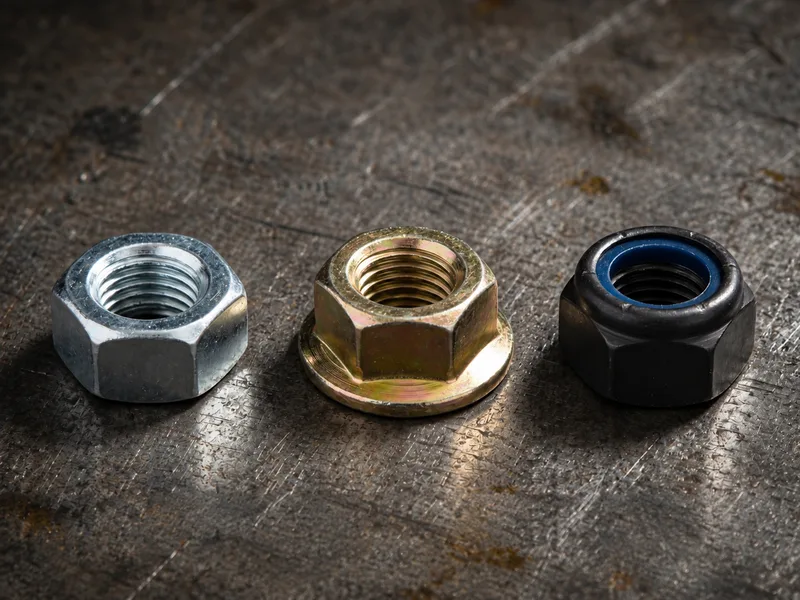
ISO 4161 is the plain (non-locking) coarse-pitch flange nut: a hex nut with an integrated flange that spreads the clamp load over a bearing diameter wider than the nut itself, replacing a separate washer in most assemblies. Where the x182 page covers the nylon-insert locking versions of this form, this is the free-spinning counterpart — it runs freely to the seating face and clamps by torque alone, so it suits joints where vibration locking is handled elsewhere (thread adhesive, a lock washer elsewhere in the stack, or simply a joint without meaningful vibration). The flange does the seating work: on slotted or oversize holes and on softer base material, the printed bearing band (dc max against dw min) is the check that the flange covers the hole with margin. One reading note for RFQ use: the source ladder is coarse thread only and does not tabulate M12 or M18, and it stops at M20 — a fine-pitch requirement belongs to ISO 10663, and sizes outside the printed ladder are a quotation question here, not a table lookup.
| Standard / scope | ISO 4161 — hex flange nuts, coarse thread series, sizes M5 to M20 on the source ladder with M12/M18 not tabulated by the source (gaps carried, not interpolated) |
|---|---|
| Form | plain (non-locking) hex nut with integrated flange — the free-spinning counterpart of the ISO 7043 nylon-insert flange lock nut; no insert, runs freely to the seating face |
| Product grade | grade A printed through M16, grade B at M20 (per the source table's Product Grade column) |
| Flange bearing face | dc max and dw min printed per size (e.g. dc 21.8 / dw 19.6 at M10, dc 42.8 / dw 39.9 at M20) — the washer-replacement bearing diameter; the check against slot or oversize holes |
| Height band | m max/min printed per size (5.0/4.7 at M5 rising to 20.0/18.7 at M20) — the plain flange nut is taller than an equivalent plain hex nut, which is the trade for the integrated flange |
| Width across flats | s max/min printed per size: 8.00/7.78 at M5, 13.00/12.73 at M8, 15.00/14.73 at M10, 30.00/29.16 at M20 — identical wrench sizes to the standard hex nut series |
| Thread series | coarse only on the source print (pitch 0.8 at M5 rising to 2.5 at M20); fine pitch in this form is ISO 10663, a separate ladder and a separate page |
| Anomaly note | the source calculator dump repeated the M8 row verbatim; the duplicate was collapsed (values identical) and the M12/M18 gaps are carried as printed |
| Not tabulated | fine-pitch ladder (ISO 10663), proof load or hardness class, MOQ, lead time and price — the last three are confirmed at quotation |
| Thread size | Product grade | Standard | Pitch (mm) | c min | da max | da min | dc max | dw min | e min | m max | m min | mw min | s max | s min | r max |
|---|---|---|---|---|---|---|---|---|---|---|---|---|---|---|---|
| 5 | A | ISO 4161 | 0.8 | 1 | 5.75 | 5.00 | 11.8 | 9.8 | 8.79 | 5.0 | 4.7 | 2.5 | 8.00 | 7.78 | 0.3 |
| 6 | A | ISO 4161 | 1 | 1.1 | 6.75 | 6.00 | 14.2 | 12.2 | 11.05 | 6.0 | 5.7 | 3.1 | 10.00 | 9.78 | 0.4 |
| 8 | A | ISO 4161 | 1.25 | 1.2 | 8.75 | 8.00 | 17.9 | 15.8 | 14.38 | 8.00 | 7.64 | 4.6 | 13.00 | 12.73 | 0.5 |
| 10 | A | ISO 4161 | 1.5 | 1.5 | 10.8 | 10.0 | 21.8 | 19.6 | 16.64 | 10.00 | 9.64 | 5.6 | 15.00 | 14.73 | 0.6 |
| 14 | A | ISO 4161 | 2 | 2.1 | 15.1 | 14.0 | 29.9 | 27.6 | 23.36 | 14.0 | 13.3 | 7.7 | 21.00 | 20.67 | 0.9 |
| 16 | A | ISO 4161 | 2 | 2.4 | 17.3 | 16.0 | 34.5 | 31.9 | 26.75 | 16.0 | 15.3 | 8.9 | 24.00 | 23.67 | 1 |
| 20 | B | ISO 4161 | 2.5 | 3 | 21.6 | 20.0 | 42.8 | 39.9 | 32.95 | 20.0 | 18.7 | 10.7 | 30.00 | 29.16 | 1.2 |
Materials
- Flange nuts order in steel (typically zinc-plated for general service, with stainless for corrosive duty); the source page is a dimension reference and does not print material or finish stocks — state thread size, grade A or B preference, and any finish requirement on the RFQ. Commercial terms (MOQ, lead time, price) are confirmed at quotation.
Ordering & documentation
Documents
Shipments of ISO 4161 Flange Nuts (Coarse Thread) are backed by Mill Test Certificate (MTC), Dimensional Report, Salt Spray Test Report on request, with full batch traceability from raw material to finished product. Quality management for ISO 4161 Flange Nuts (Coarse Thread) orders follows the owner-confirmed compliance list: ISO 9001:2015, RoHS, REACH. Exact document sets are confirmed on the order.
Quotation
- The product family (ISO 4161 Flange Nuts (Coarse Thread)), product standard/designation and drawing or part number.
- The dimensions that apply to this part — such as size, pitch, length, thickness, fit, grip or groove geometry.
- Material/grade, heat-treatment condition and surface finish, together with the service environment.
- Quantity per size, delivery destination and required test or traceability documents.
Sample & supply
Supply source for ISO 4161 Flange Nuts (Coarse Thread): own manufacturing plus qualified outsourcing (per the owner-confirmed scope of supply (own production plus outsourcing)).
Minimum order quantity for iso 4161 flange nuts (coarse thread) is 10,000 pieces (applies to the standard sizes and finishes for iso 4161 flange nuts (coarse thread); mixed, special or custom variants are quoted — final commercial terms per quotation) Stock items for iso 4161 flange nuts (coarse thread) run 3–7 days. Quantities or variants of iso 4161 flange nuts (coarse thread) outside the standard range are confirmed at quotation.
Storage & shipping
ISO 4161 Flange Nuts (Coarse Thread) are packed for export and shipped factory-direct to buyers in Europe, Asia, the Americas and the Middle East. Store iso 4161 flange nuts (coarse thread) dry and protected until installation, and keep coated parts in their packaging until use; specific packing and preservation requirements can be stated on the order and confirmed at quotation.
Frequently asked questions
When is a plain ISO 4161 flange nut the right pick versus the nylon-insert flange lock nut?
Both carry the same integrated flange — the bearing face does the washer's work either way — so the decision is entirely about locking. The plain nut spins freely and clamps by torque alone, which makes assembly faster, allows reuse without insert wear, and suits joints where the lock comes from somewhere else (a jam pair, thread adhesive, or a joint without meaningful vibration). The nylon-insert version adds prevailing-torque lock at the cost of insertion torque and an insert with temperature limits. A common pattern on multi-bolt assemblies is plain flange nuts everywhere with locking only where the joint analysis asks for it. The tables on this page and the x182 flange-lock page share wrench sizes and bearing diameters per thread size, so the seating check runs the same against either.
Why does the table skip M12 and M18, and what should a requirement on those sizes do?
The source page serves dimensions through a per-size calculator, and the recovered ladder simply does not include M12 or M18 — the gaps are disclosed rather than filled, because values quoted from another reference would not share this print's provenance. The geometry of those sizes follows the same ladder pattern (flange diameter and height stepping with thread size), but the confirming numbers should come back with the offer: state the size and application on the RFQ and treat the dimension check as part of the quotation, not an assumption from this table.
Does the flange really replace a washer in every case?
Mostly yes on sound, flat seating: the printed bearing diameter (dw min 19.6 mm at M10 against the nut's own flats of 15 mm) is larger than a standard M10 washer's effective bearing, and because the flange is part of the nut it cannot be omitted or misaligned in assembly. The exceptions are the usual washer territory — very soft base material where a larger-diameter washer spreads load further, heavily corroded or uneven seating where a washer bridges locally, and joints that are disassembled often enough that the flange's bearing face wear becomes a replacement question for the whole nut rather than a two-cent washer. The dc/dw band printed per size is the check for whether the flange alone covers the hole with the expected margin.
Request a Quote
Get factory-direct pricing from the manufacturer.
What to include in your ISO 4161 Flange Nuts (Coarse Thread) inquiry
- ✓ Name the nut standard, style and nominal thread size/pitch, including metric or inch thread series.
- ✓ State the nut property class or material and the bolt class/material it must be paired with.
- ✓ Specify locking or prevailing-torque feature, coating and corrosion environment.
- ✓ Give quantity per size, destination and any lot or mechanical-test documentation.
- ✓ Factory-direct pricing for your ISO 4161 Flange Nuts (Coarse Thread)
- ✓ Standard and custom specifications
- ✓ Factory-direct export to buyers in Europe, Asia, the Americas and the Middle East
- ✓ Full fastener family support