
DIN 427 Slotted Head Screws with Shank
DIN 427 slotted cheese head screws with shank, M1 to M20 — the precision shanked variant whose unthreaded shank is drawn to tighter limits for location — with the full collected 18-size table from M1 to M20: shank limits, slot geometry and thread lengths.
Last updated: 2026-11
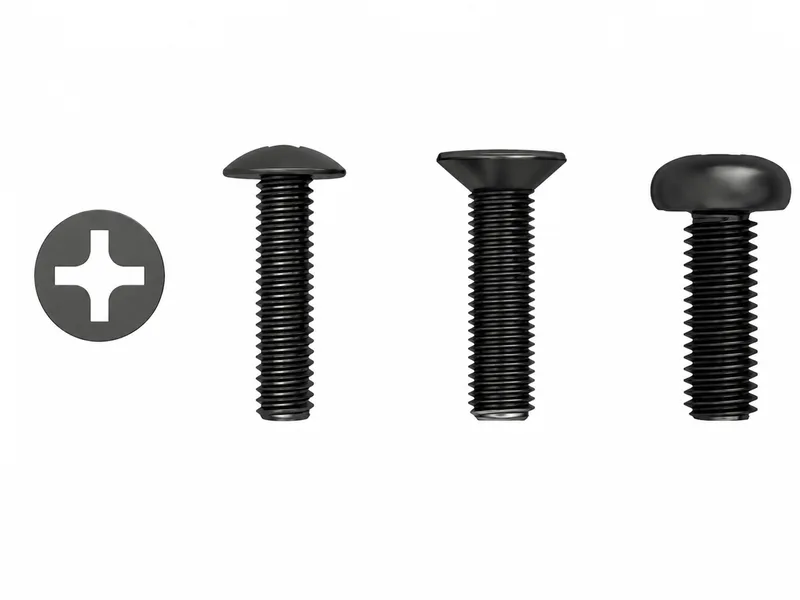
Specifications
DIN 427 is the slotted cheese head screw made for precision assembly: below the head it carries a ground-feel unthreaded shank — the d s column — so the screw can pass through and positively locate mating parts before the thread engages, and the collected table gives that shank its own limit bands because the fit, not just the clamp, is the function. This is the screw for fixtures and guides where repeated disassembly must not chew a clearance hole: the shank pilots the parts, the thread draws them together. The collected table is unusually deep — M1 to M20, well past the M10 ceiling of most machine-screw standards — and tabulates per size: thread length b with its min=nominal / max band, shank d s (max=nominal / min), slot width n as Nominal with min/max limits, slot depth t (max / min), the d f feature, head runout U and thread-end lash x. The shanked counterpart to the fully threaded DIN 84 cheese head: specify DIN 427 where the joint needs a pilot, and check the d s band against your clearance hole, not just the nominal. Materials, property classes and finishes are not printed by the collected specification and follow the drawing callout.
| Standard | DIN 427 — slotted head (cheese head) screws with shank (unthreaded shank portion) |
|---|---|
| Series | M1 – M20 (18 sizes tabulated, including (M3.5), (M14), (M18)) |
| Tabulated geometry | Per size: pitch P, thread length b (min=nominal / max), shank d s (max=nominal / min), slot width n (Nominal / min / max), slot depth t (max / min), d f, head runout U max, thread-end lash x max |
| Dimensions at M6 | Thread b 7.2 min / 9.2 max; shank d s max=nominal 6 / min 5.82; slot n nominal 1 (1.06–1.2); slot depth t 1.6–2; d f 4.8; runout U max 2; lash x max 2.5 |
| Dimensions at M12 | Thread b 14 min / 17.5 max; shank d s max=nominal 12 / min 11.73; slot n nominal 2 (2.06–2.31); slot depth t 2.8–3.7; d f 9.6; runout U max 3.5; lash x max 4.375 |
| Shank | Unthreaded shank with defined d s limit band pilots mating parts before thread engagement |
| Materials / strength | Not tabulated by the collected specification — per RFQ (property class and finish per drawing callout) |
Materials
- Material, property class and finish specified per RFQ — the collected specification table covers geometry only
Ordering & documentation
Documents
Shipments are backed by Mill Test Certificate (MTC), Dimensional Report, Salt Spray Test Report on request, with full batch traceability from raw material to finished product. Quality management follows the owner-confirmed compliance list: ISO 9001:2015, RoHS, REACH. Exact document sets are confirmed on the order.
Quotation
- The fastener family (DIN 427 Slotted Head Screws with Shank) plus the standard designation from your drawing — DIN / ISO / JIS / ASTM / ANSI, or a drawing for custom parts.
- Size (diameter and length), thread type (metric or inch), property class or grade, and coating or finish.
- Quantity per size and your target delivery date.
- Destination country, and any required documents (for example a mill test certificate) so the quote includes them.
Sample & supply
Minimum order quantity is 10,000 pieces. Stock items run 3–7 days. Quantities or variants outside the standard range are confirmed at quotation.
Storage & shipping
Parts are packed for export and shipped factory-direct to buyers in Europe, Asia, the Americas and the Middle East. Store fasteners dry and protected until installation, and keep coated parts in their packaging until use; specific packing and preservation requirements can be stated on the order and confirmed at quotation.
Frequently asked questions
When does a shanked cheese head screw (DIN 427) beat the fully threaded DIN 84?
When the joint is re-assembled often or needs to locate, not just clamp. A fully threaded screw leaves thread crests rubbing in the clearance hole on every insertion, gradually cutting the hole oversize and degrading any positional accuracy the joint had; the DIN 427 shank slides through with only the smooth d s cylinder contacting the hole, so the parts pilot positively and the hole survives the service life. The cost is grip: the thread only engages over the b length, so the clamped stack must sit within that thread or the screw cannot close. Check the two columns together at quotation — thread length b against your clamped thickness, and shank limit d s against your hole — because a shanked screw specified with a too-long grip length simply threads into the clearance hole and loses the very pilot function you paid for.
What is the MOQ and lead time for these screws?
Minimum order quantity is 10,000 pieces per item. Stocked sizes ship in 3–7 days; non-stock diameters, lengths or finishes are quoted with a confirmed schedule. Common sizes in this designation are widely stocked — confirm the exact schedule against quantity and size mix at quotation.
Related knowledge
- Thread-Forming vs Thread-Cutting vs Thread-Rolling Self-Tapping Screws: What the Evidence Settles on Base Material
- Screw Family Selection by Base Material: Wood, Machine and Self-Tapping Threads, Engagement and Coating
- Hex Bolts vs Socket Head Cap Screws: What the Evidence Settles on Strength, Clearance and Cost
Request a Quote
Get factory-direct pricing from the manufacturer.
What to include in your inquiry
- ✓ Standard and property class (e.g. DIN 912, ISO 4762, class 8.8) — or a drawing for custom parts.
- ✓ Sizes, lengths and thread type (metric or inch).
- ✓ Quantity per size and your target delivery date.
- ✓ Destination country, plus any coating or finish requirement.
- ✓ Any documents you need with the shipment (e.g. mill test certificate) so the quote includes them.
- ✓ Your inquiry goes straight to the factory team by email and gets a reply within 24 hours.
- ✓ Factory-direct pricing
- ✓ Standard and custom specifications
- ✓ Factory-direct export to buyers in Europe, Asia, the Americas and the Middle East
- ✓ Full fastener family support