
DIN 7997 Cross Recessed Countersunk Flat Head Wood Screws
DIN 7997 cross recessed countersunk flat head wood screws, No. 2 to No. 8: shank and head geometry, type H/Z recess depths and the commercial length ladder to 80 mm.
Last updated: 2026-11
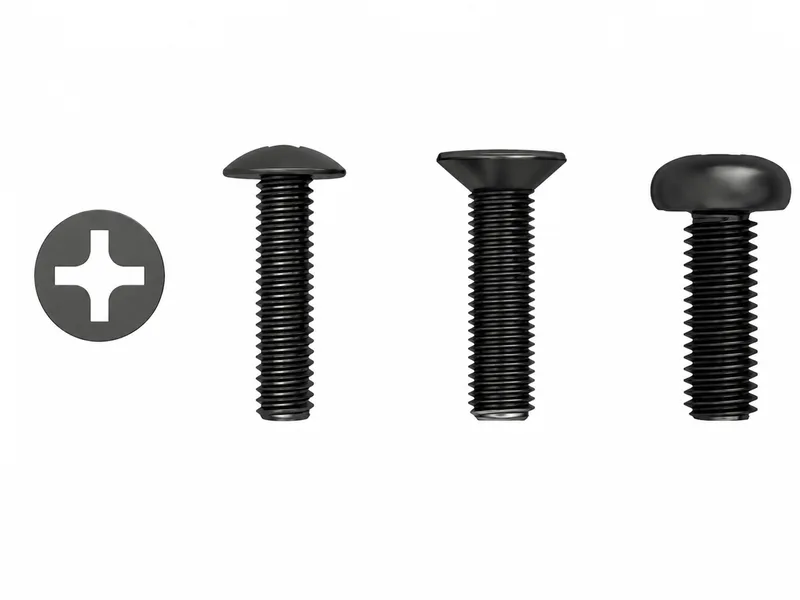
Specifications
DIN 7997 is the flat countersunk wood screw with cross recess — the flush-finish timber screw, the default where hardware must sit at or below the wood surface (hinges, slide rails, floor plates, any face another part rides over). The collected 12/2016-edition table runs sizes 2 to 8 with shank ds min, countersunk head diameter dk nom, head height k max., the cross recess number and the m depth columns for type H (Phillips) and type Z (Pozi, as the source labels it) drivers (type Z 2.8 at size 2.5 to 6.1 at size 8), and the commercial length ladder 10 to 80 mm with its mass table; the superseded 12/2010 edition is transcribed as a separate table alongside, both verbatim. The flush result depends on the 90° seat: drill-and-csk tooling matched to dk/k per size is part of the joint, not an option.
| Standard / scope | DIN 7997 cross recessed countersunk flat head wood screws — sizes 2 to 8, edition 12/2016 (supersedes 12/2010; the superseded edition is transcribed as a separate table) |
|---|---|
| Shank / head | ds min per size; countersunk head dk nom; head height k max. — the seat depth the 90° csk must produce |
| Cross recess | Recess number per size; m depths for type H and type Z drivers (Z 2.8 at size 2.5 → 6.1 at size 8) |
| Commercial lengths l | Ladder 10 to 80 mm; approximate mass per 1000 pcs (ρ=7,85 kg/dm³) tabulated per size/length |
| Not tabulated | Point type, material, finish — per RFQ |
Materials
- Zinc-plated steel interior, A2/A4 stainless or coated exterior, brass for visible furniture work — and where the screw heads stay exposed to handling, stainless also removes the rust-bleed that telegraphs through finished timber. State timber/board type for point selection, and H vs Z recess tooling per the m columns; hinges and hardware pre-drilled for one system should not be mixed with the other
Ordering & documentation
Documents
Shipments are backed by Mill Test Certificate (MTC), Dimensional Report, Salt Spray Test Report on request, with full batch traceability from raw material to finished product. Quality management follows the owner-confirmed compliance list: ISO 9001:2015, RoHS, REACH. Exact document sets are confirmed on the order.
Quotation
- The fastener family (DIN 7997 Cross Recessed Countersunk Flat Head Wood Screws) plus the standard designation from your drawing — DIN / ISO / JIS / ASTM / ANSI, or a drawing for custom parts.
- Size (diameter and length), thread type (metric or inch), property class or grade, and coating or finish.
- Quantity per size and your target delivery date.
- Destination country, and any required documents (for example a mill test certificate) so the quote includes them.
Sample & supply
Minimum order quantity is 10,000 pieces. Stock items run 3–7 days. Quantities or variants outside the standard range are confirmed at quotation.
Storage & shipping
Parts are packed for export and shipped factory-direct to buyers in Europe, Asia, the Americas and the Middle East. Store fasteners dry and protected until installation, and keep coated parts in their packaging until use; specific packing and preservation requirements can be stated on the order and confirmed at quotation.
Frequently asked questions
Flat (DIN 7997) or raised (DIN 7995) countersunk — same screw otherwise?
Same shank, same lengths, different head: DIN 7997 finishes flat with the wood, DIN 7995 leaves its dome above the surface. The choice is surface function — anything that rides over the joint (hinge leaf, slide, plate) wants the flat head, because a dome lifts the mating part and the joint rattles; decorative or wear-shedding exposed screws take the raised. Both need their matching csk geometry, and the k columns differ (k max. flat versus the raised head height), so the countersink tooling is not shared. On a drawing that just says "CSK wood screw", read the mating hardware: if a part sits on the head, it is DIN 7997.
Why is the recess labeled both type H and type Z?
The two columns are the depth data for the two cross-recess systems — type H (Phillips) and type Z (the source's label for the Pozi-type geometry) — printed per size (type Z 4.2 at size 4, for example). One recess, two tool systems with different engagement: the deeper-engaging Z/Pozi driver cambs out less under high torque, which is why production wood assembly standardized on it, while H remains in consumer and legacy tooling. The failure mode of mixing systems is recess destruction and a screw you cannot back out of finished work — so fix the tool system per line. Volume orders can be supplied with recess inspection against the m band your assembly is tooled to.
Related knowledge
- Thread-Forming vs Thread-Cutting vs Thread-Rolling Self-Tapping Screws: What the Evidence Settles on Base Material
- Screw Family Selection by Base Material: Wood, Machine and Self-Tapping Threads, Engagement and Coating
- Hex Bolts vs Socket Head Cap Screws: What the Evidence Settles on Strength, Clearance and Cost
Request a Quote
Get factory-direct pricing from the manufacturer.
What to include in your inquiry
- ✓ Standard and property class (e.g. DIN 912, ISO 4762, class 8.8) — or a drawing for custom parts.
- ✓ Sizes, lengths and thread type (metric or inch).
- ✓ Quantity per size and your target delivery date.
- ✓ Destination country, plus any coating or finish requirement.
- ✓ Any documents you need with the shipment (e.g. mill test certificate) so the quote includes them.
- ✓ Your inquiry goes straight to the factory team by email and gets a reply within 24 hours.
- ✓ Factory-direct pricing
- ✓ Standard and custom specifications
- ✓ Factory-direct export to buyers in Europe, Asia, the Americas and the Middle East
- ✓ Full fastener family support