
DIN 7500 Trilobular Thread Rolling Screws
DIN 7500 trilobular thread rolling screws form rather than cut the mating thread: a machine-screw pitch on a three-lobed shank work-hardens the substrate thread as it turns into a pilot hole. Chipless, low drive torque, strong vibration resistance — the metal-on-metal forming screw for sheet, extrusions and machined bosses.
Last updated: 2026-11
Specifications
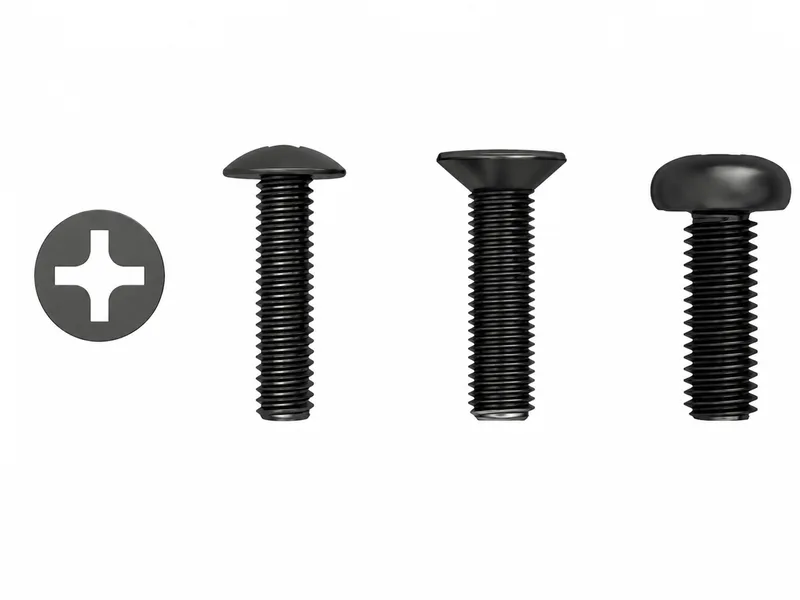
Thread rolling screws look like machine screws but do the work of a tap. The trilobular shank — three lobes at a machine-screw pitch — forms the internal thread as it enters a prepared pilot hole, and the forming action work-hardens the substrate into a smooth grain flow. The collected DIN 7500 sheets list the consequences buyers care about: insertion torque stays low, vibration loosening resistance is high, and no chips are produced, so the screw can be specified for assemblies that cannot tolerate swarf. Formed threads suit drilled, punched or cored holes in ductile metals; because the screws are case hardened, the sheets advise against rolling threads in die-cast or extruded aluminum and zinc, where the formed material cannot take the work hardening. The geometry, performance and hole-size tables below are reproduced at named sizes from the collected DIN 7500-1 spec sheet.
| Standard | DIN 7500 — trilobular thread rolling (thread forming) screw with machine-screw thread pitch; case-hardened, forms its own thread in a pilot hole |
|---|---|
| Thread geometry (M2) | Circumscribing circle 2.06 / 1.98 mm; major thread diameter 1.98 / 1.90 mm; point diameter max 1.67 mm; test plate 2.0 mm; pilot hole 1.825 / 1.8 mm |
| Thread geometry (M3) | Circumscribing circle 3.05 / 2.97 mm; major thread diameter 2.95 / 2.87 mm; point diameter max 2.57 mm; test plate 3.0 mm; pilot hole 2.775 / 2.75 mm |
| Thread geometry (M6) | Circumscribing circle 6.10 / 5.97 mm; major thread diameter 5.90 / 5.77 mm; point diameter max 5.13 mm; test plate 6.0 mm; pilot hole 5.530 / 5.5 mm |
| Performance | Minimum breaking torque 0.4 Nm (M2) rising to 15 Nm (M6); minimum breaking force 1650 N (M2) to 16000 N (M6); maximum screw-in torque 0.3 Nm (M2) to 8 Nm (M6) |
| Pilot holes | Guideline values by engagement: at 2.0 mm engagement — M2.5 2.31/2.25 mm, M3 2.81/2.75 mm, M4 3.66/3.6 mm, M5 4.56/4.5 mm, M6 5.46/5.4 mm |
| Build | AISI 1022 steel; surface hardness 450 HV 0.3 min; case depth 0.05–0.15 mm (M2/M2.5) through 0.15–0.28 mm (M6/M8); core hardness 290–370 HV5 (M2–M3.5) and 290–370 HV10 (M4 and larger) |
| Finish | Zinc finish with a wax coating; stainless screws typically passivated with a wax coating |
Materials
- Case-hardened steel (AISI 1022)
- Stainless steel
Ordering & documentation
Documents
Shipments are backed by Mill Test Certificate (MTC), Dimensional Report, Salt Spray Test Report on request, with full batch traceability from raw material to finished product. Quality management follows the owner-confirmed compliance list: ISO 9001:2015, RoHS, REACH. Exact document sets are confirmed on the order.
Quotation
- The fastener family (DIN 7500 Trilobular Thread Rolling Screws) plus the standard designation from your drawing — DIN / ISO / JIS / ASTM / ANSI, or a drawing for custom parts.
- Size (diameter and length), thread type (metric or inch), property class or grade, and coating or finish.
- Quantity per size and your target delivery date.
- Destination country, and any required documents (for example a mill test certificate) so the quote includes them.
Sample & supply
Minimum order quantity is 10,000 pieces. Stock items run 3–7 days. Quantities or variants outside the standard range are confirmed at quotation.
Storage & shipping
Parts are packed for export and shipped factory-direct to buyers in Europe, Asia, the Americas and the Middle East. Store fasteners dry and protected until installation, and keep coated parts in their packaging until use; specific packing and preservation requirements can be stated on the order and confirmed at quotation.
Frequently asked questions
Why choose a thread rolling screw over a thread cutting screw?
The forming action displaces metal instead of removing it: no chips are generated, and the work hardening left in the formed thread gives high resistance to vibrational loosening at low drive torque. The collected sheet describes the formed thread as producing an uninterrupted grain flow, and notes the prevailing torque behaviour compares well with locking screws. Thread cutting screws remain the right choice where the substrate cannot tolerate the displacement forces of forming.
How do I size the pilot hole?
The DIN 7500-1 sheet publishes guideline hole diameters by thread size and engagement length: for example at 2.0 mm engagement, M3 takes a 2.75–2.81 mm hole while M6 takes 5.4–5.46 mm. The hole opens up slightly as engagement grows (M3 moves to 2.825/2.75 mm from 3.2 mm engagement). Treat the table as a starting point and confirm on the actual substrate — the guideline is material dependent, and the sheet labels the values as such.
Can DIN 7500 rolling screws be used in aluminum?
The sheets draw a line by material condition: the screws can roll threads in aluminum or non-ferrous materials generally, but because they are case hardened they are not recommended in die-cast or extruded aluminum or zinc. Ductile wrought stock and punched or cored holes in ductile metals are the intended applications. Send the substrate spec with the RFQ and the application can be checked against the forming limits before sampling.
What is the MOQ and lead time for these thread forming screws?
Minimum order quantity is 10,000 pieces per item. Stocked sizes ship in 3–7 days; non-stock diameters, lengths or finishes are quoted with a confirmed schedule. Confirm the exact schedule against quantity and size mix at quotation.
What should an RFQ for these thread forming screws state?
State the standard designation (for example DIN 7500 CE or DIN 7500 ME), the head form and drive, thread size and pitch, length, material and grade (case-hardened steel or A2/A4 stainless), finish, pilot-hole or sheet thickness if you need a hole-size recommendation, required certificates such as a mill test report per EN 10204 3.1, and quantity per size — plus destination country.
Related knowledge
- Thread-Forming vs Thread-Cutting vs Thread-Rolling Self-Tapping Screws: What the Evidence Settles on Base Material
- Screw Family Selection by Base Material: Wood, Machine and Self-Tapping Threads, Engagement and Coating
- Hex Bolts vs Socket Head Cap Screws: What the Evidence Settles on Strength, Clearance and Cost
Request a Quote
Get factory-direct pricing from the manufacturer.
What to include in your inquiry
- ✓ Standard and property class (e.g. DIN 912, ISO 4762, class 8.8) — or a drawing for custom parts.
- ✓ Sizes, lengths and thread type (metric or inch).
- ✓ Quantity per size and your target delivery date.
- ✓ Destination country, plus any coating or finish requirement.
- ✓ Any documents you need with the shipment (e.g. mill test certificate) so the quote includes them.
- ✓ Your inquiry goes straight to the factory team by email and gets a reply within 24 hours.
- ✓ Factory-direct pricing
- ✓ Standard and custom specifications
- ✓ Factory-direct export to buyers in Europe, Asia, the Americas and the Middle East
- ✓ Full fastener family support