
DIN 968 Tapping Screws, Cross Recessed Pan Head with Collar
DIN 968 cross recessed pan head tapping screws with washer collar, ST 2.9 to ST 6.3: collar and head geometry, cross recess data and the commercial length ladder to 50 mm.
Last updated: 2026-11
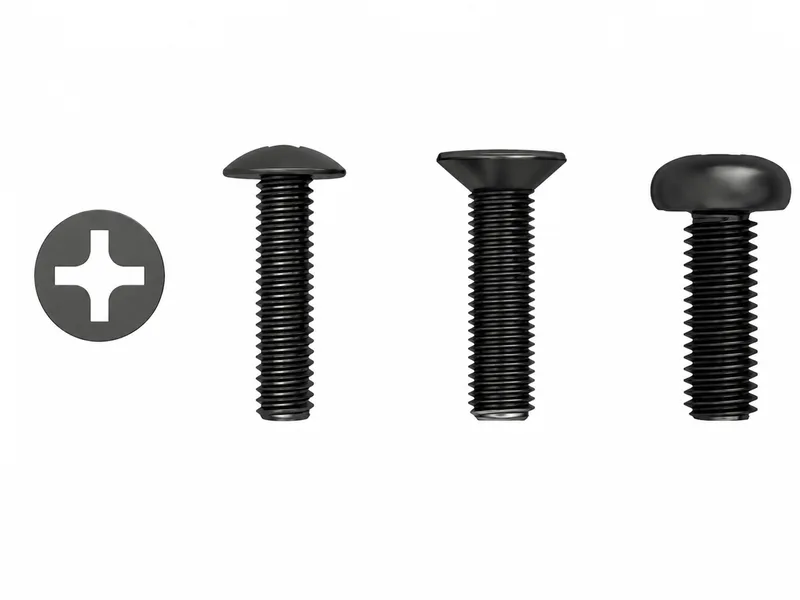
Specifications
DIN 968 adds the integral washer collar to the cross recessed pan head: the 05/2008-edition table runs ST 2.9 to ST 6.3 with thread pitch a, head height k nom=max (4.55 at ST6.3), head-and-collar diameter dK nom=max (14.5 at ST6.3), collar edge c max and the collar thickness a mx, plus the cross recess number (3 at ST6.3) with its depth columns (7.1/6.7). The commercial length ladder runs 4.5 to 50 mm with the mass table. The collar is the point of the standard: it spreads the clamp over a larger bearing circle without a separate washer, seals the hole edge against weather on outdoor sheet, and keeps the driven head from burying in soft or oversize holes — the reason roofing, cladding and appliance lines standardized on it. The two cross-recess depth columns (H and Z driver data as the source prints them) are the assembly-quality check for production driving.
| Standard / scope | DIN 968 tapping screws, cross recessed pan head with collar — ST 2.9 to ST 6.3, edition 05/2008 (supersedes 12/2002) |
|---|---|
| Head + collar | k nom=max 4.55 at ST 6.3; dK nom=max (head over collar) 14.5; collar edge c max 1.8; collar thickness a mx 1.8 |
| Cross recess | Recess number per size (3 at ST 6.3) with the two printed depth columns 7.1/6.7 — driver penetration data |
| Commercial lengths l | Ladder 4.5 to 50 mm; approximate mass per 1000 pcs (ρ=7,85 kg/dm³) tabulated |
| Not tabulated | Case hardness, EPDM sealing variants, finish — per RFQ |
Materials
- Case-hardened steel, zinc-plated for general duty and mechanically galvanized or coated for outdoor cladding; A2/A4 stainless for coastal and food-plant sheet. If the joint needs a sealing washer under the collar, say so — sealing variants with bonded EPDM are quoted against the same geometry with the washer added, and the collar thickness a mx in the grid is the stack-up input
Ordering & documentation
Documents
Shipments are backed by Mill Test Certificate (MTC), Dimensional Report, Salt Spray Test Report on request, with full batch traceability from raw material to finished product. Quality management follows the owner-confirmed compliance list: ISO 9001:2015, RoHS, REACH. Exact document sets are confirmed on the order.
Quotation
- The fastener family (DIN 968 Tapping Screws, Cross Recessed Pan Head with Collar) plus the standard designation from your drawing — DIN / ISO / JIS / ASTM / ANSI, or a drawing for custom parts.
- Size (diameter and length), thread type (metric or inch), property class or grade, and coating or finish.
- Quantity per size and your target delivery date.
- Destination country, and any required documents (for example a mill test certificate) so the quote includes them.
Sample & supply
Minimum order quantity is 10,000 pieces. Stock items run 3–7 days. Quantities or variants outside the standard range are confirmed at quotation.
Storage & shipping
Parts are packed for export and shipped factory-direct to buyers in Europe, Asia, the Americas and the Middle East. Store fasteners dry and protected until installation, and keep coated parts in their packaging until use; specific packing and preservation requirements can be stated on the order and confirmed at quotation.
Frequently asked questions
Does the integral collar really replace a separate washer?
For load spread and burial resistance, mostly yes: the collar is part of the hardened head, cannot be forgotten at assembly, and its dK 14.5 at ST 6.3 gives the bearing circle a loose washer would, at every screw on the line. What it does not give is sealing and adjustability — a bonded washer compresses against an uneven surface and weathers the hole, and you can swap washer types per joint. So: internal or dry assemblies run DIN 968 alone; outdoor through-fixing into cladding usually wants the sealing-washer variant, which we quote on the same collar geometry. Check the hole: the collar also covers slotted or oversize holes up to roughly its own diameter, a common reason the standard gets specified for pre-punched sheet.
Why does the table carry two cross recess depth columns?
They are the penetration data for the two recess depth tolerances the production drive checks against: minimum and maximum recess depth per size (7.1/6.7 at ST 6.3 as printed). Too shallow and the driver cambs out mid-tightening (the classic under-torque on automated lines); too deep and the driver bottoms before head seat, stripping the recess. Production engineering uses the pair to set driver height and reject screws outside the band; maintenance just needs the right driver size — recess number 3 at ST 6.3 per the grid. If you drive at rate, send the target torque and we supply against the recess depth band the line is set to.
Related knowledge
- Thread-Forming vs Thread-Cutting vs Thread-Rolling Self-Tapping Screws: What the Evidence Settles on Base Material
- Screw Family Selection by Base Material: Wood, Machine and Self-Tapping Threads, Engagement and Coating
- Hex Bolts vs Socket Head Cap Screws: What the Evidence Settles on Strength, Clearance and Cost
Request a Quote
Get factory-direct pricing from the manufacturer.
What to include in your inquiry
- ✓ Standard and property class (e.g. DIN 912, ISO 4762, class 8.8) — or a drawing for custom parts.
- ✓ Sizes, lengths and thread type (metric or inch).
- ✓ Quantity per size and your target delivery date.
- ✓ Destination country, plus any coating or finish requirement.
- ✓ Any documents you need with the shipment (e.g. mill test certificate) so the quote includes them.
- ✓ Your inquiry goes straight to the factory team by email and gets a reply within 24 hours.
- ✓ Factory-direct pricing
- ✓ Standard and custom specifications
- ✓ Factory-direct export to buyers in Europe, Asia, the Americas and the Middle East
- ✓ Full fastener family support