
ISO 1483 Slotted Raised Countersunk Head Tapping Screws
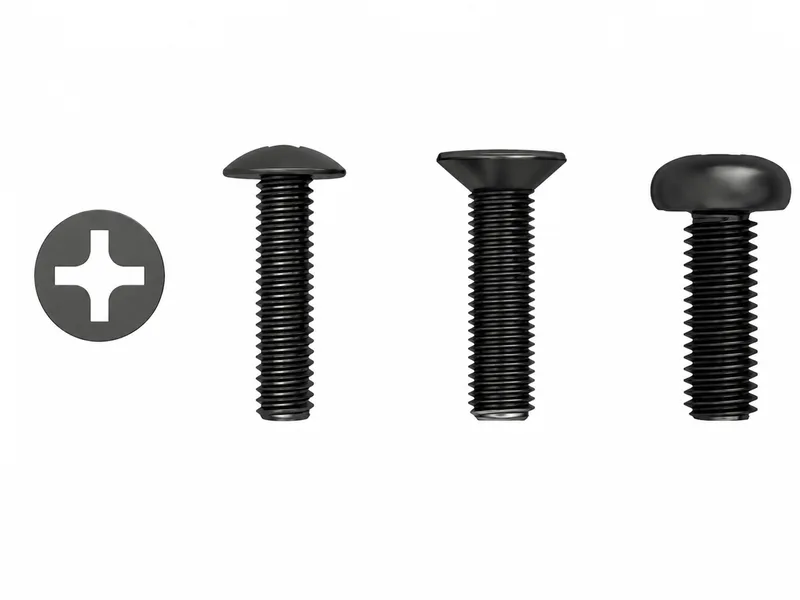
ISO 1483 slotted raised countersunk head tapping screws ST2,2 to ST6,3 — the countersunk body with a low rounded crown, with the collected geometry ladder including the f crown height and rf crown radius rows.
Last updated: 2026-11
Specifications
ISO 1483 splits the difference between the flush and the domed tapping heads: a standard countersunk body with a shallow crown rising above the sheet. You get the countersunk head's centered seating in a csk-prepped hole plus a small proud button (the collected f row, approx. 0,7 mm at ST2,2 up to 2 at ST6,3) that keeps a driver engaged where paint, debris or panel warping would bury a flush slot. The crown geometry is carried in two rows the flush member lacks: f (crown height) and rf (crown radius, 3,8 → 11,1 mm — the radius that blends the button into the cone). The rest of the ladder matches the family: dk nominal=max./min. (4,3/4 at ST2,2 up to 12,4/11,97), the slot triple n nominal/min./max. (with the same verbatim ST4,8 "12" print defect flagged), slot depth t min./max. 0,95/1,15 → 2,85/3,45 (deeper than the flush member's — the crown gives the metal somewhere to go), and the y Type C/F thread-end allowances. Length ladder l 6,5 to 38 with Type C/F limits and approximate mass columns per thread. Property class, material and finish are not tabulated — per RFQ.
| Standard | ISO 1483 — slotted raised countersunk head tapping screws |
|---|---|
| Size range | ST2,2 – ST6,3; parenthesised (ST3,9) is the source's non-preferred marking |
| Raised crown | f approx. 0,7 → 2 mm; crown radius rf approx. 3,8 → 11,1 |
| Head diameter | dk nominal=max. 4,3 → 12,4 mm (min. 4 → 11,97) |
| Slot | n nominal 0,6 → 1,6 (ST4,8 cell prints 12 verbatim — flagged); t min. 0,95 → 2,85, max. 1,15 → 3,45 |
| Length ladder | l 6,5 – 38 with Type C/F min./max. limits and approximate mass per thread |
| Material / finish | Not tabulated by the collected specification — per RFQ |
| Attribute | Limit | ST2,2 | ST2,9 | ST3,5 | (ST3,9) | ST4,2 | ST4,8 | ST5,5 | ST6,3 |
|---|---|---|---|---|---|---|---|---|---|
| P | 0,8 | 1,1 | 1,3 | 1,3 | 1,4 | 1,6 | 1,8 | 1,8 | |
| a | max. | 0,8 | 1,1 | 1,3 | 1,3 | 1,4 | 1,6 | 1,8 | 1,8 |
| dk | nominal=max. | 4,3 | 5,5 | 6,8 | 7,5 | 8,1 | 9,5 | 10,8 | 12,4 |
| dk | min. | 4 | 5,2 | 6,44 | 7,14 | 7,74 | 9,14 | 10,37 | 11,97 |
| f | approx. | 0,7 | 0,9 | 1,2 | 1,3 | 1,4 | 1,5 | 1,7 | 2 |
| k | approx. | 1,3 | 1,7 | 2,1 | 2,3 | 2,5 | 3 | 3,4 | 3,8 |
| n | nominal | 0,6 | 0,8 | 1 | 1 | 1,2 | 12 | 1,6 | 1,6 |
| n | min. | 0,66 | 0,86 | 1,06 | 1,06 | 1,26 | 1,26 | 1,66 | 1,66 |
| n | max. | 0,8 | 1 | 1,2 | 1,2 | 1,51 | 1,51 | 1,91 | 1,91 |
| r | max. | 0,8 | 1,1 | 1,4 | 1,5 | 1,6 | 1,9 | 2,1 | 2,4 |
| rf | approx. | 3,8 | 4,6 | 5,4 | 6 | 6,6 | 8,2 | 9,4 | 11,1 |
| t | min. | 0,95 | 1,25 | 1,55 | 1,7 | 1,85 | 2,15 | 2,42 | 2,85 |
| t | max. | 1,15 | 1,5 | 1,9 | 2,05 | 2,25 | 2,6 | 2,95 | 3,45 |
| y max. | Type C | 2 | 2,6 | 3,2 | 3,5 | 3,7 | 4,3 | 5 | 6 |
| y max. | Type F | 1,6 | 2,1 | 2,5 | 2,7 | 2,8 | 3,2 | 3,6 | 3,6 |
- Row 7 (n): n nominal at ST4,8 prints 12 against the sibling progression 0,6/0,8/1/1/1,2/…/1,6/1,6 — a lost decimal point suspected. Carried verbatim, not normalized.
| l nominal | Type C min. | Type C max. | Type F min. | Type F max. | ST2,2 | ST2,9 | ST3,5 | (ST3,9) | ST4,2 | ST4,8 | ST5,5 | ST6,3 |
|---|---|---|---|---|---|---|---|---|---|---|---|---|
| 6,5 | 5,7 | 7,3 | 5,7 | 6,5 | 0,18 | 0,332 | ||||||
| 9,5 | 8,7 | 10,3 | 8,7 | 9,5 | 0,24 | 0,44 | 0,721 | 0,888 | 1,07 | 1,53 | ||
| 13 | 12,2 | 13,8 | 12,2 | 13 | 0,31 | 0,566 | 0,898 | 1,11 | 1,32 | 1,88 | 2,74 | 3,46 |
| 16 | 15,2 | 16,8 | 15,2 | 16 | 0,37 | 0,674 | 1,05 | 1,3 | 1,53 | 2,18 | 3,12 | 4 |
| 19 | 18,2 | 19,8 | 18,2 | 19 | 0,782 | 1,2 | 1,49 | 1,74 | 2,48 | 3,51 | 4,54 | |
| 22 | 21,2 | 22,8 | 20,7 | 22 | 1,35 | 1,68 | 1,95 | 2,78 | 3,89 | 5,08 | ||
| 25 | 24,2 | 25,8 | 23,7 | 25 | 1,51 | 1,87 | 2,16 | 3,08 | 4,28 | 5,62 | ||
| 32 | 30,7 | 33,3 | 30,7 | 32 | 2,65 | 3,78 | 5,19 | 6,88 | ||||
| 38 | 36,7 | 39,3 | 36,7 | 38 | 4,38 | 5,97 | 7,96 |
Materials
- Material and finish specified per RFQ — same tapping-body chemistry questions as the flush member (case-hardened steel is standard); state host sheet and finish at quotation
Ordering & documentation
Documents
Shipments are backed by Mill Test Certificate (MTC), Dimensional Report, Salt Spray Test Report on request, with full batch traceability from raw material to finished product. Quality management follows the owner-confirmed compliance list: ISO 9001:2015, RoHS, REACH. Exact document sets are confirmed on the order.
Quotation
- The fastener family (ISO 1483 Slotted Raised Countersunk Head Tapping Screws) plus the standard designation from your drawing — DIN / ISO / JIS / ASTM / ANSI, or a drawing for custom parts.
- Size (diameter and length), thread type (metric or inch), property class or grade, and coating or finish.
- Quantity per size and your target delivery date.
- Destination country, and any required documents (for example a mill test certificate) so the quote includes them.
Sample & supply
Minimum order quantity is 10,000 pieces. Stock items run 3–7 days. Quantities or variants outside the standard range are confirmed at quotation.
Storage & shipping
Parts are packed for export and shipped factory-direct to buyers in Europe, Asia, the Americas and the Middle East. Store fasteners dry and protected until installation, and keep coated parts in their packaging until use; specific packing and preservation requirements can be stated on the order and confirmed at quotation.
Frequently asked questions
Why is the raised head's slot depth (t) so much deeper than the flush member's?
The crown is where the metal lives. The collected ladders show t min. running 0,95 → 2,85 mm on ISO 1483 against 0,4 → 1,2 on the flush ISO 1482 across the same sizes — roughly double. A flush countersunk head has only the cone above the hole to cut a slot into, so the slot bottoms out early; the raised crown adds the f row (0,7 → 2 mm) of extra height, and the slot extends into it, which is exactly what keeps a flat blade from camming out before the screw is tight. The same logic shows in the crown radius rf 3,8 → 11,1: the button blends into the cone gradually instead of a sharp flush edge. Practical consequence: if your application truly needs flush (sliding workpieces, seals), the raised head is not a substitute however similar the hole is; if you only wanted a low-profile head and can tolerate f above the sheet, the raised member drives more reliably. Slot-n ST4,8 print defect flagged on both pages; material and finish per RFQ.
Related knowledge
- Thread-Forming vs Thread-Cutting vs Thread-Rolling Self-Tapping Screws: What the Evidence Settles on Base Material
- Screw Family Selection by Base Material: Wood, Machine and Self-Tapping Threads, Engagement and Coating
- Hex Bolts vs Socket Head Cap Screws: What the Evidence Settles on Strength, Clearance and Cost
Request a Quote
Get factory-direct pricing from the manufacturer.
What to include in your inquiry
- ✓ Standard and property class (e.g. DIN 912, ISO 4762, class 8.8) — or a drawing for custom parts.
- ✓ Sizes, lengths and thread type (metric or inch).
- ✓ Quantity per size and your target delivery date.
- ✓ Destination country, plus any coating or finish requirement.
- ✓ Any documents you need with the shipment (e.g. mill test certificate) so the quote includes them.
- ✓ Your inquiry goes straight to the factory team by email and gets a reply within 24 hours.
- ✓ Factory-direct pricing
- ✓ Standard and custom specifications
- ✓ Factory-direct export to buyers in Europe, Asia, the Americas and the Middle East
- ✓ Full fastener family support